

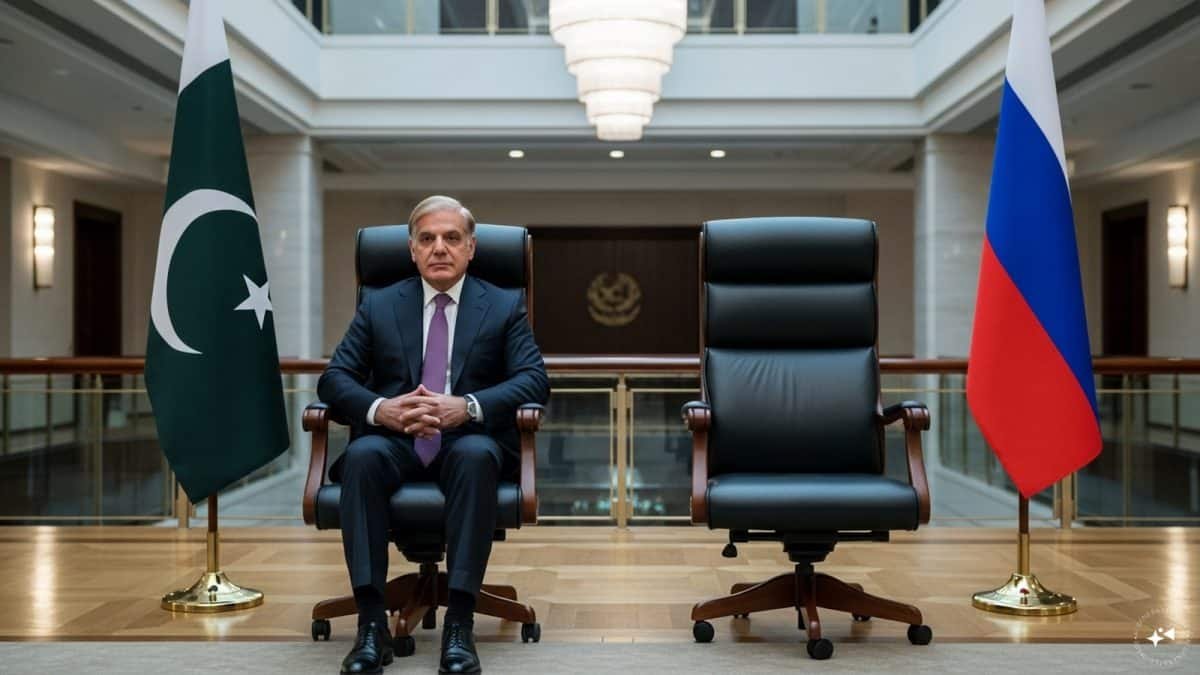
Pakistan Prime Minister Shehbaz Sharif found himself at the centre of an unusual humiliation this week after waiting nearly 40 minutes for a scheduled meeting with Russian President Vladimir Putin, only to walk into a closed-door discussion between Putin and Turkish President Recep Tayyip Erdogan.
A video posted by RT India shows that Prime Minister Shehbaz Sharif inadvertently walked into a closed-door meeting between Russian President Vladimir Putin and Turkish President Recep Tayyip Erdoğan after his own bilateral meeting with Putin was pushed back.
RT later posted a statement on X, saying that the post had been deleted as it “may have been a misrepresentation of the events.”
We deleted an earlier post about Pakistani Prime Minister Sharif waiting to meet Vladimir Putin at the Peace and Trust Forum in Turkmenistan.
The post may have been a misrepresentation of the events.
— RT_India (@RT_India_news) December 12, 2025
Sharif, accompanied by Foreign Minister Ishaq Dar, had been kept waiting in a nearby room for around 40 minutes. Growing increasingly frustrated, he eventually chose to enter the meeting room where Putin and Erdoğan were already in discussion, hoping to secure at least a brief exchange with the Russian leader.
Long wait, few results
Sharif arrived at the meeting venue in Russia’s Black Sea resort of Sochi with expectations of a one-on-one discussion with President Putin. But when that meeting failed to materialise after an extended wait of about 40 minutes, sources say the Pakistani prime minister grew frustrated.
With official aides reportedly unable to secure a slot in Putin’s schedule, Sharif instead entered a meeting already in progress between Putin and Erdogan, an unorthodox move that was captured on video and widely circulated on social media.
The footage shows Sharif entering the room, greeting both leaders briefly and then leaving within minutes. While some observers have interpreted the act as “gate-crashing”, others within diplomatic circles describe it as a calculated expression of Islamabad’s determination to be heard amid competing priorities.
A test of diplomatic patience and positioning
The incident is more than a minor embarrassment; it highlights the precarious balancing act Pakistan must perform in an increasingly multipolar world. Traditionally aligned with China and maintaining complex ties with both Moscow and Washington, Islamabad faces pressure to assert its foreign policy relevance even as great-power relations shift due to the Ukraine war, renewed US focus on the Indo-Pacific, and Turkey’s more independent outreach.
For Sharif, a meeting with Putin was more than symbolic. Pakistan has sought to deepen economic and energy cooperation with Russia including discussions on oil and gas imports, trade concessions, and potential collaboration on infrastructure projects.
A direct conversation with Putin could have bolstered Islamabad’s leverage on these fronts. Instead, the fractured scheduling and improvised entry into the Putin-Erdogan meeting highlighted Pakistan’s secondary status in a diplomatic arena dominated by larger regional players.
The diplomatic optics
Critics argue that Sharif’s decision to enter the meeting uninvited may have been counterproductive.
“Diplomacy is built on protocol and mutual respect,” says one former ambassador. “Even when relations are friendly, bypassing gatekeepers sends the wrong message about preparedness and priority.”
The Turkish-Russian meeting itself was widely expected to focus on escalating tensions in the West Asia and on economic cooperation, particularly in energy and trade. Erdogan, who has skilfully balanced Ankara’s relationships with both the West and Russia, commands significant diplomatic capital. For Sharif, entering that space, even briefly, was perhaps intended to signal that Pakistan too seeks a seat at the table of emerging geopolitical dialogues.
What Sharif sought and what he got
Reports suggest that Sharif did not emerge from the encounter with any substantive agreement or even a follow-up meeting scheduled with Putin. Instead, the episode has drawn attention for its theatrics rather than its diplomatic dividends.
Pakistani analysts said that while the international media fixated on the video, domestic coverage has been more circumspect, focusing on why Sharif’s team failed to secure a formal meeting slot in advance.
Some experts argue that this misstep underscores a broader challenge for Pakistan: the need to professionalise its diplomatic corps and strategy so that engagements with global leaders yield concrete outcomes rather than headlines about protocol breaches.
Domestic and international reactions
In Pakistan, reactions were mixed. Supporters described Sharif’s actions as a bold assertion of agency, saying it showed willingness to pursue national interests proactively. Critics, however, pointed to the lack of tangible outcomes and questioned whether such moments could weaken Pakistan’s credibility on the world stage.
Internationally, analysts observed the surreal nature of the clip but also pointed to the larger context: Russia’s foreign calendar is heavily oversubscribed, with leaders from China, India, Turkeyand others competing for time with Putin. In that environment, smaller states may find themselves deprioritised despite longstanding ties.
End of Article