

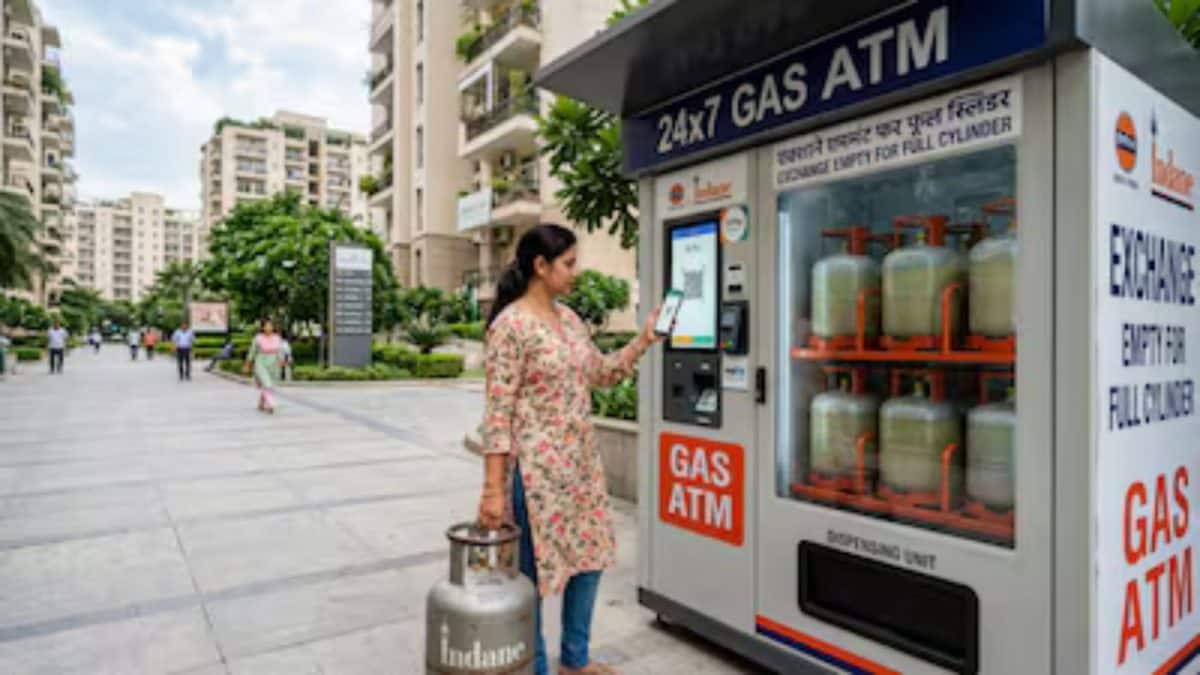
Residents of Gurugram now have access to a 24×7 self service facility that simplifies the process of obtaining cooking fuel.
For residents of Gurugram grappling with the ongoing scarcity of cooking gas, a technological solution has emerged in the heart of the city. A pioneering LPG vending machine, commonly referred to as a ‘Gas ATM’, has been inaugurated at Central Park Flower Valley in Sohna Sector 33.
This initiative, spearheaded by Bharat Petroleum Corporation Limited (BPCL), serves as a crucial pilot project for the Delhi NCR region, providing a seamless way to secure fuel during the current supply volatility.
Innovative exchange system
This automated facility operates on a simple swap principle where users can trade an empty cylinder for a fully replenished one. The contactless interface is designed for speed and efficiency, ensuring that a new unit is dispensed within moments.
To utilise the service, a customer simply enters their registered mobile number and verifies it through a one time password. After scanning the required QR code and completing the digital transaction via UPI or a debit card, the machine releases the filled cylinder.
Lightweight composite technology
One of the most striking features of this ‘Gas ATM’ is the transition from heavy steel to modern composite cylinders. These advanced fibre based containers are significantly more user friendly, weighing approximately 15 kg, which is half the weight of the traditional 30 kg iron variants.
Beyond their portability, these cylinders possess a translucent body, allowing households to monitor their gas levels visually. This transparency eliminates the guesswork often associated with metal containers, helping families plan their kitchen needs with greater precision.
Round the clock accessibility
To ensure maximum convenience for the public, the vending machine remains operational 24 hours a day. It is equipped with an intelligent inventory management system that can house up to ten cylinders at any given time.
When the available stock dwindles to just two units, the machine automatically transmits an alert to the local agency to trigger a restock. While the facility is still in its early stages and public awareness remains relatively low, it represents a significant shift towards a self service model in energy distribution.
Geopolitical impact on energy
The introduction of this pilot project arrives at a time when India is facing a strained LPG supply chain. With the nation importing nearly 60% of its cooking gas requirements, any disruption in maritime corridors has an immediate domestic impact. The recent closure of the Strait of Hormuz, a vital artery for energy shipments, has severely restricted the flow of fuel.
As the government redirects available stocks to ensure household security, the commercial sector has felt the brunt of the shortage. If this automated model proves successful in Gurugram, it may offer a scalable blueprint for other Indian cities to mitigate the effects of global energy fluctuations.
End of Article