

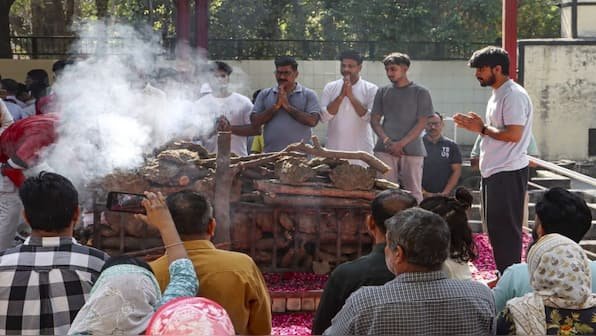
It was a quiet end to a 13-year-struggle. After spending 13 years in a vegetative state, Harish Rana, the first person in India to be granted passive euthanasia by a court, was cremated on Wednesday (March 25), a day after he passed away at the All India Institute of Medical Sciences, Delhi.
In south Delhi’s Green Park, the family and friends of the 31-year-old gathered to
bid adieu to him, bringing an end to a case that marked a significant moment in the country’s legal and medical history.
VIDEO | Delhi: People pay last respects to Harish Rana, the first person in India to be allowed passive euthanasia, at Green Park Cremation Ground. Rana passed away on Tuesday at AIIMS-Delhi after more than 13 years in a coma.
The 31-year-old, who has been in a coma since 2013,… pic.twitter.com/L5dKVY5g3N
— Press Trust of India (@PTI_News) March 25, 2026
Harish Rana, who was in a coma since 2013 when he fell from a fourth-floor balcony while studying engineering at Panjab University, has shone the spotlight on India’s euthanasia laws. Here’s more on them.
What is euthanasia?
Derived from two Greek words —‘Eu’ meaning good, and ‘thantos’ meaning death, euthanasia means good death. This act is often referred to as “mercy killing” or “physician-assisted death,” and is a complex and highly debated topic within legal and ethical realms.
Euthanasia comes in several different forms: there’s active euthanasia and passive euthanasia. There’s also assisted suicide, which refers to cases where the person who is going to die needs help to kill themselves and asks for it. It may be something as simple as getting drugs for the person and putting those drugs within their reach.
But what’s the difference between active and passive euthanasia? In active euthanasia, a person directly and deliberately causes the patient’s death. In passive euthanasia, they don’t directly take the patient’s life, they just allow them to die.
Simply put, active euthanasia occurs when a medical professional, or another person, deliberately does something that causes the patient to die. Meanwhile, passive euthanasia occurs when the patient dies because medical professionals either don’t do something necessary to keep the patient alive, or when they stop doing something that is keeping the patient alive.
What are the laws on euthanasia in India?
While India doesn’t permit for active euthanasia, it was in 2011 that the Supreme Court laid down guidelines for passive euthanasia in the
Aruna Shanbaug case. At the time, the court reaffirmed that Article 21 of the Constitution does not include a general “right to die”.
However, at the same time, the Bench recognised that the right to live with dignity may, in limited circumstances, include a dignified death.
Then hearing a petition filed by NGO Common Cause, the Supreme Court in 2018 recognised the right to die with dignity for terminally ill patients, allowing them to opt for passive euthanasia by executing a living will and refusing medical treatment, thereby leading to passive euthanasia.
The apex court of the country noted that a premature end to life for a patient in a terminal condition or persistent vegetative state “may fall within the ambit of the ‘right to die’ with dignity as a part of right to live with dignity, when death due to termination of natural life is certain and imminent and the process of natural death has commenced”.
Declaring the ‘right to die with dignity’ as a fundamental right, the court said, “Life and death are inseparable. Every moment our bodies undergo change… life is not disconnected from death. Dying is a part of the process of living.”
The apex court also laid down guidelines for passive euthanasia, in case the patient has left an ‘advance directive’ or ‘living will’ to withdraw life support if they fall terminally ill, and in case there is no such will.
But, it also stated that
assisted dying remains illegal.
In the Harish Rana case, on March 11, the apex court granted Rana’s plea the ‘right to die with dignity’, saying that the doctor’s duty to treat a patient “no longer sustains when the patient has no hope of recovery”.
What is the procedure for passive euthanasia in India?
In 2024, the Union Health Ministry released a set of
draft guidelines, based on the top court’s 2023 directives, detailing the process hospitals must follow to withhold or withdraw care.
First, the treating physician needs to decide if the patient has any hope of recovery or having a good quality of life if treatment measures remain in place. Then, a primary board has to assess the case and reach a consensus. This board comprises the treating physician and two subject experts with five or more years of experience.
The doctors then need to discuss the prognosis with family and whether they want any other treatment. A shared decision has to be taken and the team of doctors has to come up with a consistent plan for care. If the doctors and the family decide that the measures should be withdrawn, they need to submit a request to be submitted to a secondary medical board. This board consists of a doctor nominated by the chief medical officer (CMO) of a district and two subject experts with five or more years of experience. This board has to take a decision within 48 hours. Hospitals must also inform magistrates before withdrawal of treatment, though their approval is not required.
What are euthanasia laws across the world?
Countries like the Netherlands and Belgium allow for both active and passive euthanasia for patients who face “unbearable suffering”. According to Dutch law, the patient must have “unbearable suffering with no prospect of improvement” and must have requested to die in a way that is “voluntary, well-considered and with full conviction”.
Luxembourg decriminalised euthanasia and assisted dying in 2009. Spain in 2021 authorised euthanasia and medically assisted suicide for people with a serious and incurable illness, followed by Portugal in 2023. In the latter case, the law is not yet in force.
Switzerland prohibits euthanasia. However, it allows assisted suicide. This has made it the go-to destination for decades for patients across Europe looking for assistance to end their suffering.
Australian law also permits both types of euthanasia for patients of sound mind, for terminally ill patients who may not survive more than a year.
With inputs from agencies
End of Article