

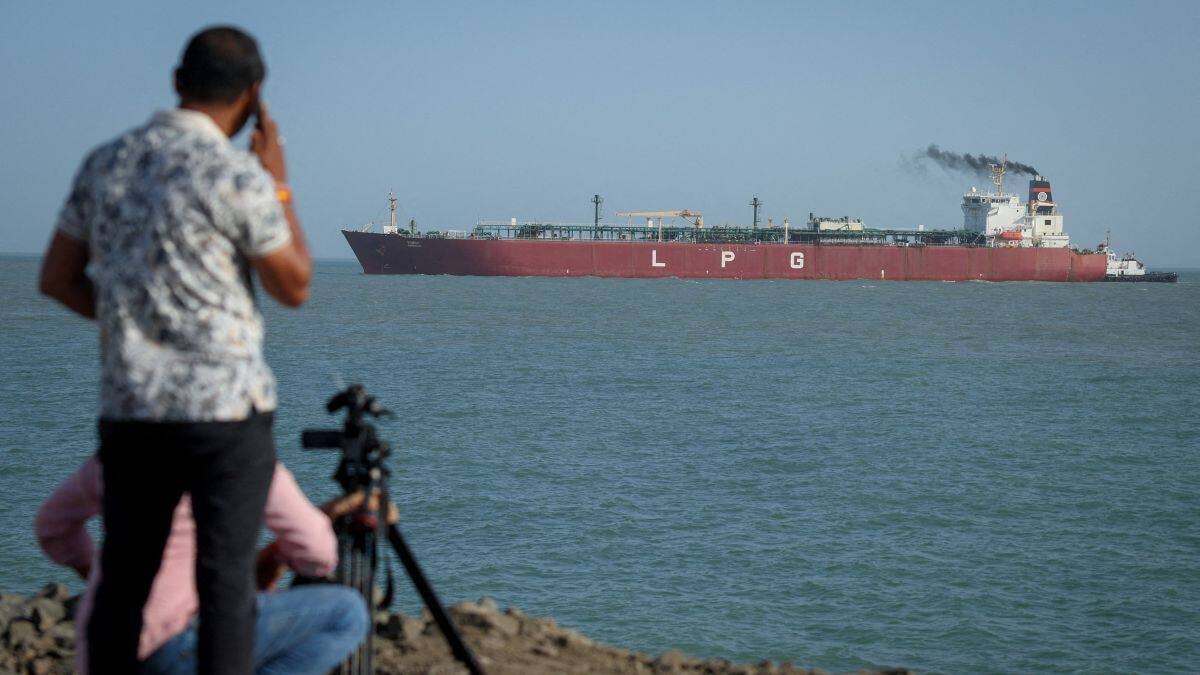
Indian LPG tanker Pine Gas navigated a narrow, unusual route through the Strait of Hormuz amid the US-Israel-Iran conflict, with the Indian Navy escorting the vessel safely to the Arabian Sea
For 23 days, the 27-man crew of the Indian-flagged LPG tanker Pine Gas lived under a sky streaked with fire. Floating in the volatile waters of the Persian Gulf as a full-scale conflict erupted between Iran and US-led forces, they were a sitting duck for the drones and missiles.
The Pine Gas had loaded 45,000 tonnes of cooking gas at the UAE’s Ruwais port on February 28, just 24 hours before the regional tension escalated into open warfare. What was supposed to be a routine seven-day voyage turned into a three-week ordeal of “wait and watch,” Chief Officer Sohan Lal, a veteran mariner who led the vessel told Reuters.
“We saw missiles and drones flying overhead every day,” Lal said. “In the night sky, you could see the projectiles streaking through. We were on standby since March 11, but the intensity of the conflict kept us pinned.”
The ‘yes or no’ decision
By March 23, a narrow window opened. However, the path was anything but standard.
The Islamic Revolutionary Guard Corps (IRGC) informed the ship that the primary shipping lanes in the
Strait of Hormuz were heavily mined. They offered an alternative, which was a treacherous, narrow channel north of Larak Island, deep within Iranian territorial waters.
The decision to take the risk was not forced by the shipping company or the Indian government; it was left to the men on the bridge.
“The authorities needed a ‘yes’ or a ‘no’ from all crew members,” Lal recalled. “It was a collective decision. We knew the risks of the mines in the main channel and the aerial threats in the alternative one. Everyone onboard agreed to push through.”
Follow our live coverage on the Iran-Isreal-US war
here.
The silent run
To avoid detection and electronic interference, the Pine Gas performed a “silent run.” The crew disabled the Automatic Identification System (AIS) and operated without GPS, which was being jammed across the Gulf.
Under the eye of the IRGC and eventually met by four Indian warships in the Gulf of Oman, the tanker navigated the Larak channel. The Indian Navy provided a 20-hour close-shadow escort until the vessel reached the safety of the Arabian Sea.
While 18 other Indian-flagged vessels remain stranded in the region, the successful arrival of the Pine Gas—and its sister ship Jag Vasant—has provided a critical lifeline to India’s LPG reserves.
“We didn’t pay a fee to pass, and we weren’t boarded,” Lal said. “We just wanted to bring the cargo—and our lives—back home,” he added.
End of Article