

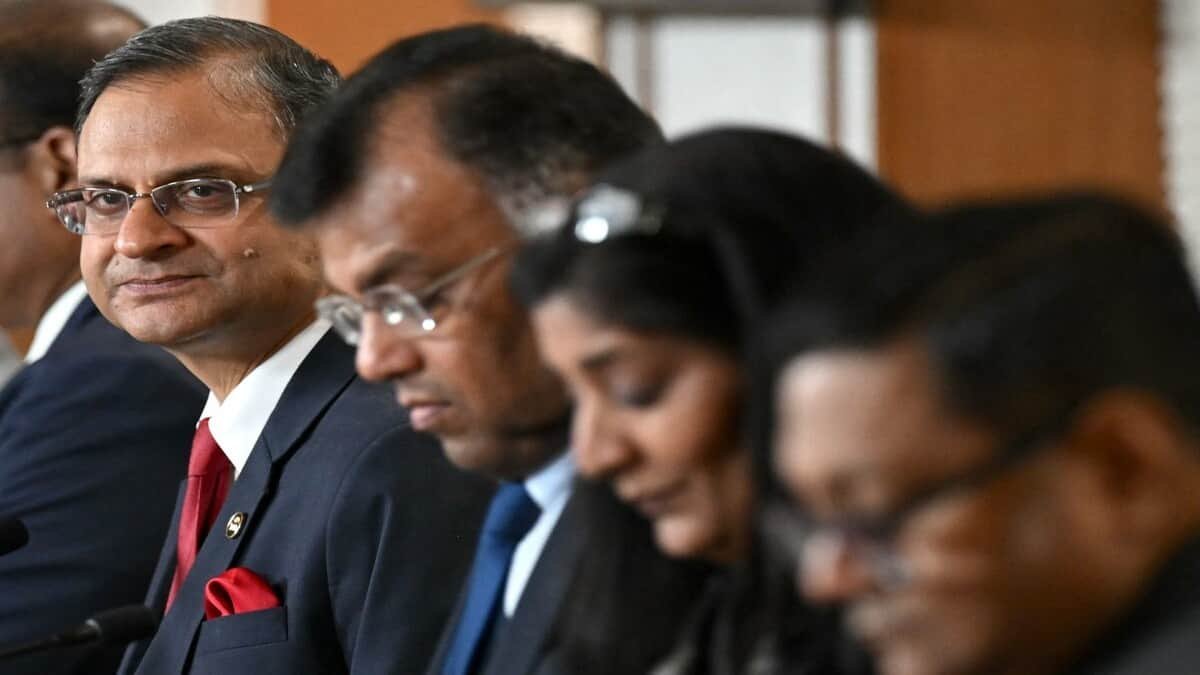
RBI MPC Meeting Live Updates: The Reserve Bank of India is set to announce its April 2026 policy decision today, with markets watching the repo rate call and Governor Sanjay Malhotra’s guidance amid oil price volatility and global uncertainty
The April 2026 monetary policy decision by the Reserve Bank of India comes at a moment of extraordinary global flux, with a sudden geopolitical twist just hours before the announcement adding a new layer of complexity. A surprise two-week ceasefire announcement by Donald Trump in the ongoing Iran conflict has triggered a sharp plunge in global oil prices, even as uncertainty over its durability remains high.
Adding to the challenge is mounting pressure on the Indian currency. The rupee has weakened nearly 3 per cent since the start of the year, with economists warning of further downside risks if crude oil prices remain elevated. While recent interventions by the RBI have offered temporary relief, the currency’s trajectory remains closely tied to global macroeconomic conditions and capital flows.
Against this volatile backdrop, the six-member Monetary Policy Committee (MPC) is set to announce its decision at 10:00 AM IST, with the benchmark repo rate currently at 5.25 per cent. While a pause is widely expected, Governor Sanjay Malhotra’s commentary will be crucial in signalling how the central bank intends to navigate rapidly shifting global risks.
RBI MPC Meeting Live Updates: Policy pause likely, but Malhotra’s guidance on inflation, liquidity and rupee in focus
RBI MPC Meeting Live Updates: The Reserve Bank of India is set to announce its April 2026 policy decision today, with the repo rate likely to remain unchanged at 5.25 per cent. Markets will closely track Governor Sanjay Malhotra’s commentary on inflation, growth, and liquidity as oil prices swing sharply following a fragile Iran ceasefire.
The policy review comes amid fast-evolving developments in West Asia, where the geopolitical situation remains fluid despite the ceasefire announcement. The United States has agreed to suspend military action against Iran for two weeks, with Tehran indicating that talks could begin as early as April 10 in Islamabad. However, there is no formal confirmation yet from Washington, and reports of continued missile activity and heightened military alerts across the Gulf underline the fragile nature of the truce.
Crucially for global markets,
the ceasefire is tied to the reopening of the Strait of Hormuz — a vital artery for global energy supplies. Oil prices have already reacted sharply, with US crude plunging more than 15–17 per cent in early trade following the announcement. Yet, the lack of clarity on when the ceasefire will fully take effect and whether supply routes will normalise keeps volatility elevated.
For India, these developments are central to the monetary policy calculus. The country imports nearly 85–90 per cent of its crude requirements, with a significant portion routed through Hormuz. Any disruption — or even the threat of it — feeds directly into inflation, widens the current account deficit, and pressures the rupee. The sudden drop in oil prices may offer temporary relief, but policymakers are unlikely to view it as a durable trend given the fragile ceasefire conditions.
This places the RBI in a particularly tight spot. On one side, easing oil prices could help contain near-term inflationary pressures. On the other, persistent geopolitical uncertainty, currency weakness, and global financial volatility argue for caution. The central bank must weigh whether the recent cooling in oil is sustainable or merely a short-lived reaction to headline risk.
Market consensus still points to a status quo on rates, extending the pause after cumulative easing in 2025. However, expectations around the policy stance have become more nuanced. Economists now see a stronger possibility of the RBI shifting its tone to reflect heightened external risks, even if it refrains from immediate action.
Financial markets have already begun adjusting to this new reality. Bond yields have remained elevated, the rupee has seen sharp swings, and capital flows have turned volatile. The ceasefire-triggered drop in oil may provide short-term relief to markets, but investors will look to the RBI for reassurance on liquidity conditions and its readiness to manage currency pressures if needed.
Beyond the headline rate decision, the MPC’s communication will carry added significance this time. Investors and economists will closely track how the central bank interprets the geopolitical shock — whether as a transient supply disruption or a more prolonged risk to inflation and growth dynamics.
For households and businesses, the implications remain immediate. A pause in rates would keep EMIs stable for now, offering some relief amid rising uncertainty. However, if inflation risks persist or resurface, the window for future rate cuts could narrow significantly.
In effect, the April policy is being shaped in real time by geopolitical developments. The abrupt shift from escalating conflict to a tentative ceasefire underscores the unpredictability of the current environment — and reinforces why the RBI’s response is likely to prioritise flexibility, caution, and data dependence over decisive moves.