

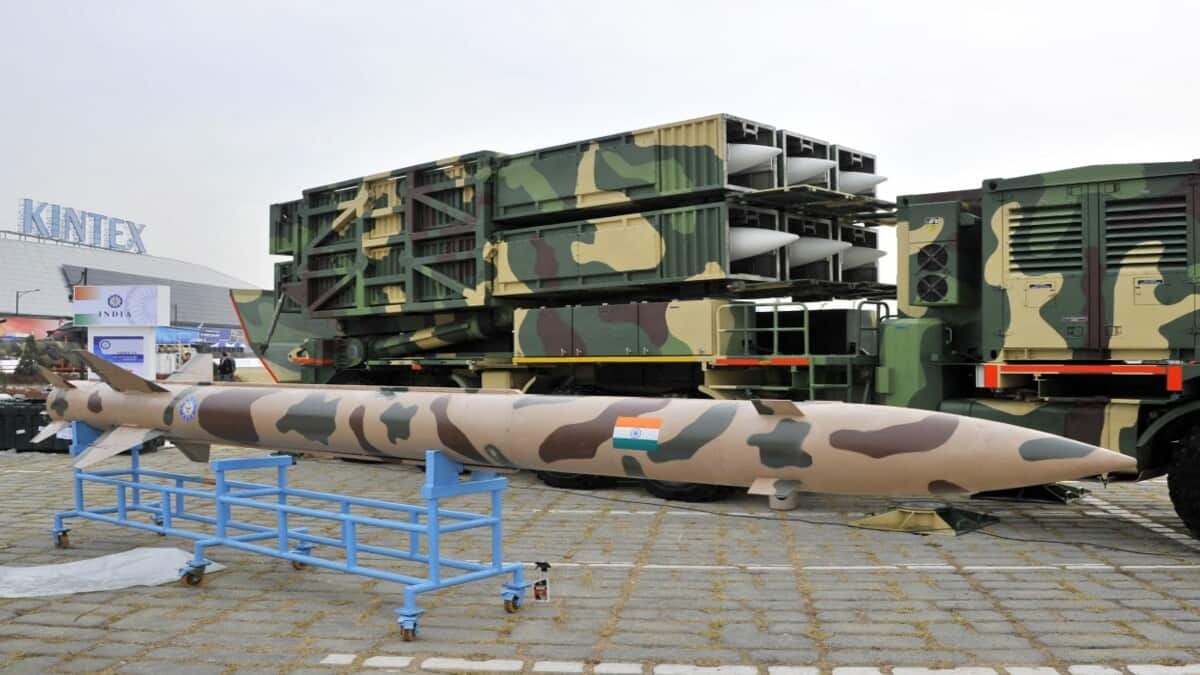
Global military expenditure rose to $2.887 trillion in 2025, marking an increase of 2.9 per cent in real terms and extending a decade-long trend of rising defence budgets amid global conflicts and geopolitical uncertainty, according to new data released by the Stockholm International Peace Research Institute (SIPRI).
India emerged as one of the world’s top five defence spenders in 2025, joining the United States, China, Russia and Germany in a group that together accounted for 58 per cent of global military spending, the data showed
The findings underline a steady acceleration in global rearmament, with spending rising for the 11th consecutive year and the global defence burden reaching 2.5 per cent of gross domestic product (GDP) — the highest level since 2009.
Top spenders dominate global military outlays
The United States remained the world’s largest defence spender at $954 billion in 2025, despite a 7.5 per cent decline from the previous year, largely due to reduced military assistance for Ukraine.
China followed at an estimated $336 billion, marking its 31st consecutive year of rising defence expenditure.
Russia and Germany also featured among the top five, with Russia spending $190 billion amid the ongoing war in Ukraine, while Germany’s defence budget rose sharply by 24 per cent to $114 billion as Europe continued its largest rearmament drive since the Cold War.
India, ranked fifth globally, increased its military spending by 8.9 per cent to $92.1 billion.
Europe leads regional surge
Europe recorded the sharpest regional increase in defence spending, rising 14 per cent to $864 billion in 2025. The increase was driven by continued conflict in Ukraine, NATO’s expanded spending commitments, and broader rearmament across the continent.
The 29 European NATO members collectively spent $559 billion, with 22 members crossing the 2 per cent of GDP defence threshold. Germany and Spain saw particularly steep increases, underscoring Europe’s accelerating shift towards military self-reliance.
“European NATO members increased spending faster than at any time since 1953,” SIPRI researchers noted, warning that expanding defence budgets could blur the lines between military and broader security expenditures.
Russia and Ukraine continued to drive wartime spending escalation, with Ukraine’s military expenditure rising 20 per cent to $84.1 billion, equal to 40 per cent of its GDP — the highest military burden globally.
Asia-Pacific sees fastest growth since 2009
Military expenditure in Asia and Oceania rose 8.1 per cent to $681 billion, the fastest growth rate since 2009. China’s continued military modernisation, alongside increased spending by Japan, Taiwan and other US allies, contributed to the surge.
Japan’s defence budget climbed 9.7 per cent to $62.2 billion, while Taiwan’s spending jumped 14 per cent to $18.2 billion amid rising regional tensions.
India’s inclusion in the top five underscores the region’s growing strategic weight in global defence spending patterns.
Pakistan’s military expenditure rose 11 per cent to $11.9 billion in 2025, reflecting heightened security pressures and regional instability.
India defence spending rises on China, Pakistan concerns
India’s military spending has gone up mainly because of security concerns and modernisation needs.
India spent $92.1 billion in 2025, an increase of 8.9 per cent, making it one of the top five defence spenders in the world.
One key reason is tension with China along the border. Even though there is no full-scale war, both countries keep troops and weapons ready in sensitive areas. This pushes India to invest more in surveillance, roads, drones, and air defence systems.
Another reason is modernisation. A lot of India’s military equipment is old, so the government is spending more to buy new fighter jets, ships, missiles, and upgrade technology.
On the western side, concerns related to Pakistan also play a role. While there is no major war, India keeps spending on defence to stay prepared for possible border tensions or security incidents.
West Asia remains broadly stable
Military spending in the Middle East stood at $218 billion, showing marginal growth of 0.1 per cent. Israel’s expenditure fell slightly to $48.3 billion following a ceasefire in Gaza, while Türkiye recorded a 7.2 per cent increase to $30 billion. Iran’s spending declined in real terms to $7.4 billion amid economic constraints and high inflation.
Structural shift in global defence priorities
SIPRI researchers noted that global military spending has been shaped by “wars, uncertainty and geopolitical upheaval,” with sustained increases expected in the coming years.
“The growth will probably continue through 2026 and beyond,” said Xiao Liang of SIPRI’s Military Expenditure Programme, pointing to long-term rearmament trends and rising strategic competition.
First Published:
April 27, 2026, 14:20 IST
End of Article