

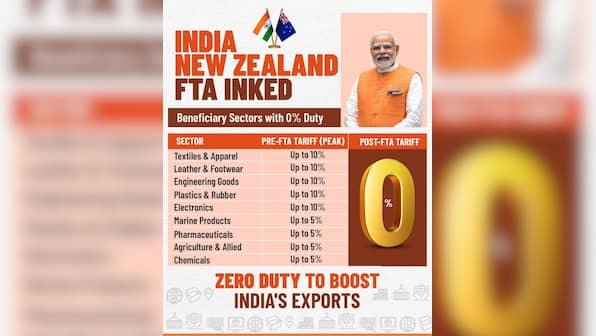
India’s trade received a huge boost on Monday (April 27) after it signed a “once in a generation” free trade agreement (FTA) with New Zealand. The pact, which will come into effect later this year after New Zealand’s parliament ratifies it, will greatly benefit farmers, youth, women, MSMEs, startups, and students, among others.
Hailing the big moment, Prime Minister Modi said on X, “Today marks a landmark moment in the India-New Zealand partnership! I am delighted that the India-New Zealand FTA signed today will add unprecedented momentum to our developmental partnership. It reflects the deep trust, shared values, and ambition that bind our two nations.”
In turn, New Zealand’s Prime Minister Christopher Luxon noted on X, “This is a once-in-a-generation agreement that gives NZ (New Zealand) exporters unprecedented access to 1.4 billion people and an economy set to become the third-largest in the world.”
What makes the India-New Zealand FTA even more notable is that it goes beyond just trade and customs duties. The deal also makes significant advances in services and mobility. For the first time in any bilateral agreement, New Zealand has created a dedicated pathway for student mobility and post-study work visas for India.
Let’s take a closer look at how the India-New Zealand FTA is a win-win for women, students, and working professionals.
India-New Zealand FTA — signed in 13 months
On Monday, Union Minister Piyush Goyal and New Zealand’s Minister for Trade and Investment, Todd McClay, met in New Delhi, where both sides signed the
India-New Zealand FTA. This marks India’s ninth such agreement in the past few years with 38 developed countries.
The signing of the
“once in a generation” FTA follows negotiations that began on March 16, 2025. Following five formal rounds of negotiations and several intersessions, both sides concluded the agreement on December 22, 2025, just nine months after launch, making it one of the fastest FTAs concluded by India with a developed country.
With the signing of this pact, India gains duty-free access to the New Zealand market for all 8,284 of its export products from day one. Earlier, Indian exports faced an average tariff of 2.2 per cent, with some labour-heavy sectors like textiles and leather seeing duties of up to 10 per cent. These will now drop to zero.
This is expected to benefit sectors such as garments, leather, engineering goods, chemicals, electronics, and food products.
India’s pharmaceutical sector is also set to gain from the FTA. It will gain easier access, with New Zealand agreeing to accept inspection reports from global regulators. This will reduce repeated checks and cut compliance costs.
In turn, India has opened 70.03 per cent of its tariff lines to New Zealand, covering 95 per cent of current imports. New Zealand exporters will benefit in areas such as wool, wine, wood, coal, and fruits like avocados and blueberries.
Hailing the deal, India’s Commerce Secretary Rajesh Agrawal said: The India–New Zealand FTA marks a new era in our economic partnership, one marked by trust and complementary strengths. India now has a level playing field for exports to New Zealand. The FTA broadens its scope to agriculture productivity, organics, services, mobility, Ayush, and pharma access, making the opportunities all-inclusive and future-oriented. The agreement gives a strong competitive push to India’s labour-intensive sectors. India’s exporters now have zero-duty access to New Zealand and the broader regional trade ecosystem. Indian exporters can operate with greater scale and diversification in the Indo-Pacific. The deal offers predictability in today’s uncertain world.”
A huge win for women
A defining feature of the FTA is that it is India’s first women-led deal. Nearly the entire negotiating team comprised women. These include the chief negotiator, deputy chief negotiator, sectoral leads, and India’s ambassador to New Zealand.
Additionally, according to Union Minister Piyush Goyal, the deal places “special emphasis on strengthening MSMEs, fostering innovation, and enabling women-led enterprises to thrive in global markets”.
Experts note that the reduced trade barriers will help India’s MSMEs. Additionally, there will be a specific focus on startups and enterprises owned by women and youth. Farmers, MSMEs, startups, students, and professionals are expected to benefit from improved access to global value chains, reduced trade barriers, and enhanced opportunities for growth and innovation.
FTA offers boost to students and professionals
A noteworthy feature of the India-New FTA is that it doesn’t just focus on trade but also on the mobility of professionals and
students.
Under this new agreement, Indian workers will be able to apply for jobs in New Zealand across several key sectors. These include IT, healthcare, and engineering, along with more specialised areas like yoga instruction and Indian cuisine. Each visa will allow professionals to stay in New Zealand for up to three years. After that, they may also be able to move towards permanent residency through existing immigration routes.
The India-New Zealand FTA also includes the Working Holiday Visa programme through which 1,000 young Indians annually can avail multiple entries in New Zealand for a period of 12 months.
The FTA also stands to benefit students. The agreement removes numerical caps on Indian students, guarantees a minimum of 20 hours per week of work during study, and provides extended post-study work opportunities-up to three years for STEM Bachelor’s and Master’s graduates, and up to four years for Doctorate holders-creating clear pathways for skills development and global careers.
Officials have called the India-New Zealand FTA “a future-ready and facilitative mobility framework,” aimed at improving entry and stay options for professionals, students, and young workers. The idea is to make it easier for Indian talent to work abroad and support services trade between both countries.
Strategic gains from India-New Zealand FTA
The FTA between the two countries also holds strategic significance.
India has been actively pursuing trade deals with major global partners as part of its economic diplomacy strategy. Recent
agreements with the United Kingdom and Oman in 2025, along with a comprehensive pact with the
European Union earlier this year, demonstrate New Delhi’s commitment to expanding its network of trade partnerships. With the inclusion of New Zealand, India continues to solidify its position as a central player in global trade.
The deal also gives New Zealand a stronger foothold in South Asia through a rules-based arrangement with one of the region’s biggest economies. For both countries, this reduces dependence on a narrow set of markets and creates a more resilient economic relationship.
According to a report in the Indian Narrative, it also sends a signal that middle powers can still build practical trade coalitions even in a fractured global trading environment. The FTA combines openness with protection, which is why it has been described as a “balanced” deal rather than a sweeping liberalisation pact. That balance is likely to shape how both governments defend the agreement domestically and how businesses use it in the years ahead.
With inputs from agencies
First Published:
April 28, 2026, 09:15 IST
End of Article