

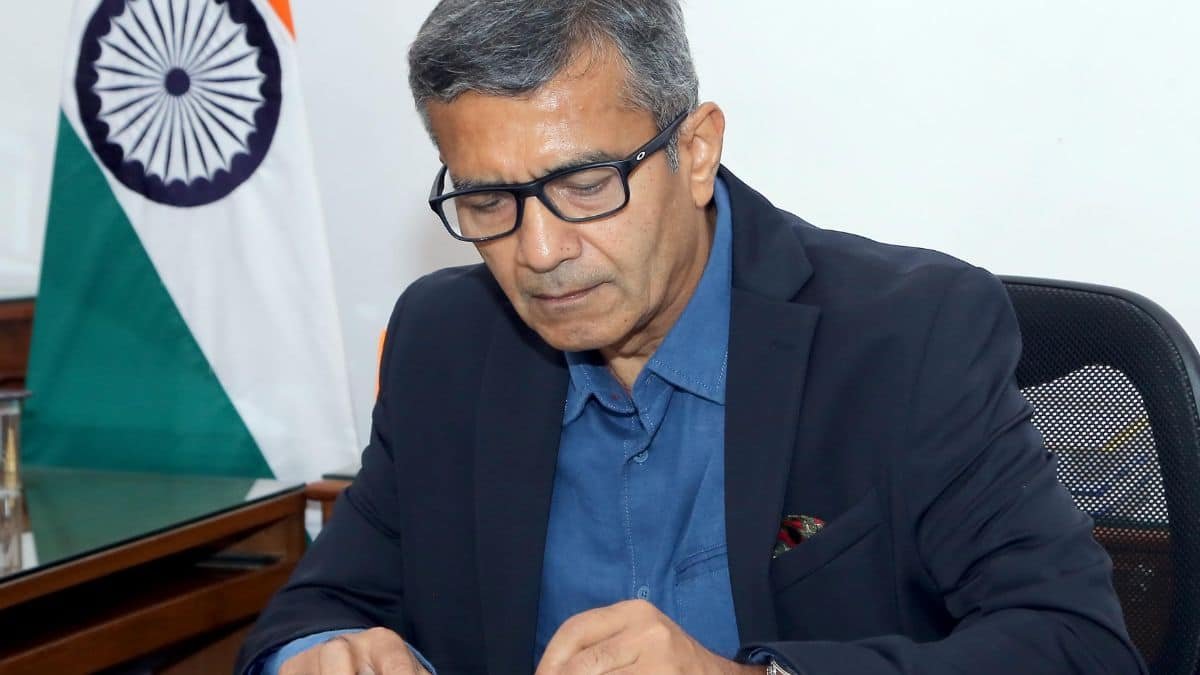
India is likely to reassess its approach to conventional missile capabilities as evolving global conflicts—particularly in West Asia—and Pakistan’s military trajectory alter strategic calculations, Defence Secretary Rajesh Kumar Singh said on Thursday.
Speaking at the ANI National Security Summit 2.0 in New Delhi, marking one year of Operation Sindoor, Singh underlined the growing importance of advanced weapons systems, strong air defence, and faster procurement processes.
Responding to a question on whether recent conflicts and concerns over civilian targeting require a shift in India’s defence planning, Singh said the underlying assumptions are changing. He noted a stronger case is emerging for a conventional missile force, especially as Pakistan develops similar capabilities. Missiles, once viewed mainly as strategic tools, are now increasingly being used in wider operational roles, he said, adding that India would need to adjust accordingly.
Singh said institutional processes for raising such capabilities would proceed alongside efforts to boost production. He acknowledged that India has largely depended on a single public-sector producer, along with DRDO’s in-house capacity, and described expanding industrial participation as essential. According to him, missile production must be scaled up across the broader industry.
“We will not wait for the institutional part of raising a force will go on in parallel with providing the supply orders to industry to start scaling up production of missiles, which is a big challenge in India because so far we’ve essentially relied on one producer, one public sector producer and some in-house production capabilities of DRDO,” the Defence Secretary stated.
His remarks come amid growing debates within strategic circles on whether recent conflicts in West Asia, including in West Asia, signal a shift towards increased use of conventional missile systems and broader targeting doctrines.
He outlined key priorities for modernising India’s armed forces, saying lessons from global conflicts are guiding India’s defence modernisation, with a focus on air defence, drones, and fast-track procurement to address capability gaps.
The Defence Secretary said lessons drawn from ongoing conflicts in West Asia and the Russia-Ukraine war are shaping procurement and capability-building efforts. Responding to a question on the top priorities in defence modernisation amid global conflicts, the Defence Secretary said, “Both from Op Sindhu and from West Asia as well as the ongoing Ukraine conflicts, you do have lessons, things like the importance of standoff weaponry, of a layered and strong air defence system, of sufficient stockpiles of ammunition and missiles, of ensuring that your radars are mobile and your artillery is also mobile.
“He said these lessons have already influenced procurement decisions. “All of those lessons are fairly clear and we’ve taken those lessons and accordingly calibrated our procurements, which is why, for example, on the EP side, the bulk of what we did, almost Rs 30,000 crores worth of EP contracts after Op Sindhu, and the bulk of those contracts have gone primarily for drones and counter-drone systems, loitering munitions, and some types of radars and EW equipment as well,” Singh said.
The session “Future of Warfare and National Security” also featured DRDO Chairman Dr Samir V. Kamat and Chief of Integrated Defence Staff Air Marshal Ashutosh Dixit. The summit was inaugurated by Defence Minister Rajnath Singh.
Emphasising the need to strengthen these priorities further, Singh referred to a major defence initiative announced by the Prime Minister. “As you are aware, the Hon’ble Prime Minister had announced a multi-layered sort of air defence and offensive system called Sudarshan Chakra Mission from the Red Fort last year. A committee under the DRDO chairperson has already submitted a kind of pre-feasibility report on that mission. So we’ll be working on all of that,” he added.
The Defence Secretary also stressed the importance of speeding up procurement processes. “Even as these committee reports come in, whether it is this or whether it’s things like the revision of DAP, we will continue to also focus on ensuring that parallelly, we do the fast-track procurement that we really need,” he said.Highlighting recent progress, Singh noted that procedural efficiency can significantly improve outcomes.
“When I say fast-track, I mean that even the procedural changes might take some time, but even within the existing procedures, you should be able to do things faster if you essentially pursue things effectively, which is what we’ve done over the last two and a half years,” he said.
He added, “We’ve signed almost Rs 4.5 lakh crores of contracts in the last two years. So yes, we are on the job and hopefully we’ll be ensuring that these lessons are not only learned, but they are adequately implemented in terms of filling any critical capability gaps that might exist.”
With inputs from ANI.
First Published:
April 30, 2026, 17:26 IST
End of Article