

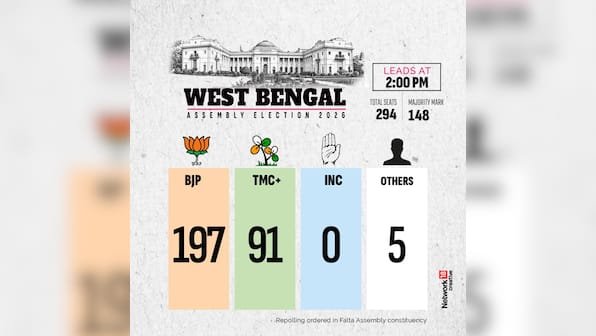
West Bengal stands at a decisive crossroads counting trends indicate that the Bharatiya Janata Party (BJP) is on course to form its first-ever government in the state.
With leads ranging roughly near 200 seats in the 293-member Assembly — well above the halfway mark of 148 — the scale of the party’s surge has shifted attention to the next big question: Who will be the next chief minister of West Bengal?
The BJP, unlike several regional parties, does not typically project a chief ministerial face in states where it is attempting to unseat an incumbent.
This approach was followed in West Bengal as well, even as the campaign witnessed high-decibel attacks on the ruling Trinamool Congress (TMC) and Chief Minister Mamata Banerjee.
Now, with the possibility of forming the government turning into a near-certainty, the central leadership faces the crucial task of identifying a leader who can both consolidate the electoral mandate and govern a politically complex state.
Union Home Minister Amit Shah had, during the campaign, repeatedly underlined that the BJP would appoint a Bengali as chief minister if voted to power.
The statement was aimed at countering the TMC’s persistent charge that the BJP was dominated by “bohiragotos” or outsiders. That political framing has now become an important lens through which the party’s leadership choice is being evaluated.
BJP’s historic surge in West Bengal
Early data indicated the BJP leading in as many as 194 seats at one stage during the afternoon,
while broader trends consistently placed the party close to the 200-seat mark.
In contrast, the TMC appeared to be trailing significantly, hovering around the 90-seat range in several projections.
Such numbers, if they hold, would mark the end of over a decade and a half of TMC dominance in the state, which began in 2011 when Mamata Banerjee first came to power riding the wave of the anti-land acquisition movements, including Nandigram.
The 2026 mandate also reflects a sharp turnaround from the 2021 Assembly elections, when the BJP had emerged as the principal opposition with 77 seats but failed to dislodge the TMC.
Over the subsequent five years, the party focused on strengthening its organisational network and maintaining political pressure on the ruling dispensation, setting the stage for the current electoral outcome.
Suvendu Adhikari: From TMC insider to BJP’s central figure
At the centre of the chief ministerial debate is
Suvendu Adhikari, who has emerged as the most prominent face of the BJP in West Bengal politics. Currently serving as the Leader of Opposition, Adhikari’s political trajectory has been closely intertwined with the state’s recent history.
He began his political career in student politics with the Congress at a time when the Left Front was dominant in Bengal.
Over time, he became one of Mamata Banerjee’s most trusted associates within the TMC and played a pivotal role in mobilising support during the Nandigram agitation — a movement that proved instrumental in the TMC’s rise to power in 2011.
His departure from the TMC in December 2020, just months before the 2021 Assembly elections, was one of the most consequential political shifts in recent Bengal politics.
The move not only dealt a setback to the TMC but also provided the BJP with a leader who had deep insight into the ruling party’s organisational structure.
In the 2021 elections, Adhikari defeated Mamata Banerjee in Nandigram, a contest that became the focal point of the entire campaign. Although the BJP did not secure a majority, the victory elevated Adhikari’s stature significantly within the party.
Over the next five years, he functioned as the Leader of Opposition, consistently targeting the TMC government on various issues inside the Assembly and across the state. His role extended beyond legislative politics, particularly in the aftermath of the 2021 elections, when the BJP faced organisational challenges in several districts.
In the current election, Adhikari has once again taken on high-profile contests. He is contesting from both Nandigram and Bhabanipur, directly challenging the TMC leadership in key constituencies.
Early counting trends showed him leading in Nandigram by more than 3,100 votes against TMC’s Pabitra Kar. In Bhabanipur, Mamata Banerjee
initially trailed before moving ahead by 898 votes after three rounds of counting.
Adhikari’s influence extends beyond individual constituencies. His organisational base in regions such as East Midnapore and his ability to mobilise support across different parts of the state have made him a central figure in the BJP’s campaign and subsequent discussions on leadership.
Samik Bhattacharya: The organisational strategist
Another significant name in the discussion is Samik Bhattacharya, the current state BJP president. A long-time member of the Rashtriya Swayamsevak Sangh (RSS), Bhattacharya represents the organisational backbone of the party in West Bengal.
He has been associated with the BJP since its early years in the state, when it had minimal electoral presence. Notably, he became the first BJP MLA in West Bengal after winning a by-election from Basirhat Dakshin in 2014. Over the years, he has contributed to building the party’s structure at the grassroots level.
Bhattacharya is often viewed as a moderate leader, with a political style that has drawn comparisons to former Prime Minister Atal Bihari Vajpayee. His focus has largely been on internal management, booth-level organisation, and electoral strategy rather than mass mobilisation.
Currently serving as a Rajya Sabha MP since 2024, he has played a role in consolidating the BJP’s support base across different regions of the state.
His profile aligns with the “bhadralok” image that the party may consider in its leadership choice, particularly in a state where political messaging often intersects with cultural identity.
Dilip Ghosh: Architect of BJP’s expansion in Bengal
Dilip Ghosh remains one of the most influential figures in the BJP’s rise in West Bengal. As a former state president, he was instrumental in expanding the party’s footprint during a critical phase of its growth.
When Ghosh took charge, the BJP had a marginal presence in the state Assembly, with just three MLAs. Under his leadership, the party achieved a significant breakthrough in the 2019 Lok Sabha elections, winning 18 out of 42 seats — a performance that marked its arrival as a major political force in Bengal.
Known for his strong grassroots connect and assertive political style, Ghosh played a key role in mobilising cadre support and building the party’s organisational network.
However, following the BJP’s defeat in the 2021 Assembly elections and subsequent setbacks in the 2024 Lok Sabha polls, he gradually moved away from the centre of state politics.
Earlier this year, he was brought back into active engagement after a meeting with Amit Shah, signalling a renewed role within the party. In the current Assembly election, Ghosh is contesting from Kharagpur Sadar and is expected to secure a victory.
His experience in organisational building and his popularity among party workers continue to make him an important figure in discussions around leadership, even as the party weighs multiple factors in its decision-making process.
Sukanta Majumder: A key organisational and regional figure
Dr. Sukanta Majumder, another former state BJP president, is also among the leaders being considered. Currently serving as a Union minister in the Narendra Modi-led government, Majumder represents a different dimension of the party’s leadership pool.
He is seen as having a clean public image and strong links with the RSS, which remains an important factor in the BJP’s internal dynamics.
His leadership has been associated with organisational consolidation, particularly in regions where the party has established a strong presence.
Majumder’s political base lies in North Bengal,
a region that has consistently supported the BJP in recent elections.
Swapan Dasgupta: Intellectual and policy-oriented presence
Swapan Dasgupta, a former journalist, is another name that features in the broader list of potential candidates. He became actively involved in the BJP’s organisational activities in West Bengal ahead of the 2021 Assembly elections.
Dasgupta is considered close to the party’s central leadership and is often associated with its intellectual and policy-oriented approach. Like Bhattacharya, he represents a “bhadralok” face within the party.
However, his relative lack of administrative experience is seen as a limitation in the context of leading a state government, particularly one as politically intricate as West Bengal.
Other leaders in the discussion
Apart from the primary contenders, several other leaders have been mentioned in media reports as part of the wider pool of potential candidates or future leadership figures within the BJP.
These include former Union minister Nisith Pramanik, BJP MLA Agnimitra Paul, former Rajya Sabha MP Roopa Ganguly, and Siliguri MLA Shankar Ghosh.
Agnimitra Paul, who represents Asansol South and serves as a national spokesperson, has emerged as a visible face of the party through her media engagements. Her inclusion in discussions reflects the BJP’s efforts to promote women leaders in the state.
Shankar Ghosh, on the other hand, is an important figure in North Bengal politics. His role has largely been focused on regional mobilisation and organisational work, and his influence is considered more localised compared to statewide leaders.
Factors shaping BJP’s electoral breakthrough
One of the major points of contention during the campaign was the Special Intensive Revision (SIR) of electoral rolls. The exercise reportedly led to the removal of a large number of names, with estimates suggesting nearly 90 lakh deletions.
The BJP maintained that this was a corrective measure aimed at addressing irregularities, while the TMC argued that it disproportionately affected its support base.
At the same time, broader issues such as unemployment, corruption, and law and order featured prominently in the BJP’s campaign narrative. The party sought to position itself as an alternative to what it described as governance fatigue under the TMC.
The TMC, for its part, continued to emphasise welfare schemes and regional identity, including the theme of “Bengali pride.” However,
the emerging trends suggest that a significant section of voters may have opted for change.
Also Watch:
With inputs from agencies
First Published:
May 04, 2026, 16:01 IST
End of Article