

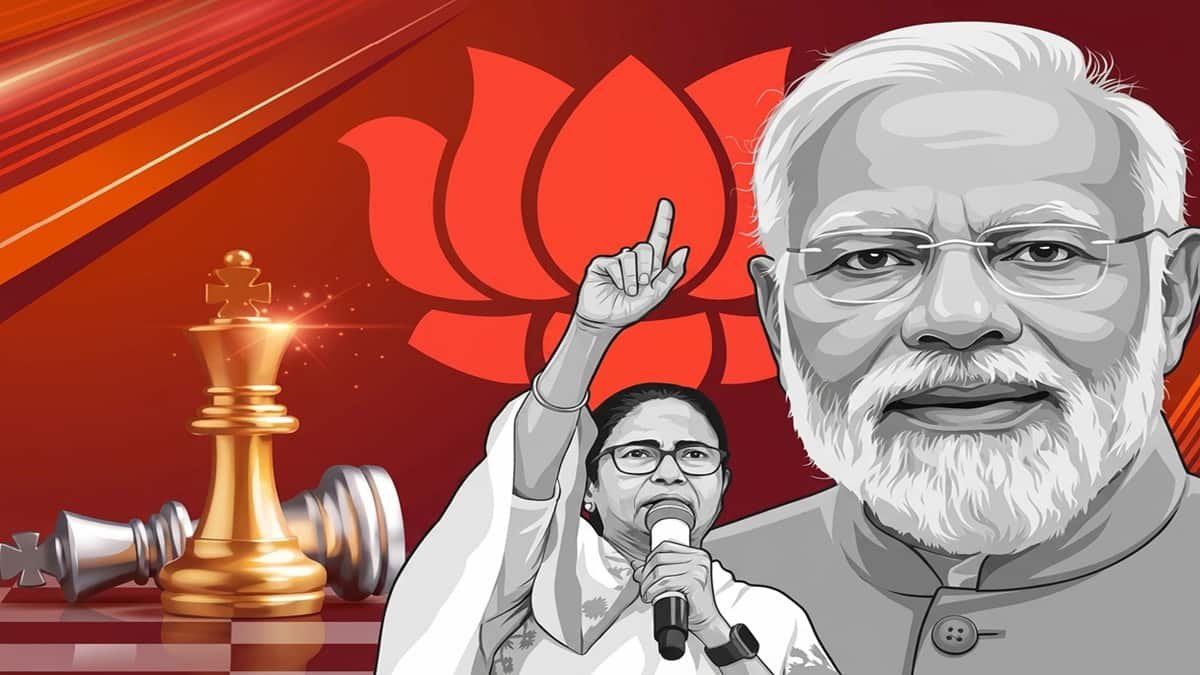
Her stand raises a key constitutional question: can a Chief Minister stay in office after losing an election, and what happens next under the rules?
A day after the BJP’s victory in the West Bengal Assembly elections, TMC chief Mamata Banerjee said she would not resign as Chief Minister, claiming her party had not lost the mandate and alleging the
verdict had been “looted”.
Her remarks have triggered a key constitutional question: can a Chief Minister continue in office after losing an election?
Mamata refuses to step down
“I have not lost, so I will not go to Raj Bhavan. I
will not tender my resignation,” Banerjee said at a press conference in Kolkata.
She alleged that the BJP’s victory was the result of manipulation, claiming nearly 100 seats had been “stolen”. Escalating her attack, she accused the government and the Election Commission of India of acting in concert.
“This is not how democracy works. When the judiciary is not there, when the Election Commission is biased and the government wants one-party rule, a wrong message goes out to the world,” she said.
Banerjee also alleged “direct interference” by the Centre, claiming elections had earlier been “stolen” in Maharashtra, Haryana and Bihar, and that Bengal had now met the same fate.
While she did not spell out her next move, she said leaders of the INDIA bloc had reached out and assured support.
What the Constitution says
Under India’s constitutional framework, a Chief Minister must enjoy the confidence of the State Legislative Assembly. Once election results make it clear that the incumbent no longer commands a majority, constitutional convention requires the Chief Minister to resign and submit the Council of Ministers’ resignation to the Governor.
If the Chief Minister refuses to step down, the Governor can step in. Under Article 164(1) of the Constitution of India, ministers hold office at the Governor’s pleasure. If it is evident that the government has lost majority support, the Governor can dismiss the Chief Minister and the Council of Ministers.
The Governor may then invite the leader of the majority party or coalition to form the government or ask a claimant to prove their majority on the Assembly floor.
Bengal verdict and what follows
In West Bengal, the BJP scripted a decisive win, securing 206 seats and a more than two-thirds majority. The result brings an end to the TMC’s 15-year rule and marks a significant political shift in the state.
With the numbers indicating that the TMC no longer holds a majority, the next constitutional step now rests with the Governor.
How other CMs responded
Across states, outgoing Chief Ministers have followed established convention by stepping down after electoral defeats.
DMK president MK Stalin resigned as Tamil Nadu Chief Minister after his party lost the Assembly elections, which saw a debut victory for Vijay-led Tamilaga Vettri Kazhagam (TVK).
In Kerala, Pinarayi Vijayan also stepped down after the Left Democratic Front suffered a defeat, ending a decade-long tenure.
An official statement from Lok Bhavan confirmed that Governor Arlekar accepted Stalin’s resignation.
Constitutional convention and transition
The resignation of a Chief Minister after election results is a well-established constitutional practice. It is followed by both outgoing and re-elected leaders to ensure a smooth and orderly transition of power, reinforcing democratic norms even in closely contested or politically charged elections.
First Published:
May 05, 2026, 20:33 IST
End of Article