

It’s been a year since military hostilities broke out between India and Pakistan. On May 7, 2025, New Delhi initiated Operation Sindoor — military action against terror camps across the border — prompting Islamabad to launch a counter, targeting civilian infrastructure.
Tensions were at a peak for four days as both nuclear-armed nations launched a barrage of drones and missiles at one another across the border. The operation also saw both nations flexing their military muscle; Pakistan fired Chinese-and-Turkish-made weapons, whereas India exhibited its ‘aatmanirbhar (self-reliant) spirit by deploying home-grown armaments.
However, among all the weapons, which India deployed amid
Operation Sindoor, one grabbed eyeballs the most — the Russian-made
S-400. This air defence system successfully countered Pakistan’s aerial attacks, making it the star of the operation.
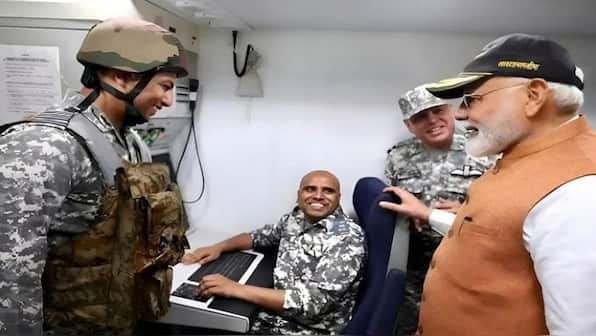
Now, a year later, we take a look back at the man behind the weapon. Indian Air Force Group Captain Animesh Patni was the man who helmed the air defence system and successfully took down a Pakistani jet.
Patni in the hot seat
It was May 7, 2025, and hostilities between India and Pakistan had commenced. Missiles were flying across the international border, and Group Captain Animesh Patni, stationed at Adampur Airbase, knew it was only a matter of time before he would be called into action.
On May 10, that moment arrived. The Indian military identified a crucial High Value Target (HVT) coordinating attacks from a safe distance. This turned out to be a Saab 2000 Erieye
Airborne Early Warning and Control (AEW&C) aircraft.
Procured from Sweden, the Erieye serves as the “eyes in the sky” for the Pakistan air force, using its powerful radar to direct fighter jets and manage strike missions. This made it a vital target for the IAF to disrupt.
And this is when Patni and his S-400 regiment were roped in to destroy the crucial asset. Patni had trained for this moment repeatedly, but this was the real deal.
He then ordered the primary long-range air search radar of his S-400 system to open up, and almost immediately, Patni had a lock. As Patni recounts in the book The Sky Warriors: Operation Sindoor Unveiled, “On the first night, we had butterflies in our stomachs because the system had not been combat tested, but it was now in a live operation. There are a lot of safeties which have to be removed before we carry out any kind of live operation, just to avoid any kind of accident.”
Soon, the S-400 was prepped for attack; all it took was the single press of a button to fire a missile that cost more than $1.5 million.
“I took a deep breath before giving my final call – “Okay, launch”, and then it was the turn of my 2IC [second-in-command]. He asked me to confirm the launch because this was the first time we had ever launched a surface-to-air missile into enemy airspace. We were trying to shoot down the enemy over his own territory,” said IAF’s Patni as quoted in the book.
After the 2IC pressed the button, it seemed like time paused. “The button had been pressed – was there something wrong?,” Patni wondered.
But then, Patni and his 2IC heard a loud boom. The missile hit its target, with the Pakistani jet’s satellite disappearing off the screens.
“It’s a huge sound, and it actually lit up the entire sky, and after that sound, I heard one more sound. And that was the call of “Bharat Mata ki Jai”. The men all started shouting “Bharat Mata ki Jai” after seeing that missile launch, and everybody was charged up,” recounts Patni.
@Chopsyturvey
A strike for the record books
Months later, in October, Indian Air Force Chief,
Air Chief Marshal Amar Preet Singh, described Operation Sindoor as the most significant military engagement of the year.
He also confirmed that Patni’s strike was the longest kill achieved by India. “This was the largest ever recorded surface-to-air kill,” Singh said, adding that the S-400’s 40N6 missile, with a 380-km reach, kept Pakistani aircraft outside their weapons’ release range.
The Air Force chief further added, “Pakistan was unable to operate even within its own territory,” suggesting that the scale and surprise of the operation left the adversary paralysed and disoriented.
Later, Austrian military analyst Tom Cooper also described the strike as the longest-range confirmed kill of its kind, at over 300 kilometres.
Life and career of Group Captain Patni
For his valour and decision-making, Group Captain Patni was awarded the Vir Chakra, the nation’s third-highest wartime gallantry award. According to the citation, Patni demonstrated “exceptional gallantry and courage” in orchestrating a groundbreaking offensive air defence operation.
This was a huge honour for Patni, who joined the Indian Air Force in 2005. Hailing from Baran, Rajasthan, he began his IAF career as a MiG-29 fighter pilot. With more 2,500 hours on the Su-MKI and Mirage platforms, he transitioned to the S-400 regiment in 2024.
The success of Operation Sindoor
Operation Sindoor was India’s response to the
dastardly terror attack in Pahalgam’s Baisaran on April 22. The Indian Armed Forces launched a joint effort, taking out nine terrorist training infrastructure in both Pakistan and Pakistan-occupied Kashmir.
For India,
Operation Sindoor was a roaring success. According to a report by the Centre d’Histoire et de Prospective Militaires in Switzerland, India achieved air superiority over key sectors of Pakistani airspace. India also downed eight to 10 Pakistani fighter jets, including F-16s and JF-17s, showcasing its military might over Islamabad.
Moreover, Operation Sindoor killed more than 100 terrorists, including those involved in the IC-814 hijacking and the Pulwama terror attack in 2019. Even Jaish-e-Mohammed founder Masood Azhar claimed that 10 members of his family had died in the military strikes.
Operation Sindoor also caused heavy damage to Pakistan’s Rahim Yar Khan airbase in Pakistan’s Punjab province, as well as other bases — a message that aggression would not be tolerated.
But as Indian Army Chief General Upendra Dwivedi noted, it would be unwise to assume it will put an end to cross-border terrorism.
With inputs from agencies
First Published:
May 06, 2026, 11:26 IST
End of Article