

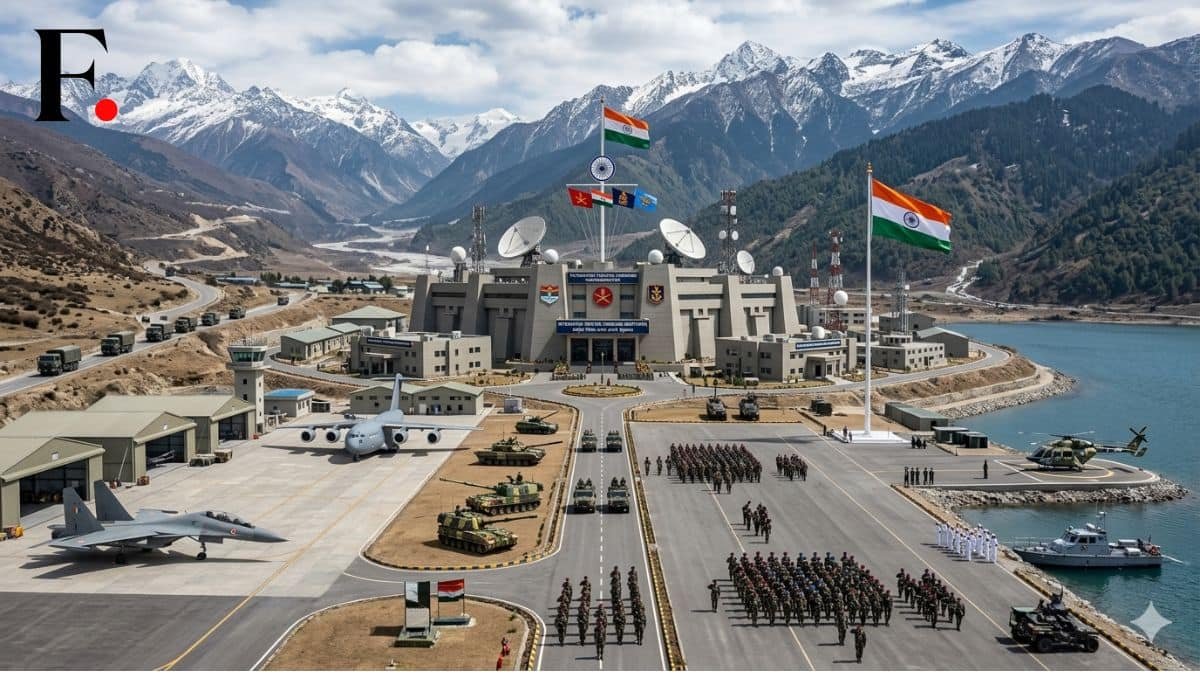
One year after Operation Sindoor became a defining example of India’s growing military coordination, the country’s long-pending plan to establish Integrated Theatre Commands (ITCs) appears to be gaining fresh momentum.
The operation, launched in the aftermath of the Pahalgam terror attack in April 2025, involved simultaneous actions by the Indian Army, Indian Air Force (IAF), and Indian Navy.
Fighter aircraft struck terror-linked targets, naval assets maintained operational pressure in the Arabian Sea, and Army formations secured positions along the Line of Control (LoC) — all in a synchronised rhythm that the old siloed system could never have achieved.
Defence planners believe the operation
demonstrated the effectiveness of coordinated military action across multiple domains.
At the same time, it also highlighted the limitations of India’s existing structure, where the three armed services continue to operate largely through separate command chains and service-specific headquarters.
For years, experts have argued that future wars will require a unified fighting structure capable of responding rapidly across land, air, sea, cyber, space, and electronic warfare environments.
The proposed Integrated Theatre Commands are intended to create exactly such a framework.
What are Integrated Theatre Commands?
Integrated Theatre Commands refer to unified military formations where all assets and manpower from the Army, Navy, and Air Force operating within a particular region are placed under one operational commander.
At present, India’s military functions through 17 separate commands — seven under the Army, seven under the Air Force, and three under the Navy. Most of these commands are independent of each other and follow separate operational structures.
Coordination between services often requires parallel communication between different headquarters during a conflict situation.
For example, in a military confrontation involving China, the Army’s Eastern Command headquartered in Kolkata and the Air Force’s Eastern Air Command located in Shillong would need to coordinate operations through separate chains despite operating in the same theatre.
The existing arrangement has frequently been criticised for slowing operational responses during fast-moving situations.
The theatre command model seeks to replace this fragmented arrangement with a single commander who would exercise operational authority over all military resources assigned to a specific theatre.
India currently has only two operational tri-service structures:
-
The Andaman and Nicobar Command, which functions as a geographical command
-
The Strategic Forces Command, which manages India’s nuclear assets
These structures are often viewed as limited examples of the broader integration India now aims to implement on a larger scale.
What kind of theatre command structure is India planning?
According to proposals submitted by Chief of Defence Staff (CDS) of the Indian Armed Forces General Anil Chauhan, India’s proposed military restructuring revolves around three principal theatre commands.
The first is the Northern Theatre Command, which will primarily focus on the frontier with China, and will reportedly be located in Lucknow. Given the terrain and operational nature of the region, the command is expected to be headed by an Army officer.
The second is the Western Theatre Command, which will oversee military operations involving Pakistan. Because of the significance of air operations across the plains and desert sectors, the command is likely to be led by an Air Force officer, in Jaipur.
The third is the Maritime Theatre Command, intended to integrate the Navy’s eastern and western operational structures into a single formation responsible for safeguarding India’s interests across the Indian Ocean Region. This command is expected to be headed by a naval officer, in Thiruvananthapuram.
Apart from geographical theatres, India is also
moving towards stronger integrated structures in cyber warfare and space operations. Defence planners increasingly consider these domains essential to modern combat operations, particularly as conflicts become more technology-driven and network-centric.
Why has India delayed these reforms for so long?
The need for integrated military structures has been discussed in India for decades. Several committees formed after the 1999 Kargil War highlighted the importance of creating unified operational commands to improve coordination between the three services.
Despite repeated recommendations, progress remained slow for years because of institutional disagreements, bureaucratic delays, and political hesitation.
The Army, Navy, and Air Force have historically operated through separate planning and operational systems, and concerns over command authority and distribution of resources often delayed consensus.
A major institutional step was finally taken in December 2019 with the appointment of a Chief of Defence Staff (CDS), a four-star officer tasked with promoting coordination among the services and resolving inter-service operational issues.
The late General Bipin Rawat strongly advocated a rapid transition towards integrated commands. However, the process slowed considerably following his death in a helicopter crash in December 2021.
General Anil Chauhan, who returned from retirement to become the next CDS in September 2022, adopted a more consultative approach aimed at building consensus among the services. While this strategy has been slower, it has also attempted to address long-standing concerns raised by different branches of the military.
There are now indications that the final approval for the creation of Integrated Theatre Commands could come before Chauhan’s extended tenure ends on May 30.
Why are Integrated Theatre Commands important for modern warfare?
Strategists argue that future wars will depend heavily on speed, coordination, and the ability to operate seamlessly across multiple domains.
One concept frequently discussed in military planning is the “OODA loop” — Observe, Orient, Decide, Act. The side capable of completing this cycle faster often gains the operational advantage in combat.
Under the current system of separate service commands, decision-making can become slower because operational coordination requires multiple levels of communication across different headquarters.
The theatre command model is designed to reduce these delays by establishing a single operational authority capable of taking rapid decisions involving all three services simultaneously.
Supporters of ITCs also argue that integration will improve resource management. India faces the possibility of handling simultaneous challenges from both China and Pakistan while continuing to balance defence spending with economic development priorities.
Military planners believe integrated commands can help avoid duplication in procurement and logistics. Instead of separate branches acquiring overlapping systems or maintaining parallel supply chains, assets can be pooled and deployed according to operational requirements.
This would apply particularly to expensive strategic systems such as the S-400 Triumf, Dassault Rafale squadrons, surveillance platforms, and drone networks.
The reforms are also tied closely
to India’s push for “Aatmanirbharta” or self-reliance in defence production. Integrated structures are expected to create more streamlined procurement planning and reduce unnecessary duplication of platforms between services.
How did Operation Sindoor showcase military integration?
Operation Sindoor is increasingly being viewed by defence analysts as a practical demonstration of how integrated military operations can function in real-time.
One of the most significant aspects of the operation
was the role played by the Integrated Air Command and Control System (IACCS), an automated network to connect surveillance, air defence, and operational assets across multiple services.
Picture of the Integrated Air Command and Control System released—crucial to the success of Operation Sindoor.#OperationSindoor pic.twitter.com/spabxZS1Pt
— MyGovIndia (@mygovindia) May 12, 2025
The system combines data from several sources, including two-dimensional and three-dimensional radars, airborne warning aircraft, unmanned aerial systems, fighter aircraft, observation posts, and civil aviation radars.
These inputs are processed through centralised command centres to create a comprehensive real-time picture of India’s airspace.
This operating picture, known as the Recognised Air Situation Picture (RASP), allows military commanders at tactical, operational, and strategic levels to monitor threats and respond quickly.
The network functions through a wide-area IP-based architecture designed to ensure rapid and secure transmission of operational data. Defence officials consider this framework central to India’s evolving network-centric warfare capability.
During the escalation in May 2025, India faced waves of Pakistani drones, missiles, and rockets targeting military positions and critical infrastructure. India’s response relied heavily on the integrated functioning of multiple air defence layers connected through IACCS.
The innermost layer of India’s air defence system focused on short-range and low-altitude threats, particularly drones. Systems deployed at this level included L70 guns, ZSU-23 Shilka platforms, MANPADS, and counter-unmanned aerial systems.
The second defensive layer consisted of point-defence missile systems designed to protect specific strategic locations. These included the Spyder, OSA-AK, and Pechora missile systems.
The middle layer relied on medium-range systems such as the indigenous Akash missile system and Indo-Israeli MRSAM platforms.
The outermost layer involved long-range systems such as the S-400 and fighter aircraft capable of intercepting hostile targets far from sensitive Indian airspace.
According to the available operational details, this layered defence structure successfully intercepted multiple aerial threats, including drones and PL-15 missiles, before they could strike Indian targets.
The operation also demonstrated the growing importance of electronic warfare in modern combat. During the mission, Indian forces reportedly jammed hostile radar systems within a short period.
Many defence experts now view Operation Sindoor as proof that coordinated tri-service operations can significantly improve combat effectiveness when military assets are connected through a unified operational framework.
How do global military powers use theatre commands?
India’s proposed reforms closely resemble military structures already adopted by several major powers.
The United States implemented a unified command system through the Goldwater-Nichols Act. The American military today operates multiple geographic and functional combatant commands.
Geographic commands such as INDOPACOM and CENTCOM are responsible for specific regions, while functional commands such as CYBERCOM and STRATCOM focus on specialised warfare domains. CENTCOM is currently active
in the US conflict against Iran in West Asia.
Under the US model, service chiefs primarily handle responsibilities related to organising, training, and equipping forces, while operational commanders conduct military campaigns.
China undertook a major military reorganisation in 2016 by replacing seven military regions with five integrated theatre commands.
Their Western Theatre Command handles the entire border with India. This means India currently faces one unified Chinese command with seven disjointed Indian commands.
Indian military planners increasingly argue that China’s unified operational system gives Beijing a coordination advantage, while India continues to function through multiple service-specific commands.
Reducing this command gap has become one of the major drivers behind India’s current military reforms.
Where does the process stand today?
India’s transition toward integrated commands appears to be entering a more concrete phase after years of discussion.
General Anil Chauhan has previously stated that a Joint Operations Centre (JOC) is expected to become fully operational by the end of May this year. The centre is expected to function as the central coordination hub supporting future theatre commanders.
India has also passed the Inter-Services Organisations (Command, Control and Discipline) Act, legislation that gives commanders authority over personnel from different services operating under integrated structures.
The timeline for the full function of the ITCs is yet to be announced.
Also Watch:
With inputs from agencies
First Published:
May 07, 2026, 17:20 IST
End of Article