

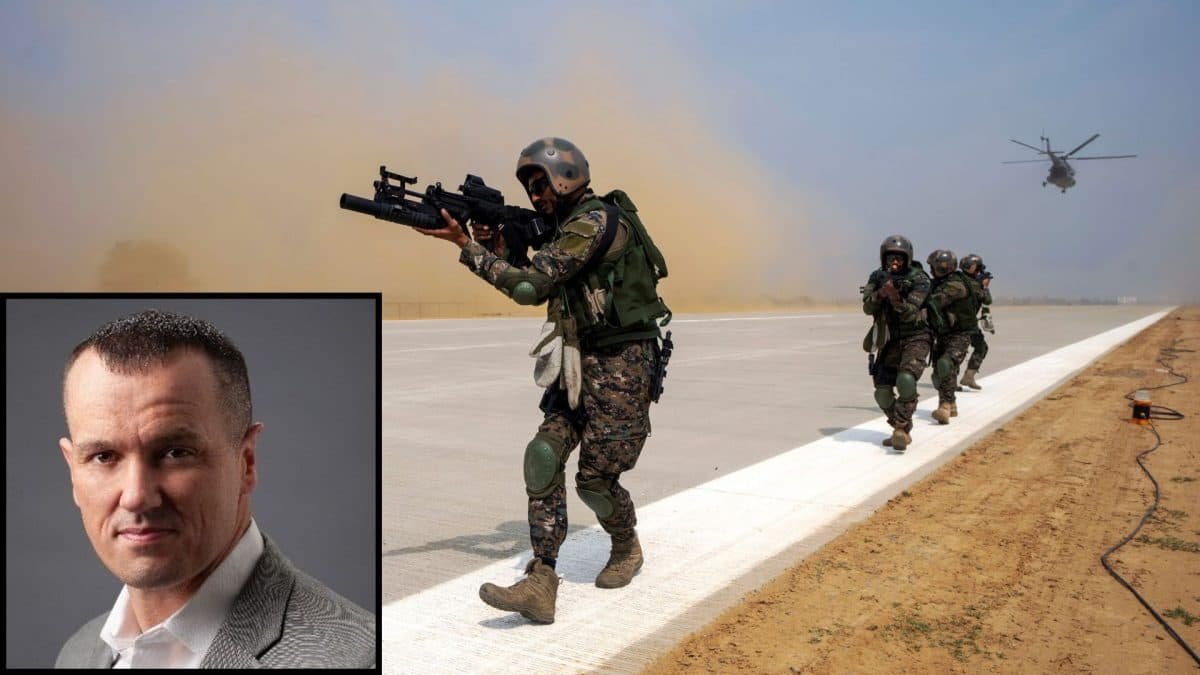
US military expert John Spencer says Operation Sindoor has become a case study in modern warfare, where narrative battles, integrated systems, and information dominance proved as decisive as battlefield strikes
A year after Operation Sindoor reshaped India’s military posture towards Pakistan-backed terrorism, US military expert John Spencer says the conflict exposed not just the realities of modern warfare, but also the growing role of narrative warfare in shaping global perceptions.
In an interview with Firstpost’s Hem Kaur Saroya, Spencer, chair of urban warfare studies at the Madison Policy Forum, reflected on how the operation altered India’s strategic doctrine and changed the military balance with Pakistan.
Saroya began by asking Spencer how he assessed the early narratives surrounding the India-Pakistan conflict and whether they misrepresented the final outcome. Spencer argued that misinformation around the conflict overshadowed what he described as India’s eventual military dominance.
“Unfortunately, with Operation Sindoor, there was initial message about a certain number of Indian aircraft, downed or grounded or destroyed that became the entire message of the entire operation,” Spencer said. “And that’s problematic and a lot of lessons to be learned about that.”
Operation Sindoor was launched on May 7, 2025, after the Pahalgam terror attack that killed 26 civilians. India responded with precision strikes on terror camps and later military targets deep inside Pakistan and Pakistan-occupied Kashmir. One year later, New Delhi maintains that while the kinetic phase may be paused, the
doctrine behind the operation continues.
When Saroya pointed out that global coverage had focused heavily on alleged early setbacks instead of the full campaign, Spencer said social media algorithms and coordinated narrative warfare played a decisive role.
“Unfortunately, we live in an algorithm-driven world where some countries, like Pakistan and others, invest heavily in that social media influencing narrative warfare capability,” he said. “Western media picks it up because they want to get out there with their first message.”
He added that India attempted to counter those narratives through daily briefings and satellite imagery showing the impact of its strikes, but the first wave of online messaging had already gained traction.
Saroya then asked Spencer how he viewed India’s restraint during the opening phase of the operation. Spencer described Operation Sindoor as a “generational change” in India’s strategic doctrine.
“I believe that it was a change in India’s strategic doctrine. So it’s both restrained but also forceful,” he said. “The political message was that enough is enough. Blood and water don’t mix no longer in a nuclear umbrella.”
He contrasted India’s response with its handling of the 2008 Mumbai terror attacks. “If you just look at the response after the Mumbai attacks to this response, it’s night and day,” Spencer noted.
Asked by Saroya what changed between May 7 and May 10 to shift momentum in India’s favour, Spencer rejected the idea that momentum had ever tilted away from New Delhi.
“India established the ability to penetrate Pakistan’s air defenses,” he said. “India demonstrated military dominance and ended with Pakistan calling for a ceasefire.”
Saroya also questioned whether sustained targeting of Pakistan’s air defence systems was critical to India’s success. Spencer said India’s ability to strike radar systems and suppress air defences opened the way for deeper precision attacks.
“India’s early success at hitting one of the Pakistani air radars was critical,” he said. “Pakistan is a Chinese-equipped military, which was a test of all of this. India’s investments in joint capabilities were shown to be dominant.”
From platforms to systems, how war is changing
A major lesson from the conflict, Spencer argued, was the importance of integrated military systems over individual weapons platforms. Responding to Saroya’s question on whether integrated systems mattered more than fighter jets, Spencer replied: “1000%. That should be the global headline.”
“It is about a system of systems that you have to have — everything from cheap attack drones to advanced air defense capabilities,” he added.
Saroya also asked whether the ceasefire was driven primarily by battlefield pressure rather than diplomacy. Spencer said military realities forced Pakistan to seek a pause in fighting.
“The facts are that Pakistan sought a ceasefire because of the dominance that India was showing,” he said. “The battlefield effects of India on Pakistan led to Pakistan asking for a ceasefire.”
As the interview concluded, Saroya asked Spencer what Operation Sindoor revealed about the future of warfare. Spencer said future conflicts would increasingly be shaped by networks, systems and information dominance as much as by battlefield victories.
“This is a new strategic doctrine — diplomatically, militarily, informationally, even economically,” he said. “Sindoor was paused because Pakistan asked for it. But the message is that enough is enough with terrorism, and there will be accountability for it.”
First Published:
May 08, 2026, 05:57 IST
End of Article