

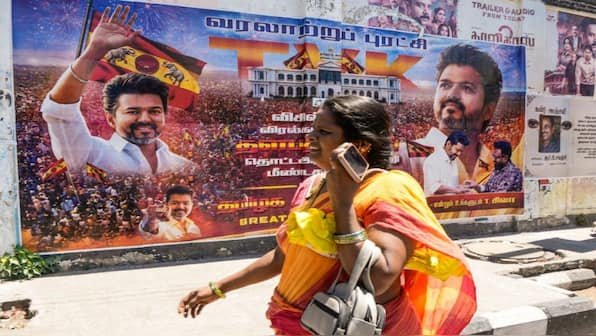
It’s been four days since the BJP and the newly-formed Tamilaga Vetri Kazagham (TVK) did the near-impossible in West Bengal and Tamil Nadu, respectively. The BJP secured a thumping majority in the eastern state, trouncing Mamata Banerjee and the TMC, while the Vijay-led party emerged as the single-largest in the state, breaking the years-long dominance of the AIADMK and the DMK.
However, despite these two victories, the states are witnessing political uncertainty, causing many to ask — what’s going on and what happens when a state has no functioning chief minister or government?
Why has Vijay not become the CM yet in Tamil Nadu?
On May 4,
‘Thalapathy’ Vijay emerged as the hero when his party scored a major win, securing 108 seats. The DMK came in a distant second with 59 seats, whereas the AIADMK managed to wrangle 47 seats.
While Vijay’s TVK emerged as the single-largest party, it didn’t secure the majority mark — 118 in the 234-member Assembly. This led to Vijay and the other political players to scramble for the numbers. Gaining the support of five Congress MLAs and the number boosting to 112 (even though TVK won 108 seats, their final tally is 107 as Vijay won from two seats and will have to give up one), Vijay even approached
Governor Rajendra Vishwanath Arlekar to stake a claim to form the government.
However, the governor rejected Vijay on two occasions and asked him to return with the magic number of 118.
The TVK now has to wrangle six more MLAs to get the required number. Reports state that the TVK is already holding negotiations with Left parties like the CPI and CPM, VCK, IUML, and independents. PMK is also a potential target for joining the government. This could eventually push TVK past the magic number of 118.
There’s also the possibility that up to 35 MLAs of the AIADMK are willing to partner with the TVK, but it is party chief E Palaniswami who is reluctant.
Meanwhile, rumours are spreading that if Vijay is unable to gather the numbers, the AIADMK and the DMK will join hands, along with the help of smaller regional players. If such a situation arises, the TVK has warned that each and every MLA of the party will resign.
As a result, Tamil Nadu currently remains without a sworn-in chief minister or new Cabinet.
What’s going on in West Bengal?
In West Bengal, the situation is different. The
BJP with 207 seats has crossed acquired the majority mark in the 293-member Assembly. However, outgoing
Chief Minister Mamata Banerjee has refused to resign, claiming the BJP’s win was the result of the looting of votes and EVM tampering. She claimed the Election Commission colluded with the saffron side to dethrone her side and that the latter won “immorally”.
“If I had lost, I would have resigned. If anyone thinks I will step down under pressure, that is not going to happen. We did not lose the election. Morally, we won,” Mamata said at a press conference on May 5.
Now, as per Article 164, the chief minister and the Council of Ministers hold office “ during the pleasure of the governor”.
This led to an unprecedented situation, resulting in chaos with the state staring at an uncertain political future.
However, on Thursday, West Bengal Governor RN Ravi put an end to the drama when he dissolved the State Legislative Assembly with effect from May 7. In a single-line communique, the governor announced: “In exercise of the power conferred on me by sub-clause (b) of Clause (2) of Article 174 of the Constitution of India, I hereby dissolve the Legislative Assembly of West Bengal with effect from 07th of May 2026.”
With this one move, Mamata’s tenure as CM ends. As Swapnil Tripathi, lead at Charkha, the Constitutional Law Centre, told NDTV that the Constitution is clear on this. “Once the Assembly has been dissolved under Article 174(2)(b), its tenure comes to an end, and with it, the institutional basis of the Council of Ministers. In such a situation, the outgoing chief minister may, at best, continue in a caretaker capacity-ideally at the governor’s request — until a new government is sworn in.”
Can a state function without a CM?
As per law, the state can’t function without a chief minister for an extended period of time. Under the Constitution, the Governor acts as the constitutional head of the state, but real executive power is exercised through the Council of Ministers headed by the chief minister.
Article 163 of the Constitution states, “There shall be a Council of ministers with the chief minister at the head to aid and advise the Governor in the exercise of his functions, except in so far as he is by or under this Constitution required to exercise his functions or any of them in his discretion.”
In such a situation when there’s no CM, there are two options; keep the outgoing CM in the role as a caretaker or impose President’s Rule. A caretaker government can remain in place for a maximum of six months, during which fresh elections have to be called. However, it’s important to note that a caretaker government can only manage day-to-day affairs and cannot make any new policy decisions or make appointments.
If constitutional machinery in a state is deemed to have failed, the Governor can send a report to the President under Article 356 recommending President’s Rule. This effectively transfers all executive functions of the State to the Centre and legislative functions to Parliament.
Once approved, it remains effective for six months from the proclamation date, with further six-month extensions requiring additional Parliamentary approval. Renewal beyond one year is allowed only if two conditions are met: an Emergency has been declared in the country or any part of the State, and if the Election Commission certifies that President’s rule is necessary due to difficulties in conducting state elections. However, in no case can the proclamation remain effective for more than three years, and the President may revoke or vary it at any time by a subsequent proclamation.
With inputs from agencies
First Published:
May 08, 2026, 11:49 IST
End of Article