

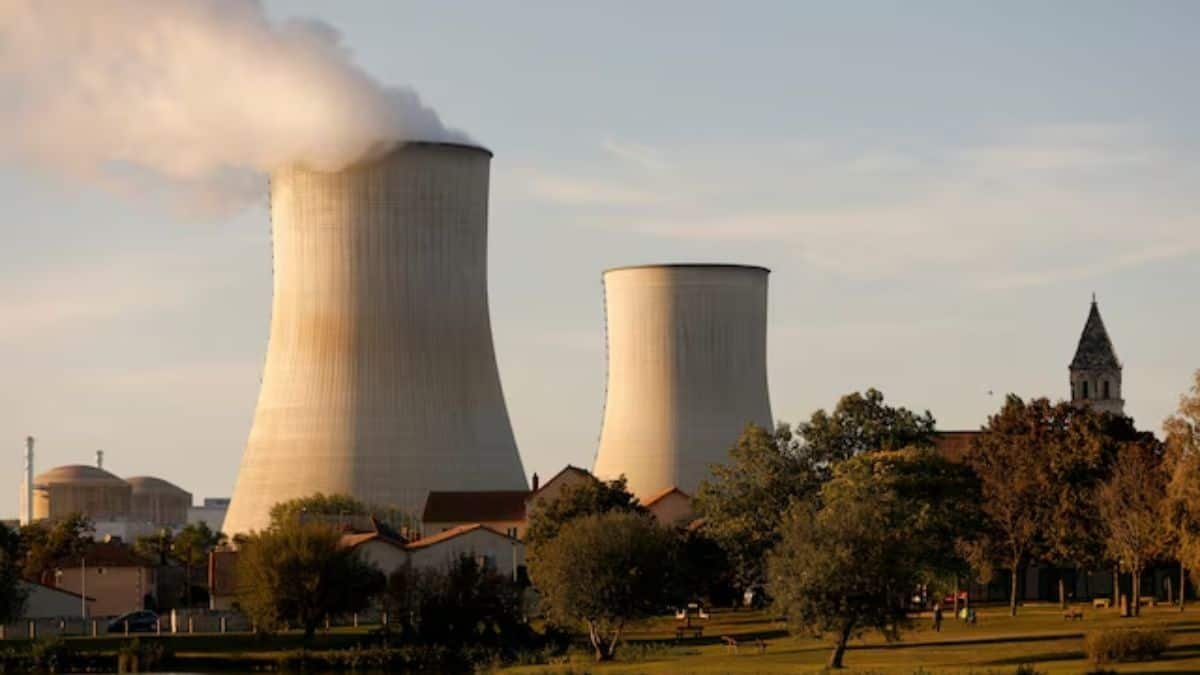
Currently, India mandates a minimum exclusion zone of around 1 kilometre around nuclear reactors, where no residential or commercial activity is allowed to minimise radiation risks.
India is considering reducing the size of exclusion zones around nuclear power plants to free up land for reactor expansion, according to three officials familiar with the matter. The move is aimed at attracting greater private and foreign investment into the nuclear energy sector, though it is likely to face criticism over safety concerns, Reuters reported.
At present, India requires a minimum exclusion zone of around 1 kilometre around nuclear reactors, where no residential or commercial activity is allowed. The rule is intended to minimise radiation risks.
Officials said the Department of Atomic Energy and the Atomic Energy Regulatory Board have given “in-principle” approval for reducing these buffer zones. The revised norms are expected to be included in detailed rules likely to be released in the coming months, following the government’s decision last year to open the nuclear power sector to private and foreign players.
India aims to increase its nuclear power capacity from around 8 gigawatts currently to 100 gigawatts by 2047 as part of its long-term clean energy strategy.
Land requirement may reduce sharply
According to an internal presentation reviewed by Reuters, the proposed changes could cut land requirements for large nuclear reactors by nearly half and by around two-thirds for smaller reactors. This could potentially allow two to three times more generation capacity at existing sites.
The presentation noted that a 10-reactor nuclear complex with a capacity of 700 megawatts each could be built on less than 700 hectares of land. Existing nuclear facilities in India typically occupy nearly 1,000 hectares.
Officials also said small modular reactors could be installed inside industrial zones for captive use. Smaller exclusion zones would also make it easier for existing nuclear plants to add more reactors by using shared infrastructure.
The proposal has not been publicly disclosed so far and was not part of the legislation passed by Parliament to open the sector to wider private participation.
The Department of Atomic Energy, the Atomic Energy Regulatory Board and the Prime Minister’s Office did not respond to Reuters’ queries on the issue.
Government cites safer reactor technology
Officials said the proposed changes are being driven by advances in safer reactor technologies and are broadly aligned with practices followed in countries such as the US and France, where fixed exclusion distances are not mandatory.
India’s nuclear projects have often faced delays due to strict siting rules, distance requirements from populated areas and lengthy land acquisition processes that can stretch beyond four to five years.
Reducing exclusion zones could help accelerate approvals and make expansion projects commercially more viable.
Safety concerns likely to trigger opposition
The proposed move, however, is expected to face resistance in a country where nuclear projects have historically witnessed public protests despite India not recording any major nuclear accident.
Critics argue that exclusion zones offer visible assurance to people living near nuclear facilities regarding radiation safety.
Opposition lawmakers had earlier raised concerns during parliamentary debates on opening the nuclear sector, arguing that the reforms prioritised private investment over public safety. They also warned that easing reactor siting rules and expanding private participation without stronger independent oversight could weaken safety safeguards.
Despite these concerns, Parliament approved the legislation.
Experts call for greater transparency
R. Srikanth, engineering dean at the National Institute of Advanced Studies, as cited by Reuters emphaised discussions on reducing exclusion zones had been ongoing for nearly 18 months.
He noted that radiation levels around existing Indian nuclear plants remain significantly lower than natural background radiation levels found in some coastal parts of Kerala and Tamil Nadu.
“Unfortunately, positive developments in India’s civilian nuclear power sector have not reached the public effectively,” he said, adding that there is a need for greater transparency and public awareness around nuclear energy projects.
First Published:
May 11, 2026, 19:35 IST
End of Article