

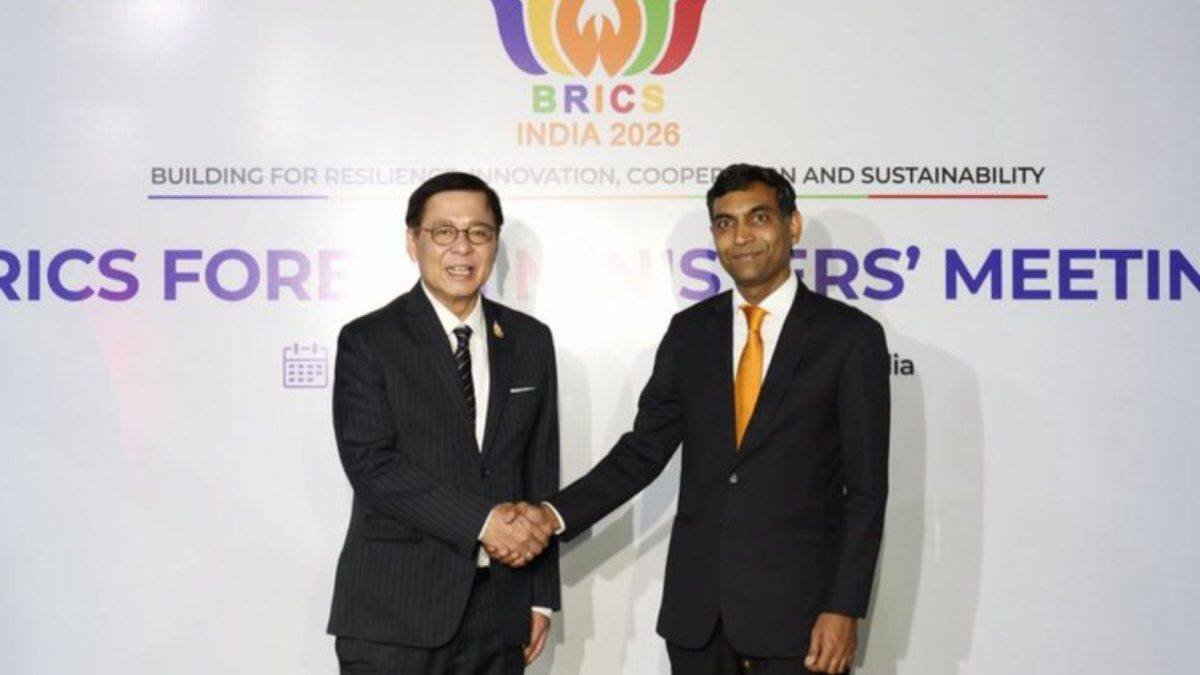
In an exclusive interview with CNN-News18, Thailand’s Foreign Minister Sihasak Phuangketkeow lays out Bangkok’s push for stronger Global South cooperation, deeper India ties, a more assertive Asean, and urgent global de-escalation, from Brics to West Asia
Thailand’s Deputy Prime Minister and Foreign Minister Sihasak Phuangketkeow, in an exclusive interaction with CNN-News18, spoke about Thailand’s support for multilateralism, stronger Global South cooperation, and regional stability across Asia and beyond.
Speaking on Brics, Sihasak said Thailand aligns with the grouping’s core ideas.
“We believe in what Brics stands for,” he said, adding that “we see the rise of the Global South.”
He noted that the world today is increasingly fragmented and uncertain, stressing the need to “reinforce multilateralism where the voice of the Global South is heard.”
“There is tremendous potential for cooperation in many, many fields. Brics countries can cooperate,” he added.
Follow our live coverage of Brics Foreign Ministers’ Meeting here.
India–Thailand relations
Highlighting the growing strength of India–Thailand ties, the Thai Foreign Minister said the relationship is expanding across sectors.
“The dynamism of our relationship is manifested in many ways. Trade is growing,” he said, adding that Thailand is “welcoming more and more tourists from India,” with over two million Indian visitors travelling to Thailand.
He said both countries are key drivers of Bimstec and share a common vision for the Indo-Pacific.
“We want to see an Indo-Pacific that is open, rules-based and inclusive,” he said, adding that there is “potential for closer bilateral and regional partnerships.”
Asean centrality and Indo-Pacific
On Asean’s role, Sihasak described the bloc as a stabilising force in the region.
“Asean is known as one of the pillars of peace and stability in the Indo-Pacific,” he said, pointing to platforms such as the Asean Regional Forum, East Asia Summit, and other defence and security cooperation mechanisms.
“Our approach is supported by promoting dialogue and cooperation,” he noted, adding that the region must remain “open and inclusive.”
He also said constructive engagement among major powers is essential to maintaining balance in the region.
“We really have to assert Asean centrality even more,” he said.
India–Thailand–Myanmar trilateral cooperation
Speaking on the India–Thailand–Myanmar trilateral project, Sihasak said he was involved in its early stages and stressed its long-term importance.
“It has tremendous significance. We have talked about it for a long time,” he said, noting that while progress has been made, more work is needed.
He acknowledged delays due to the situation in Myanmar and said the three countries should work together to restore peace and stability.
“What India, Thailand and Myanmar can do together is help bring peace and stability back to Myanmar,” he said.
West Asia conflict
On the West Asia situation, Sihasak said the conflict has global consequences.
“It has tremendous impact beyond peace and stability in the region. We have all felt the impact,” he said, warning against challenges to the rules-based international order.
He said Asean has already held emergency discussions on the crisis.
Calling for de-escalation, he said, “It’s time to bring the conflict to an end.”
“The world should have never started,” he added, urging all stakeholders to rise above divisions and work towards peace and stability.
First Published:
May 14, 2026, 13:36 IST
End of Article