

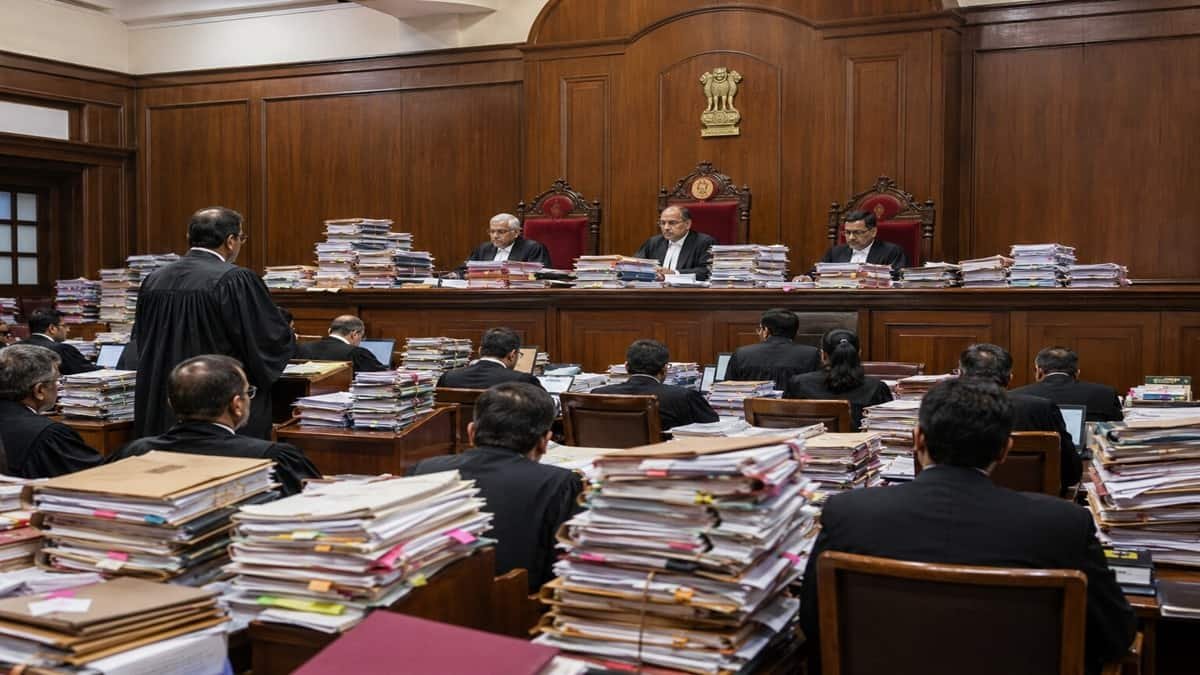
President Droupadi Murmu on Sunday promulgated an ordinance increasing the sanctioned strength of judges in the Supreme Court from 34 to 38, including the Chief Justice of India, in a major move aimed at reducing the mounting pendency of cases in the apex court.
The Supreme Court (Number of Judges) Amendment Ordinance, 2026 comes at a time when the top court is facing a backlog of more than 92,000 cases. The ordinance was issued days after the Centre approved a proposal to amend the Supreme Court (Number of Judges) Act, 1956.
Reacting to the move, Supreme Court advocate Dr Kapil Sankhla said the increase in the number of judges was a welcome step, but warned that “numbers alone will not resolve a crisis that is, at its root, structural and behavioural”.
“Approximately 95,000 cases currently crowd the Supreme Court’s docket, hovering near all-time highs,” Dr Sankhla told Firstpost.
He said that, unfortunately, because every matter can travel to the Supreme Court, the apex court is unable to fully focus on laying down and interpreting the law and delivering complete justice. “It is still utilising precious time in handling petty factual arguments and matters,” he said.
Supreme Court advocate Sharda Prasad also welcomed the move, saying it would help reduce the backlog of cases. However, he stressed that increasing the number of judges alone would not solve the larger problem of judicial delays.
Prasad said the Supreme Court should avoid hearing matters that fall exclusively within the executive domain. He also criticised the misuse of Public Interest Litigations (PILs), saying many such petitions are filed by “busybees and publicity seekers”, resulting in valuable court time being wasted.
According to him, PILs should be discouraged and the test of locus standi should be applied strictly. He further said that wherever remedies are available before High Courts, the Supreme Court registry should direct petitioners back to the High Courts instead of entertaining such pleas directly.
Pendency continues to rise
The strength of judges in the Supreme Court was last increased in 2019, when the sanctioned number rose from 31 to 34. At that time, around 60,000 cases were pending before the court.
Before that, the court’s strength was increased from 26 to 31 in 2009, and from 18 to 26 in 1988. The original 1956 Act had provided for a maximum of 11 judges, including the Chief Justice of India. The strength has been revised several times over the decades to tackle delays and ensure faster delivery of justice.
Despite these increases, pendency has continued to rise sharply. Apart from the Supreme Court, around 63.3 lakh cases are pending in High Courts, while nearly 4.6 crore cases remain pending in district and subordinate courts across the country.
According to the India Justice Report 2025, the judiciary currently has more than 5,600 vacancies at different levels. High Courts alone are facing a vacancy rate of around 33 per cent.
India’s judge-to-population ratio also remains low, with around 15 judges per 10 lakh people, far below the 50 judges per 10 lakh population recommended by the Law Commission.
‘SC was never designed as third appeal court’
Dr Sankhla said the crisis was not limited to the number of judges and argued that the Supreme Court must return to its constitutional role.
“The Trial Court decides facts and law. The High Court corrects errors of law. The Supreme Court was never designed as a third tier of appeal,” he said.
“It was designed, as Dr BR Ambedkar envisioned, as the sentinel of the Constitution,” he added.
He said constitutional jurisprudence suffers when the apex court spends most of its time hearing routine service disputes and private property matters.
Government biggest litigant
Dr Sankhla also highlighted the role of the government in increasing judicial burden. According to him, government bodies are involved in nearly 70 to 75 per cent of all cases before the Supreme Court.
“Departments appeal matters, they know they will lose because no officer wishes to take responsibility for closure. It is institutional cowardice at the citizen’s expense,” he said.
He stressed the need for accountability among officials authorising frivolous litigation.
Need for broader judicial reforms
Dr Sankhla also pointed to deeper systemic issues, including delays in investigation and prosecution.
“Pendency originates at the police station,” he said, adding that false cases, deficient chargesheets and deliberate delays burden trial courts before eventually reaching higher courts.
He also called for wider use of virtual hearings, especially for routine admissions, adjournments and procedural matters, saying the pandemic had shown that online hearings could work effectively.
Dr Sankhla further stressed the need for performance monitoring of trial court judges and filling vacancies in district courts, saying delays at the lower judiciary level ultimately push litigants towards higher courts, including the Supreme Court.
First Published:
May 17, 2026, 14:07 IST
End of Article