

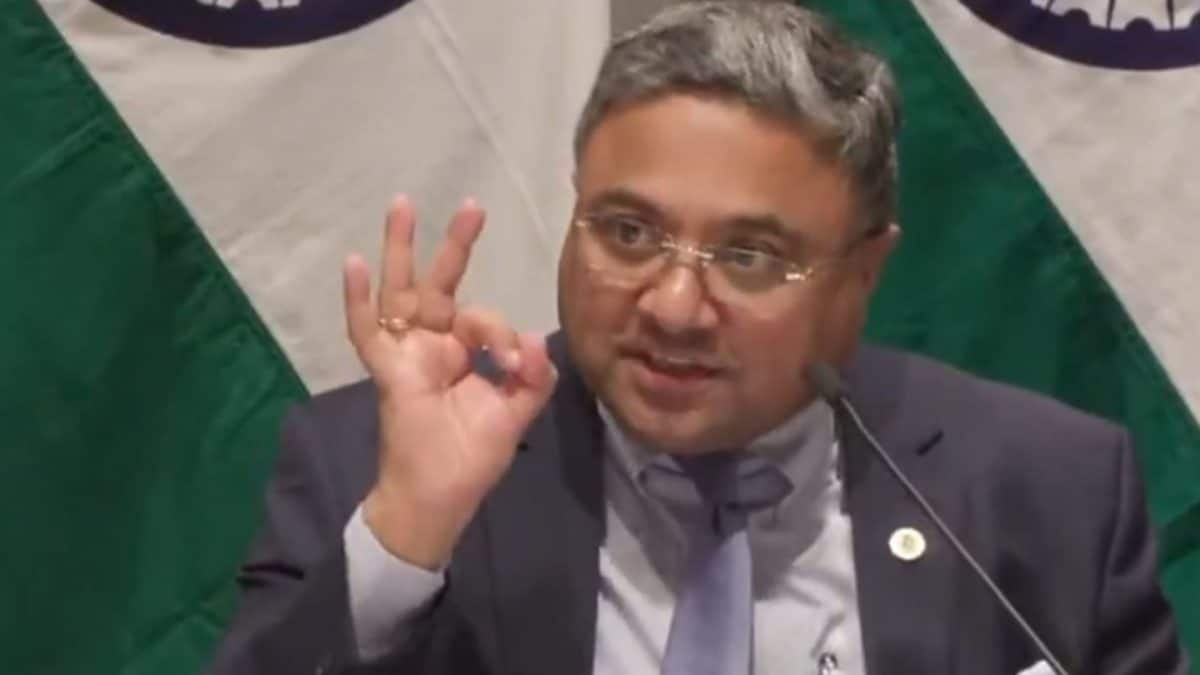
A tense press briefing in Oslo turned combative as MEA Secretary Sibi George sharply pushed back against Nordic journalists questioning India’s democratic record, dismissing criticism based on what he called “ignorant NGO reports”
A routine diplomatic briefing in Oslo escalated into a fiery ideological debate on Monday as Ministry of External Affairs (MEA) Secretary (West) Sibi George fiercely defended India’s democratic credentials against sharp questioning from Nordic journalists.
The confrontation occurred during Prime Minister Narendra Modi’s high-profile five-nation European tour.
‘Why should we trust you?’
The atmosphere inside the Oslo press room tightened when local reporters pushed the Indian delegation on issues of civil liberties and unscripted press access.
“Prime Minister Modi, why don’t you take some questions from the freest press in the world?” shouted Helle Lyng, a journalist from the Oslo-based newspaper Dagsavisen, as the Prime Minister left the stage following a joint appearance with Norwegian Prime Minister Jonas Gahr Store.
When reporters subsequently demanded answers from the MEA delegation on why foreign nations should trust New Delhi’s commitment to democratic values, Secretary Sibi George intervened to shut down the line of questioning.
“Let me answer the question, please don’t interrupt me,” George stated, cuting through the cross-talk. “You asked a question—this is my press conference. You asked why a country should trust India. Let me answer that.”
#WATCH | Oslo, Norway | MEA Secretary (West) Sibi George responds to question by reporters from Norway – “Why should we trust you?” ” Will the PM take critical questions from the Indian Press?” pic.twitter.com/iaEGIlVG08
— ANI (@ANI) May 18, 2026
Dismantling ‘godforsaken, ignorant NGO’ narratives
Refusing to play defence, George launched a counter-offensive against what he called a fundamental lack of understanding among Western commentators who rely on external indices.
“People have no understanding of the scale of India. People have no understanding,” George said. “They read, you know, one or two news reports published by some godforsaken, ignorant NGOs and then come and ask questions.”
The veteran diplomat pointed to the unparalleled scale and noise of India’s domestic media ecosystem to counter allegations of a suppressed press.
“You know how many stories are up here? We have how many breaking news coming every day in the evening? At least 200 TV channels in Delhi alone, in English language, in Hindi language, and multiple languages,” he said.
The constitutional defence
To answer the core question of international trust, George pivoted entirely away from Western metrics, steering the room back to India’s post-independence history and legal framework. He said that India’s democratic legitimacy is rooted in its Constitution, which inherently guarantees fundamental rights and robust judicial remedies.
“We have a Constitution which guarantees the rights of the people… We have equal rights for the women of our country, which is very important,” George argued, noting that India enacted universal suffrage immediately in 1947. “Many countries I know, the voting right for women came several decades after India gave that freedom. Because we believe in equality, we believe in human rights. And what is the best example of human rights? The right to change a government,” he noted.
The sharp exchange in Oslo follows an almost identical clash just 24 hours prior in The Hague. There, Dutch journalists from De Volkskrant and NRC
pressed George on critical civil liberty remarks made by Netherlands Prime Minister Rob Jetten.
In both cases, the MEA stuck to the same response, rejecting foreign criticism and pointing to India’s huge voter turnout and growing minority population as proof of a strong pluralistic society.
The green push
India and Norway officially elevated their bilateral ties to a Green Strategic Partnership. This framework shifts collaboration toward sustainable development, leveraging India’s vast market scale and workforce alongside Norway’s capital and advanced technologies.
The enhanced strategic alliance targets several critical sectors:
Climate action & energy: Accelerated focus on green hydrogen, offshore wind energy, and carbon capture.
Blue economy: Scaling up green shipping corridors, sustainable fisheries, and eco-friendly port infrastructure.
Supply chains: Securing resilient networks for critical minerals and tech components.
First Published:
May 19, 2026, 06:23 IST
End of Article