

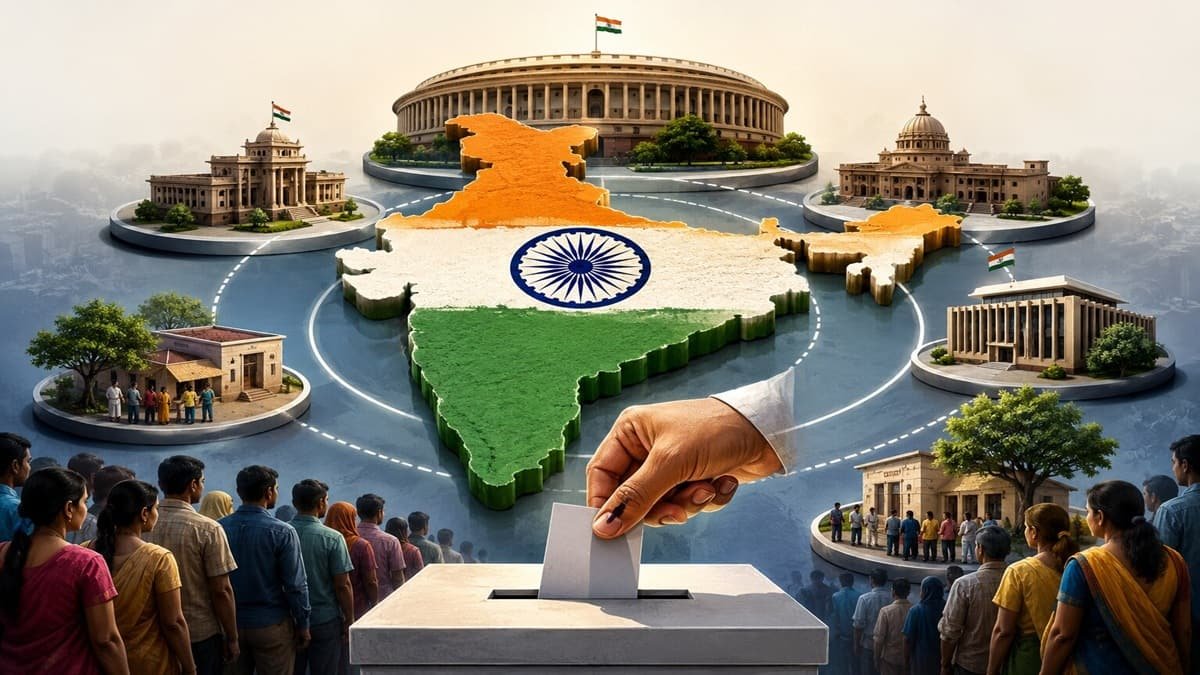
The JPC examining the proposal of ‘One Nation, One Election’ has said that holding simultaneous Lok Sabha and Assembly elections could save nearly ₹7 lakh crore and increase India’s GDP growth by up to 1.6 per cent.
The Joint Parliamentary Committee (JPC) examining the proposal of ‘One Nation, One Election’ has said that holding simultaneous Lok Sabha, Assembly and local body elections could save nearly ₹7 lakh crore and increase India’s GDP growth by up to 1.6 per cent.
The committee said that the reform would reduce the burden of frequent elections and allow governments to focus more on governance and development.
JPC Chairperson and Lok Sabha MP PP Chaudhary made the remarks during a press conference in Gandhinagar on Tuesday. He said that the proposed reform would improve administrative efficiency and help direct more public resources towards sectors such as healthcare, education, poverty alleviation and infrastructure development.
Chaudhary said that Prime Minister Narendra Modi had earlier constituted an eight-member committee under former President Ram Nath Kovind to study the feasibility of simultaneous elections. According to him, the committee spent around 186 days preparing its report before the matter was referred to the JPC.
Proposal for synchronised elections
The committee has proposed to synchronise the elections to the Lok Sabha and state legislative assemblies, followed by Panchayat and municipal polls within 100 days. The proposal is being examined under the Constitution (129th Amendment) Bill, 2024 and the Union Territories Laws (Amendment) Bill, 2024.
The JPC is currently on a three-day visit to Gujarat and held discussions with senior state officials, including Chief Secretary MK Das and Director General of Police Dr KLN Rao at the Gift City Club in Gandhinagar.
The parliamentary panel consists of 39 members, including 27 MPs from the Lok Sabha and 12 from the Rajya Sabha, apart from the Chairperson.
Constitutional and political backing
Chaudhary said that six former Chief Justices of India had informed the committee that simultaneous elections would not violate the Constitution’s federal structure, basic structure doctrine or fundamental rights. He added that institutions such as Niti Aayog and the Law Commission of India had also supported the concept.
“This reform would minimise the cycle of continuous elections and allow governments to dedicate more time and resources to governance and national progress,” Chaudhary said.
The committee has already visited Maharashtra, Uttarakhand, Himachal Pradesh, Haryana, Punjab and Karnataka before arriving in Gujarat. Chaudhary said that the panel’s aim was to gather views from all stakeholders and build broad political consensus before submitting its recommendations to Parliament.
First Published:
May 20, 2026, 18:32 IST
End of Article