

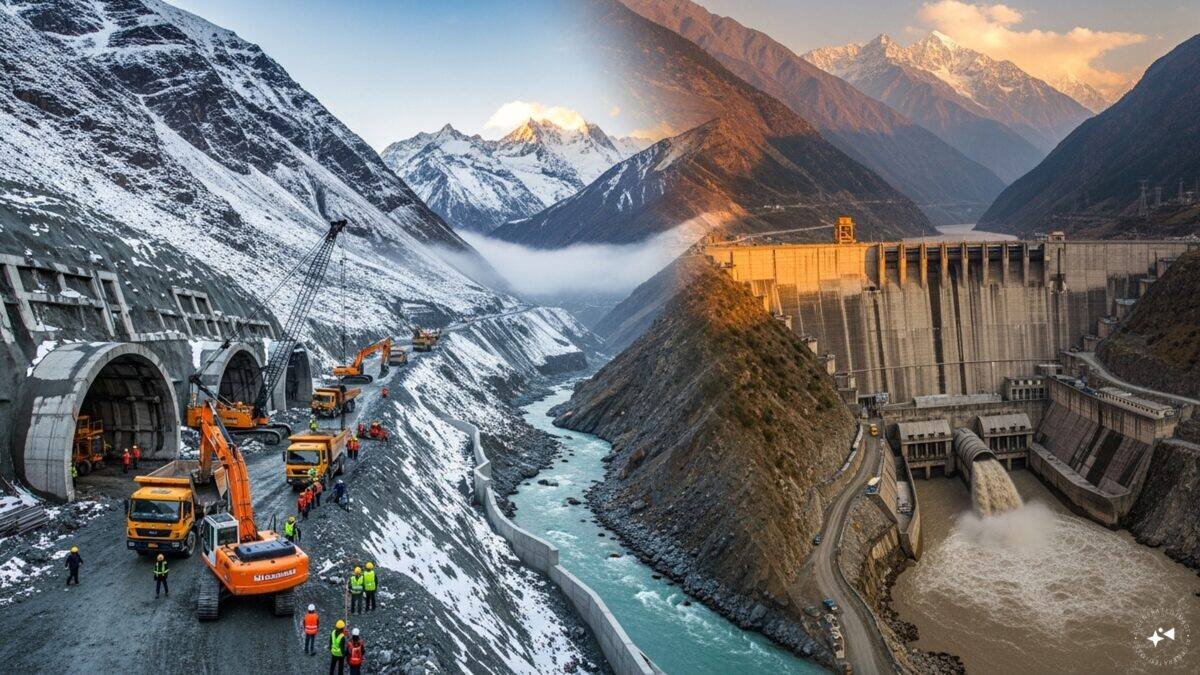
In what is being seen as a strategic shift in water and energy policy, India has reportedly fast-tracked key hydropower projects on the Chenab River worth nearly Rs 2,600 crore following its decision to freeze the Indus Waters Treaty with Pakistan.
India has launched two major Chenab-linked projects worth nearly Rs 2,600 crore weeks after putting the Indus Waters Treaty (IWT) framework with Pakistan in abeyance, with the Centre also moving to speed up work on several other projects in the region, according to a report by News18.
The projects will be executed by the National Hydroelectric Power Corporation (NHPC) as part of a wider push to increase India’s utilisation of waters governed under the 1960 treaty framework.
The larger of the two ventures is the Rs 2,352 crore Chenab–Beas Link Tunnel Project in Himachal Pradesh’s Lahaul-Spiti region. The proposal involves constructing an 8.7-km tunnel to divert surplus water from the Chenab basin into the Beas river system, it said.
Project documents accessed by CNN-News18 show the tunnel forms part of a wider inter-basin river-linking initiative aimed at transferring water from the Chandra river, a tributary of the Chenab toward the Beas basin through hydraulic structures and tunnels. A 19-metre-high barrage is also proposed across the river in the Lahaul valley as part of Phase-I construction.
The second project, Dulhasti Stage-II in Jammu and Kashmir’s Kishtwar district, is expected to increase hydropower generation capacity in the Chenab basin.
The diversion point is located near Koskar village in the strategically important Himalayan belt, upstream of the north portal of the Atal Tunnel at Rohtang. The region has seen rapid infrastructure expansion in recent years, including roads, tunnels and hydropower projects along the northern frontier.
The developments come after India suspended engagement under the 1960 Indus Waters Treaty following the Pahalgam terror attack earlier this year. The treaty, brokered by the World Bank, governs water-sharing arrangements between India and Pakistan over the Indus river system.
Under the agreement, Pakistan received rights over the western rivers Indus, Jhelum and Chenab while India retained limited rights to use these rivers for irrigation and run-of-the-river hydropower projects. Over the years, several Indian hydropower projects on the Chenab have faced objections from Pakistan over concerns related to water flow and storage capacity.
Chenab projects gain strategic significance
The Centre has tightened deadlines for multiple hydropower projects in Jammu and Kashmir, including Kiru, Kwar, Ratle and Pakal Dul, all located in the Chenab basin, it said.
The 1,856-MW Sawalkote project in Ramban district is among the biggest hydropower ventures planned in Jammu and Kashmir.
Pakistan has repeatedly objected to Indian projects on the Chenab River, arguing that the infrastructure could impact downstream water availability. India has maintained that the projects fall within the provisions earlier allowed under the treaty and are designed mainly as run-of-the-river facilities without major storage structures.
Energy security and geopolitical messaging
Beyond bilateral tensions, the Chenab push also reflects India’s broader energy and infrastructure priorities. Jammu and Kashmir possesses enormous untapped hydropower potential, much of which has remained delayed for decades due to environmental clearances, financial hurdles and treaty-related objections.
The fast-tracked projects are expected to strengthen energy generation, reduce dependence on fossil fuels and improve electricity supply in northern India. The Sawalkote project alone is projected to become one of the largest hydroelectric ventures in the region.
At the same time, the developments have intensified concerns in Pakistan, where officials fear that India’s suspension of treaty mechanisms could alter long-standing water-sharing dynamics. Islamabad has warned that unilateral moves affecting river flows could escalate regional tensions further.
While India insists the projects remain within its sovereign rights and developmental priorities, the rapid acceleration of Chenab infrastructure indicates that water, energy and strategic policy are becoming increasingly intertwined in South Asia’s evolving geopolitical framework.
First Published:
May 21, 2026, 20:08 IST
End of Article