

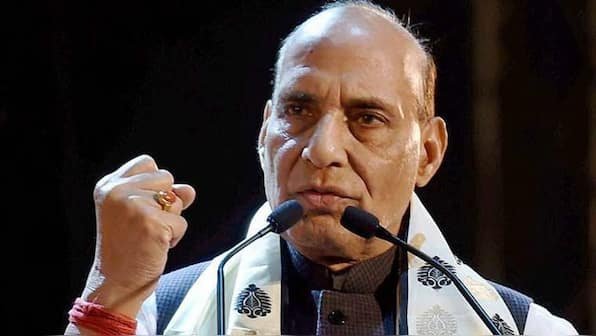
Singh told Network18 that New Delhi ceased its strikes and announced a ceasefire at the request of Pakistan’s Director General of Military Operations (DGMO)
Union Defence Minister Rajnath Singh on Friday said that Pakistani citizens were not killed during Operation Sindoor in April. Operation Sindoor, launched in response to the Pahalgam attack, targeted and destroyed several terrorist hideouts in Pakistan.
“We did not target Pakistani civilians; our strikes were directed at terrorist bases,” Singh toldNetwork18’sEditor-in-Chief Rahul Joshi in an exclusive interview.
Talking further about the Indian Army’s operation, Singh said that New Delhi ceased its strikes and announced a ceasefire at the request of Pakistan’s Director General of Military Operations (DGMO).
US President Donald Trump has time and again claimed that his intervention stopped the conflict between India and Pakistan, a statement that has been categorically denied by New Delhi.“Operation Sindoor was not paused due to any external pressure or request,” Singh toldNetwork18.
Defence Minister Rajnath Singh (@rajnathsingh) talks about #OperationSindoor, opposition’s ‘vote chori’ allegations, Bihar elections, and more in an #exclusive conversation with @18RahulJoshi
Watch it tonight at 8pm, across CNN-News18 platforms #RajnathSinghToNews18 pic.twitter.com/zrnouc6UQw
— News18 (@CNNnews18) November 7, 2025
200&&loadTaboolaIframe()})]]>
The defence minister added that the operation against Pakistan’s state-sponsored terrorism has not ended yet, and that “if needed, we’ll act again.”
#RajnathSinghToNews18 | Defence Minister @rajnathsingh opens up on #OperationSindoor, India’s nuclear strategy, and the nation’s evolving defence vision in an exclusive conversation with @18RahulJoshi
‘Pakistan begged to ceasefire. Op Sindoor is paused not finished..’ pic.twitter.com/QRYRanl9Mn— News18 (@CNNnews18) November 7, 2025
Prime Minister Narendra Modi, similarly, said earlier this year that Pakistan “begged” for a truce after Operation Sindoor.
“We penetrated hundreds of miles into Pakistan and destroyed the hideouts of terrorists. Due to the bravery of our army, Pakistan had to plead and beg for a ceasefire. The one who was begging during Operation Sindoor must not forget – it is not over yet,” PM Modi said.
Old “legacy” air defence systems, such as the L-70 anti-aircraft guns, ZU-23mm twin-barrel guns, and upgraded Schilka units, which are often overlooked in today’s high-tech military landscape, demonstrated their effectiveness in the recent conflict.
Meanwhile, the indigenous Akash air defence missile systems, with an interception range of 25 km, played a crucial role in countering larger threats like aircraft, armed UAVs, and Turkish-made Byker Yiha III kamikaze drones. Their reliable performance added a significant layer of defence against these sophisticated airborne adversaries.
End of Article