

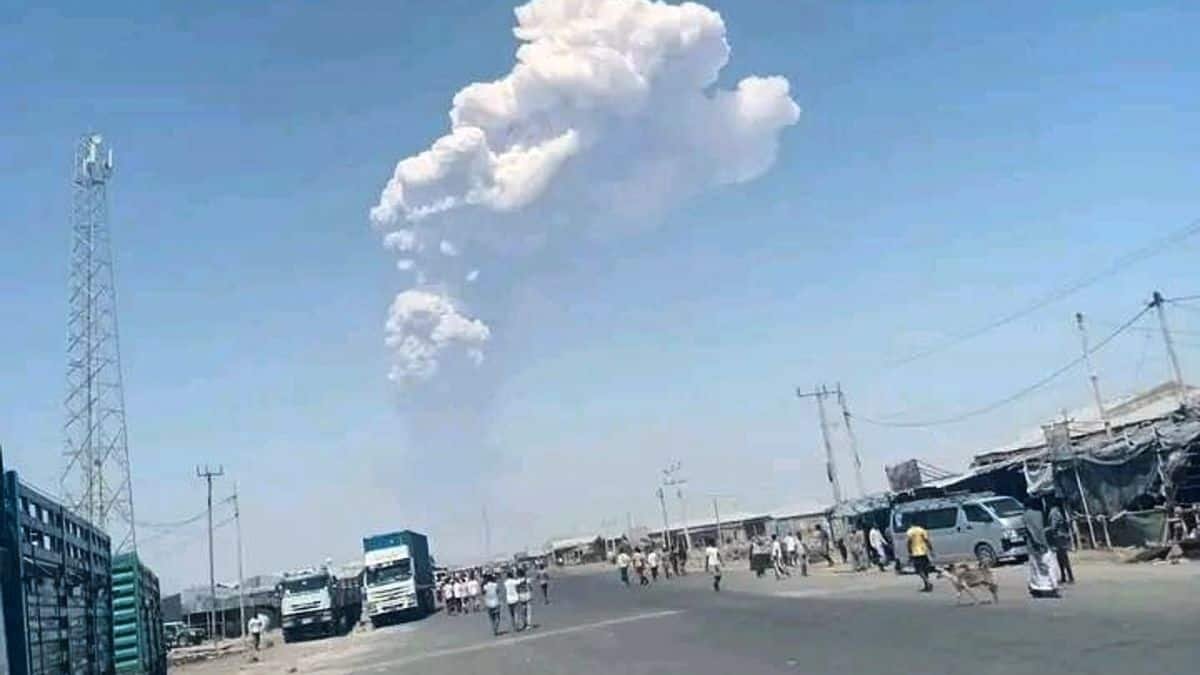
The unusual atmospheric event comes after the volcano—dormant for thousands of years—erupted with explosive force, sending a towering plume of ash and gases high into the upper atmosphere
Ash clouds from the massive eruption of the Hayli Gubbi Volcano in Ethiopia have now drifted as far as
Delhi, with environmental experts confirming visible traces of volcanic fallout over several parts of India.
The unusual atmospheric event comes after the volcano—dormant for thousands of years—erupted with explosive force, sending a towering plume of ash and gases high into the upper atmosphere.
❗️🌋🇪🇹 – Ethiopia’s Hayli Gubbi Volcano Awakens After 10,000 Years
In a stunning geological event, Ethiopia’s Hayli Gubbi volcano—long dormant in the remote Danakil Depression of the Afar Rift—erupted explosively for the first time in recorded history on November 23, 2025.
The… pic.twitter.com/bZby4sAuOC
— 🔥🗞The Informant (@theinformant_x) November 24, 2025
According to environmentalist Vimlendu Jha, the drifting ash has already been sighted across western and northern states. “The eruption of Ethopia’s volcano is enormous, and if you see it in the last 24 hours, whether we talk about Gujarat, Rajasthan or even in the last 12 hours, we can even see the ashes floating around Delhi,” he told ANI, noting that satellite imagery and ground observations both confirm the plume’s long-distance movement.
Delhi residents unlikely to feel any change in air quality
The arrival of ash clouds over India has triggered public concern, particularly in the capital, where persistent winter smog and rising pollution levels have already strained air quality.
But Jha stressed that residents in Delhi are unlikely to face an immediate deterioration of air conditions due to the volcanic debris. “The overall impact of the eruption will be in the form of ash clouds and will not immediately affect the AQI in Delhi. The clouds are made of sulphur dioxide (SO2) and glass particles. Though it will not immediately affect the AQI, we need to monitor it, as the clouds are in the very upper atmosphere,” he explained.
Atmospheric scientists say the volcanic plume has risen to altitudes where winds can transport particles across continents without allowing them to mix quickly with air near the surface.
Such high-level ash often travels thousands of kilometres before gradually descending, a process that can take days or even weeks depending on weather conditions.
Jha cautioned, however, that other regions could see effects sooner than Delhi. “The impact of these clouds might be seen in the Himalayas, the Tarai region (a lowland region of flat, alluvial soil that forms a belt along the Nepal-India border) and even parts of China,” he said, adding that elevated terrains and valleys often register early signs of atmospheric dust and ash deposition.
Authorities in India are now closely tracking the plume’s trajectory, coordinating with global atmospheric monitoring networks to assess whether the ash could influence regional weather patterns or contribute to long-term pollutant loads.
End of Article