

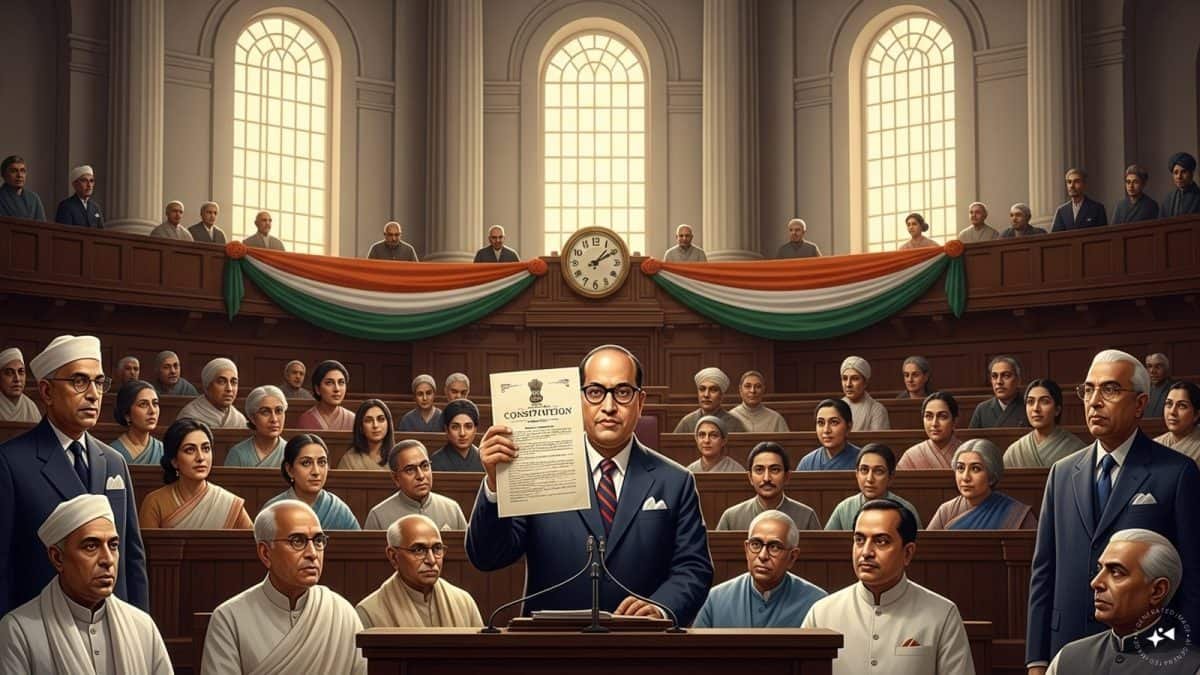
Imagining the Constitution awakening on Republic Day 2026, this reflective piece explores how its core ideals equality, free speech, privacy and civic duty engage with a rapidly changing India, balancing global recognition, technological progress, and democratic aspirations with the ongoing task of justice at home.
What would the Preamble say if it unfolded before India today — not as a document adopted in November 1949, but as a living framework of 2026? On Republic Day 2026, such a voice would not merely celebrate ideals. It would engage with a nation in motion — one navigating the space between inheritance and innovation, where technology, demographic energy and democratic debate are reshaping everyday life.
The Constitution was designed not as a static document, but as an evolving compact between citizens and the state. Its framers understood that India’s diversity, inequalities and ambitions would require institutions capable of adaptation. Today, that conversation continues — between past intent and present realities — around accountability in governance, freedom balanced with responsibility, unity that accommodates difference, and rights that gain meaning through participation.
Dr BR Ambedkar’s vision of constitutional morality — the idea that democracy depends not only on laws but on civic conduct — remains central. Prime Minister Narendra Modi continues to emphasise the significance of following Ambedkar’s vision of constitutional morality. The Preamble embodies that vision, based on dignity and equality, seeking to correct structural injustices and widen access to opportunity.
All successive governments since the Constitution was adopted on this day in 1950, have reposed faith in the Republic’s ability to resolve differences through dialogue and to situate India within a cooperative global order. The ideas enshrined in the Preamble to the Constitution still shape how India approaches social reform, institutional debate and international engagement.
Expanding opportunity in a technological age
One of the most visible transformations lies in the expansion of opportunity, particularly for younger generations. From robotics and semiconductor manufacturing to digital public infrastructure and modernised agriculture, new sectors are altering the economic landscape. Technology is increasingly woven into governance, financial inclusion, health systems and education delivery, reflecting a model where innovation and democracy operate together.
Artificial intelligence and data systems now influence everything from logistics and crop forecasting to language access and public services. This shift presents both promise and responsibility: the potential for efficiency and inclusion on one hand, and the need for ethical frameworks, transparency and digital safeguards on the other. The constitutional conversation, therefore, now includes questions the framers could not have foreseen in specific details, but anticipated in principle — how to balance progress with rights.
Equality and the continuing work of justice
Article 14’s promise of equality before the law remains foundational. While disparities linked to gender, region and socio-economic background continue to demand attention, legal reforms, judicial engagement and public advocacy have expanded awareness and recourse. The trajectory reflects an ongoing process rather than a completed task: constitutional guarantees set direction, while society works, often unevenly, toward realisation.
Similarly, debates around Article 19 — freedom of speech and expression — illustrate the vitality of democratic life. Public discourse, media scrutiny, academic debate and judicial review collectively shape how this freedom is understood in a complex information environment. Tensions over its limits are not signs of constitutional erosion alone, but also evidence of a system actively negotiating the boundaries between liberty, order and responsibility.
Privacy in the digital Republic
The right to privacy has emerged as a defining concern of the digital era — with the Supreme Court, in recent years, declaring it as a fundamental right under the Constitution of India. As services, identities and economic activity move online, questions of data protection and individual autonomy gain prominence.
Judicial recognition of privacy as a fundamental right, alongside evolving regulatory efforts, signals that constitutional principles continue to inform responses to technological change. Rather than standing apart from modernity, fundamental rights are increasingly invoked to shape it.
Civic participation and democratic resilience
India’s civic life remains animated by participation — from elections and local governance to social movements and digital engagement. Debate can be sharp, but it reflects a citizenry aware of its role in shaping the Republic. The Constitution’s endurance lies not in the absence of contestation, but in its capacity to accommodate it within institutional processes.
India’s place in the world
Internationally, India occupies a more prominent position than at any point in its post-independence history. Engagement in forums such as Brics, the G20 and global technology partnerships reflects India’s economic weight and diplomatic reach. This visibility reinforces a dual responsibility: to contribute to global problem-solving while continuing domestic efforts to ensure growth remains inclusive and institutionally grounded.
If the Preamble were read as a message for today, it would not declare the journey complete. It would recognise that a Republic is still working through its complexities, equipped with constitutional tools designed precisely for such evolution. On Republic Day, that may be the most enduring legacy of the framers — a framework resilient enough to guide a nation that continues to change, yet remains anchored in the promise of justice, liberty, equality and fraternity.
End of Article