

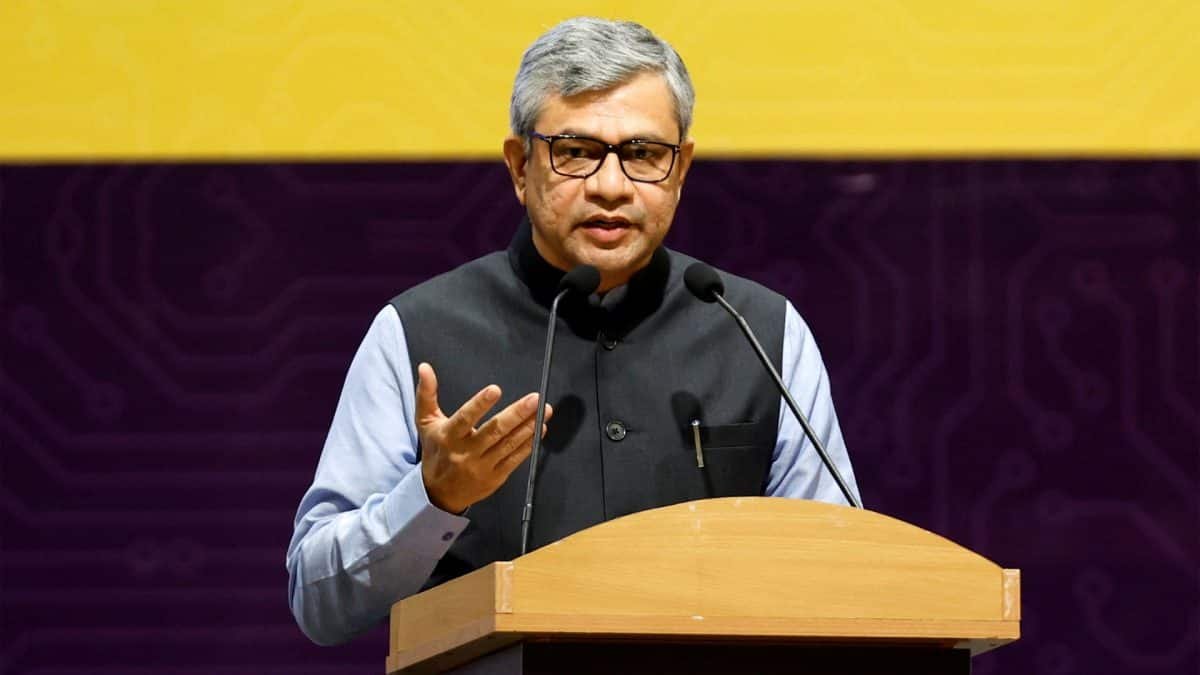
Speaking at the World Economic Forum in Davos, Vaishnaw said India’s policy stability, clarity of vision and long-term economic thinking have significantly enhanced its standing on the world stage
As global economies grapple with geopolitical churn, supply-chain disruptions and policy uncertainty, India is increasingly being seen as a trusted and dependable partner, Union Minister Ashwini Vaishnaw said on Wednesday at the World Economic Forum (WEF) in Davos.
Speaking at the World Economic Forum in Davos, the minister said India’s policy stability, clarity of vision and long-term economic thinking have significantly enhanced its standing on the world stage.
“In this world full of turbulence, everybody is looking for trusted partners who have stable policies, who have a clear thought process. India definitely ranks very high,” Vaishnaw said.
Vaishnaw, who holds portfolios including railways, electronics and information technology, said leaders across regions now view India not merely as a large market but as a strategic partner and co-creator in global growth.
“Any geography you meet the leader from, any country, they consider India a major partner, an economy, a co-developer, a co-creator, as a country which can be relied upon. That’s the thought process, that’s the feeling we got from interactions,” he said.
India’s growing appeal amid global uncertainty
Vaishnaw’s remarks come at a time when global investors and governments are reassessing their economic alliances amid slowing growth in major economies, ongoing conflicts, and concerns over protectionism.
At Davos, conversations this year have been dominated by worries over fragmented supply chains, inflationary pressures, energy security and the need for resilient growth models. Against this backdrop, India’s consistent policy direction and reform-driven approach have emerged as key talking points.
India remains one of the fastest-growing major economies, supported by public investment in infrastructure, manufacturing incentives, digital public goods and a large domestic market. The government has repeatedly emphasised policy continuity, particularly in areas such as electronics manufacturing, renewable energy, railway modernisation and digital services.
Vaishnaw pointed out that this predictability is now being recognised globally, especially by countries and companies looking to diversify their economic exposure.
Stability as a strategic asset
Policy stability has become a crucial differentiator at a time when several economies are grappling with political transitions, regulatory shifts and fiscal stress.
India’s clear long-term vision, anchored in manufacturing, technology, infrastructure and sustainability, is giving confidence to global stakeholders.
The government has repeatedly stressed that reforms undertaken over the past decade, including tax rationalisation, insolvency reforms and production-linked incentives, are structural and not transient.
At Davos, Indian officials have also highlighted the country’s demographic advantage, expanding middle class and rapid adoption of technology as factors that strengthen its case as a long-term partner.
End of Article