

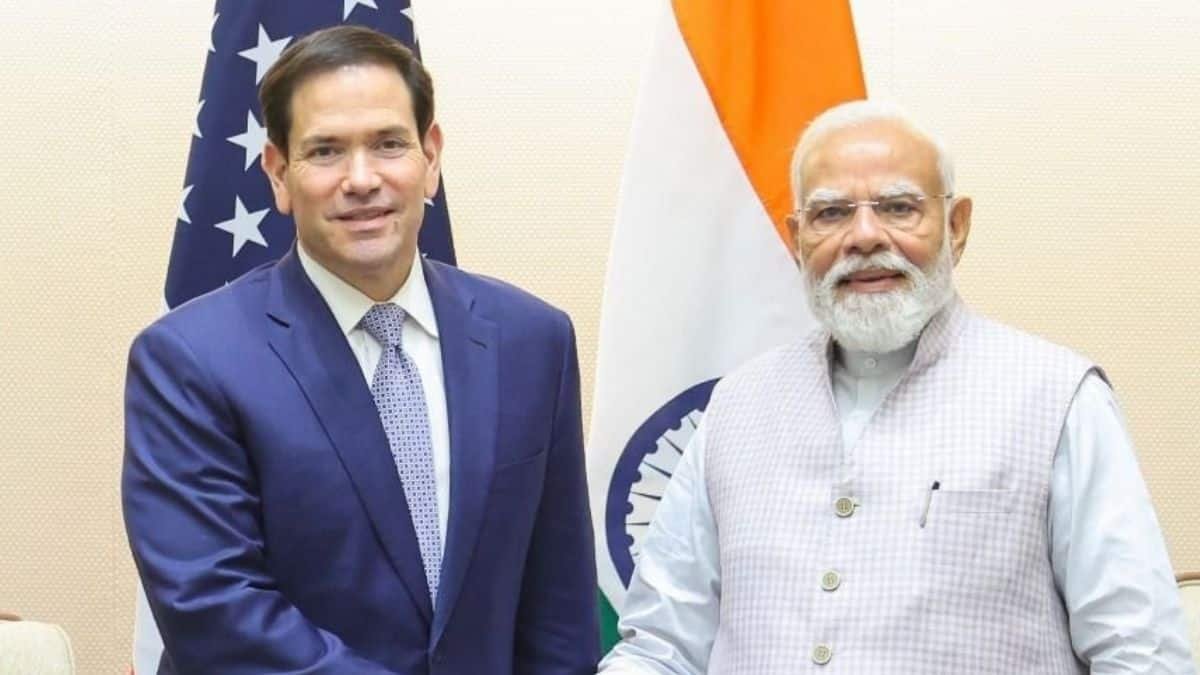
US Secretary of State Marco Rubio departed for Armenia from Delhi after concluding his four-day visit to India that focused heavily on strengthening strategic ties, expanding defence cooperation, and advancing the Indo-Pacific agenda through the Quad.
US Secretary of State Marco Rubio on Tuesday departed for Armenia from Delhi after concluding his four-day visit to India that focused heavily on strengthening strategic ties, expanding defence and energy cooperation, and advancing the Indo-Pacific agenda through the Quad partnership.
Rubio’s visit came at a sensitive moment in India-US relations, with both sides
navigating concerns over trade tariffs, US visa restrictions, Washington’s renewed engagement with Pakistan, and global instability
triggered by the Iran conflict.
During his
meetings with Prime Minister Narendra Modi, External Affairs Minister S. Jaishankar and other senior leaders, Rubio repeatedly stressed that the India-US partnership remained strong despite existing differences.
The visit also coincided with the Quad Foreign Ministers’ meeting in Delhi, where India, the United States, Australia and Japan
unveiled several new initiatives on maritime security, critical minerals, energy resilience and Indo-Pacific cooperation.
Strategic partnership reassured
One of the central themes of Rubio’s visit was to reassure India that the
bilateral partnership remained a top priority for Washington. His visit aimed to steady ties amid concerns over Trump-era tariff disputes, tightening visa rules affecting Indian professionals and students, and perceptions of a US tilt towards Pakistan and China.
Rubio repeatedly emphasised that the India-US relationship “has not lost any momentum” and said both countries were capable of managing disagreements while continuing to deepen strategic cooperation.
Energy security gains importance
Energy security emerged as another major focus of discussions, particularly amid fears that tensions involving Iran and the Strait of Hormuz could disrupt global oil supplies.
Rubio reportedly told PM Modi that the United States would not allow Iran to “hold the global energy market hostage” and offered expanded US oil and gas exports to India. The discussions reflected India’s growing need to diversify energy imports and secure stable supply chains during global uncertainty.
At the same time, Jaishankar reportedly reiterated that India would continue purchasing oil from markets that best suit its national interests.
Momentum on trade pact
Both countries also reported progress towards an interim bilateral trade agreement that could eventually lead to a broader economic pact.
Rubio expressed optimism that an agreement addressing the interests of both sides could be finalised “soon”. The discussions built upon earlier talks between PM Modi and US President Donald Trump aimed at expanding economic ties and reducing trade friction.
Reports suggesting large-scale Indian purchases from the US, including figures of up to $500 billion over five years, remained unconfirmed.
Quad, defence and technology cooperation deepen
Defence and strategic cooperation formed another major pillar of Rubio’s visit. Talks covered a renewed 10-year defence framework, underwater domain awareness, maritime surveillance, critical minerals, supply chain resilience, artificial intelligence and emerging technologies.
Rubio described India as a cornerstone of the US Indo-Pacific strategy. The Quad Foreign Ministers’ meeting also announced new initiatives on maritime surveillance collaboration, Indo-Pacific energy security and critical minerals cooperation, signalling deeper alignment among the four nations.
The developments have also raised expectations that Trump could attend the upcoming Quad summit expected later this year.
PM Modi invited to White House, visa concerns discussed
Rubio also extended a formal invitation from Trump for PM Modi to visit the White House, underlining continued high-level political engagement between the two countries.
Another key issue discussed during the visit was visa restrictions and delays affecting Indian students and skilled workers. Rubio said that recent US visa policy changes were part of a broader “modernisation” effort and were not specifically targeted at India.
He also downplayed anti-immigrant and racist rhetoric linked to visa debates, describing such remarks as comments made by “stupid” people rather than official policy.
First Published:
May 26, 2026, 14:03 IST
End of Article