

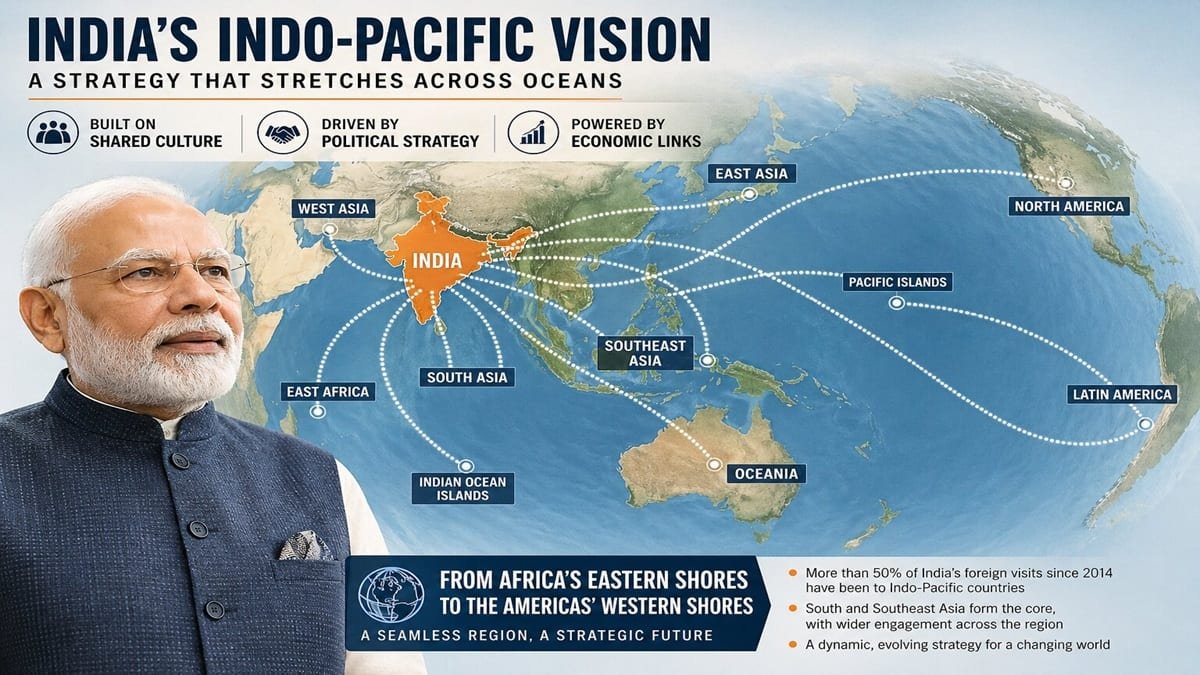
India’s idea of the Indo-Pacific is far more than a simple geographic label. It is a strategic vision that stretches from the eastern coast of Africa to western shores of the Americas, bringing together vast regions under a single framework.
India’s idea of the Indo-Pacific is far more than a simple geographic label. It is a strategic vision that stretches from the eastern coast of Africa to the western shores of the Americas, bringing together vast regions under a single framework.
First clearly outlined by Prime Minister Narendra Modi in 2018, this concept has since evolved into a key pillar of India’s foreign policy.
A new research paper by Fondation pour la Recherche Stratégique (FRS) argues that this vision is not just about geography but about strategy. It says India is “quietly redrawing” the map by presenting the Indo-Pacific as a natural, unified region, even though its boundaries remain flexible and open to interpretation.
Former Ambassador Anil Trigunayat echoed this broader strategic view, saying India is a “resident power” in the Indian Ocean and an integral part of the Indo-Pacific with a long maritime history.
He highlighted that New Delhi has increasingly acted as a “first responder” in the region, strengthening its role through initiatives such as the Indian Ocean Rim Association (IORA), Indian Ocean Naval Symposium, and the Indo-Pacific Oceans Initiative (IPOI).
Trigunayat further underlined that India’s approach does not focus on containing China, but rather on promoting inclusiveness and a rules-based order in a “free and open Indo-Pacific.”
Unlike narrower interpretations used by other countries, India’s Indo-Pacific combines its long-standing focus on the Indian Ocean with a broader engagement in the Pacific region.
Region built on ideas, not borders
According to the study, India’s Indo-Pacific is held together by three main ideas: shared culture, political strategy, and economic links. Geopolitical experts in New Delhi often describe the region as historically connected through trade, migration, and cultural exchange, especially with Southeast Asia.
India also places strong emphasis on the central role of Asean countries. Foreign minister S Jaishankar has repeatedly described Southeast Asia as the “core” of the Indo-Pacific, both geographically and politically. This helps India align its vision with the widely accepted idea of “Asean centrality.”
Politically, the Indo-Pacific builds on earlier policies like the “Look East” and “Act East” strategies, which aimed to deepen ties with East and Southeast Asia. Over time, these ideas have expanded into a broader concept of an “extended neighbourhood,” covering regions from the Gulf to East Asia.
Economic logic behind the vision
The FRS paper highlights that economic factors play a major role in shaping this concept. A large share of India’s trade flows through Indo-Pacific regions, especially West Asia, Southeast Asia, and East Asia. This makes the idea of linking the Indian and Pacific Oceans not just symbolic, but practical.
Indian policymakers argue that growing economic interdependence across these regions makes it unrealistic to treat them as separate zones. Instead, they present the Indo-Pacific as a seamless space where trade, energy routes, and supply chains are deeply connected.
From vision to practice
The study also looks at how India’s actions match its rhetoric. It finds that a large number of all foreign visits by Indian leaders since 2014 have been to Indo-Pacific countries. This suggests that the region is indeed a top priority in India’s diplomacy.
However, the engagement is not evenly spread. South Asia and Southeast Asia receive the most attention, forming what the report describes as the “core” of India’s Indo-Pacific. Other areas like East Africa, Oceania, and Latin America are part of the vision but see less frequent engagement.
This layered approach reflects what Indian officials describe as “concentric circles” of foreign policy, where neighbouring regions come first, followed by more distant partners.
Strategic map for future
The report concludes that India’s Indo-Pacific is not a fixed or natural region, but a carefully constructed one. It is shaped by history, economic needs, and political goals rather than strict geographic boundaries.
By promoting this broad and flexible idea, India is positioning itself as a key player in shaping the regional order. At the same time, the gaps between its expansive vision and its more focused engagement show that the Indo-Pacific remains a work in progress.
As global competition intensifies and regional dynamics continue to shift, India’s evolving definition of the Indo-Pacific is likely to play an even bigger role in its foreign policy — not just as a map, but as a strategy.
First Published:
April 28, 2026, 14:58 IST
End of Article