

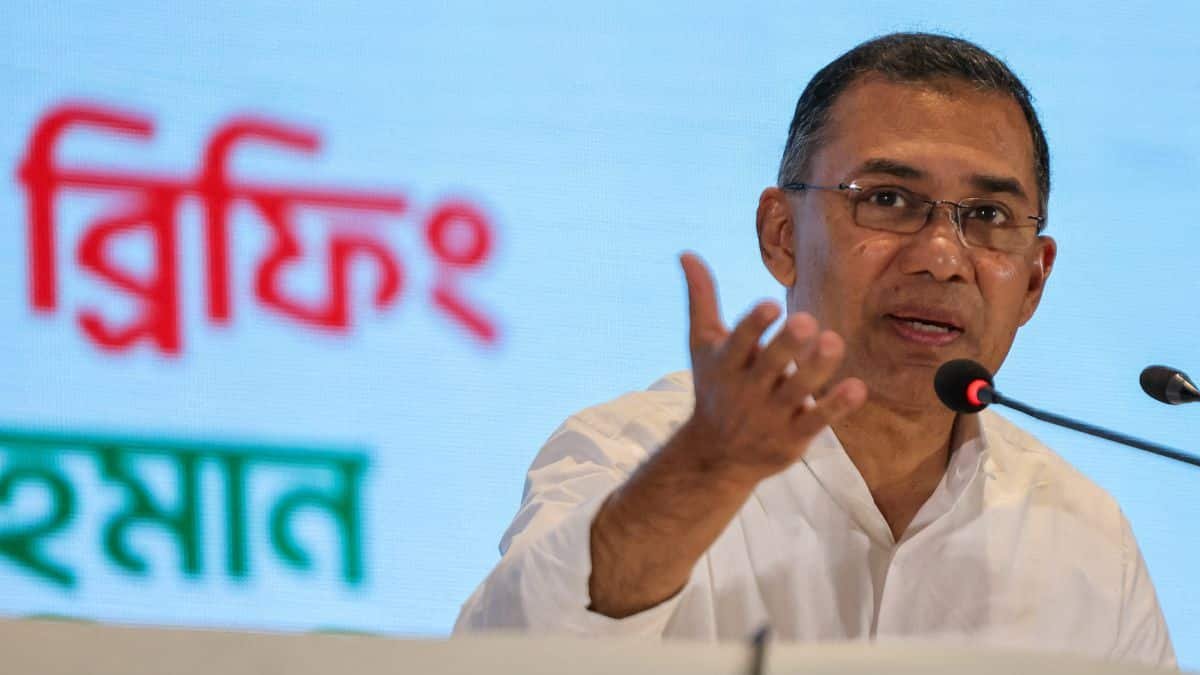
Bangladesh’s ruling BNP on Saturday said that the future of the country’s relations with India would depend on a new Ganges Water Sharing Treaty and called for immediate discussions with New Delhi.
Bangladesh’s ruling Bangladesh Nationalist Party (BNP) on Saturday said that the future of the country’s relations with India would depend on a new Ganges Water Sharing Treaty and called for immediate discussions with New Delhi to finalise an agreement that meets Bangladesh’s “expectations and needs”.
The current Indo-Bangladesh Ganges Water Sharing Treaty, signed in 1996, is set to expire in December. BNP secretary general Mirza Fakhrul Islam Alamgir said Bangladesh wanted a fresh agreement to be concluded without delay to ensure fair water sharing between the two neighbouring countries.
“We want to send a clear message to the Indian government that a new treaty must be implemented immediately through discussions according to the expectations and needs of Bangladesh’s people,” Alamgir said at an event in Dhaka, according to PTI.
He added that the opportunity to maintain good relations with India “will depend on the signing of the Ganges Water Sharing Treaty or the Farakka Agreement”.
Concerns over treaty renewal
Alamgir alleged that uncertainty surrounding the renewal of the existing 30-year treaty had created concerns over future water-sharing arrangements. The current agreement was signed during the tenure of the now-disbanded Awami League government led by former Prime Minister Sheikh Hasina.
According to the report, he said that the present treaty should remain in force until a new agreement is signed. Alamgir also suggested that future water-sharing arrangements between the two countries should not be restricted to a fixed time period.
The Ganges river, which enters Bangladesh through the northwestern Chapai Nawabganj district and becomes known locally as the Padma, is one of the country’s most important river systems. Bangladesh, a lower riparian nation criss-crossed by hundreds of rivers, depends heavily on water flowing from India through 54 shared rivers.
According to PTI, Alamgir said that nearly one-third of Bangladesh’s population of around 170 million relies on the river system for livelihoods, biodiversity and water supply to several distributaries.
Bangladesh approves Padma barrage project
The BNP leader’s remarks came days after Bangladesh approved a major project to build a barrage on the Padma river. The government said that the proposed project would help reduce the negative impact of the Farakka Barrage.
According to the report, the project, expected to be completed by 2033, was approved by the Executive Committee of the National Economic Council at a meeting chaired by Prime Minister Tarique Rahman.
Water Resources Minister Shahiduddin Chowdhury Anee said that the proposed Padma Barrage was in Bangladesh’s own interest and did not require discussions with India. However, he noted that talks regarding the Ganges river were continuing between the two countries, the report said.
Long-standing Farakka issue
The 2,240-metre-long Farakka Barrage was built to divert water into the Hooghly river to remove sediments and maintain navigability at Kolkata Port.
The Farakka issue has remained a sensitive matter in Bangladesh for decades. Successive governments and experts in Bangladesh have argued that reduced dry-season water flow downstream has caused salinity intrusion, river degradation and damage to agriculture and ecology.
India, however, has maintained that the barrage was constructed mainly to protect Kolkata Port and that water-sharing concerns have been addressed through bilateral agreements and mechanisms, including the 1996 Ganges Water Sharing Treaty.
First Published:
May 17, 2026, 12:25 IST
End of Article