

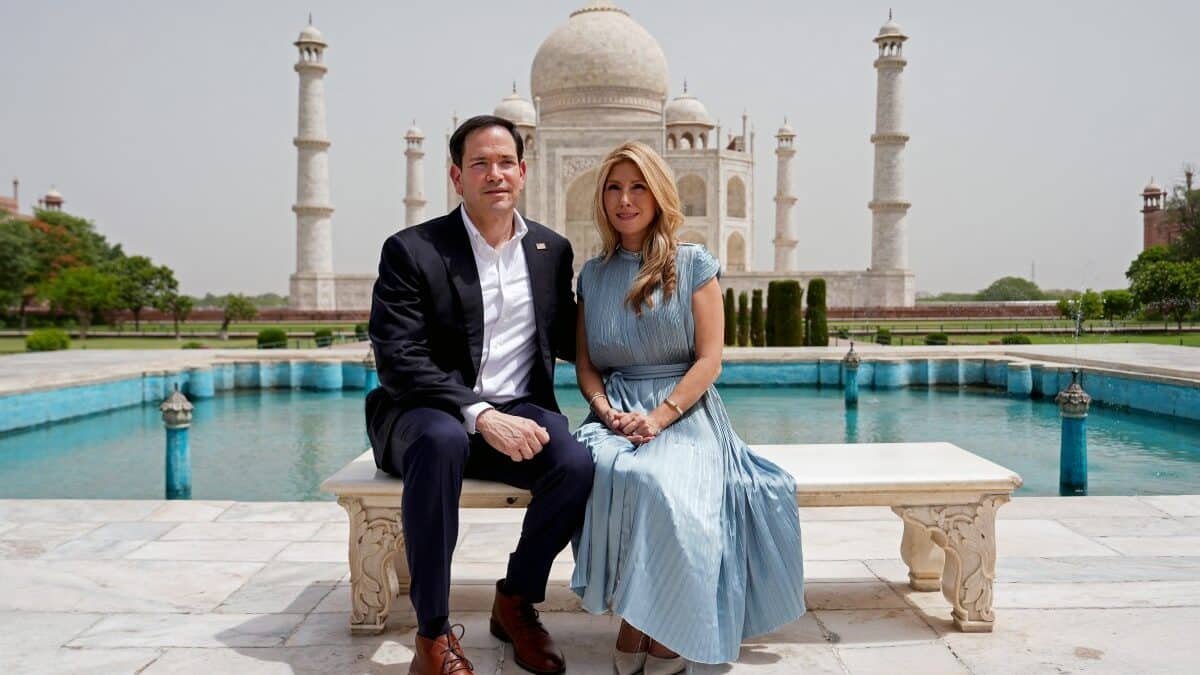
A visit by US Secretary of State Marco Rubio to the Taj Mahal during his India trip has drawn a sharp response from Iran’s diplomatic mission in Hyderabad, which accused Washington of threatening Iranian civilisation.
A visit by US Secretary of State Marco Rubio to the Taj Mahal during his India trip has drawn a sharp response from Iran’s diplomatic mission in Hyderabad, which accused Washington of threatening Iranian civilisation while appreciating a monument linked to Persian heritage.
In a post on X, the official handle of Consulate General of Iran in Hyderabad criticised Rubio’s visit to the 17th-century monument in Agra. “If Rubio knew the history or architecture, he wouldn’t have posed for a picture here,” the mission wrote.
If Rubio knew the history or architecture, he wouldn’t have posed for a picture here. This monument was built out for the love of emperor’s Iranian wife, crafted by the genius of Iranian architects — meanwhile his government today threatens to wipe out Iranian civilization,… pic.twitter.com/zi4CNU3u7U
— Iran In Hyderabad (@IraninHyderabad) May 25, 2026
The post further stated that the Taj Mahal was “built out for the love of emperor’s Iranian wife, crafted by the genius of Iranian architects”, while Rubio’s government was “threatening to wipe out Iranian civilization” and “insulting other civilizations”.
Rubio visits Taj Mahal during India trip
Rubio
arrived in Agra on Monday along with US Ambassador to India Sergio Gor after attending high-level geopolitical discussions in New Delhi. He was
accompanied by his wife, Jeanette Rubio.
The American delegation landed at the Agra Air Force Station aboard a special aircraft under heavy security arrangements before proceeding to the Taj Mahal.
Following a long-standing tradition for visiting foreign dignitaries, Rubio and his wife posed for photographs on the iconic marble bench facing the monument’s central reflection pool.
Security personnel from Indian and American agencies maintained strict movement restrictions around the complex during the visit, although the Taj Mahal remained open to tourists.
Rubio also signed the visitors’ book and thanked authorities for allowing him to see what he described as “one of the true treasures of the world”.
Taj Mahal’s Persian connection highlighted
Iran’s remarks drew attention to the Persian roots associated with the Mughal monument and its history. The Taj Mahal was built by Mughal emperor Shah Jahan in memory of his wife Mumtaz Mahal.
Born as Arjumand Banu Begum in Agra, Mumtaz Mahal belonged to a family of Persian nobility. She was the daughter of Abu’l-Hasan Asaf Khan, a senior noble in the Mughal court, and the niece of Nur Jahan, one of the most influential person of the Mughal era.
The Iranian mission’s comments come at a time of heightened tensions between Tehran and Washington over the ongoing conflict in West Asia and continued disagreements surrounding Iran’s nuclear programme and regional influence.
Although Rubio’s visit to the Taj Mahal was part of a cultural stop during his India trip, the Iranian response turned the moment into a diplomatic and historical exchange over heritage, identity and current geopolitical tensions.
First Published:
May 25, 2026, 18:06 IST
End of Article