

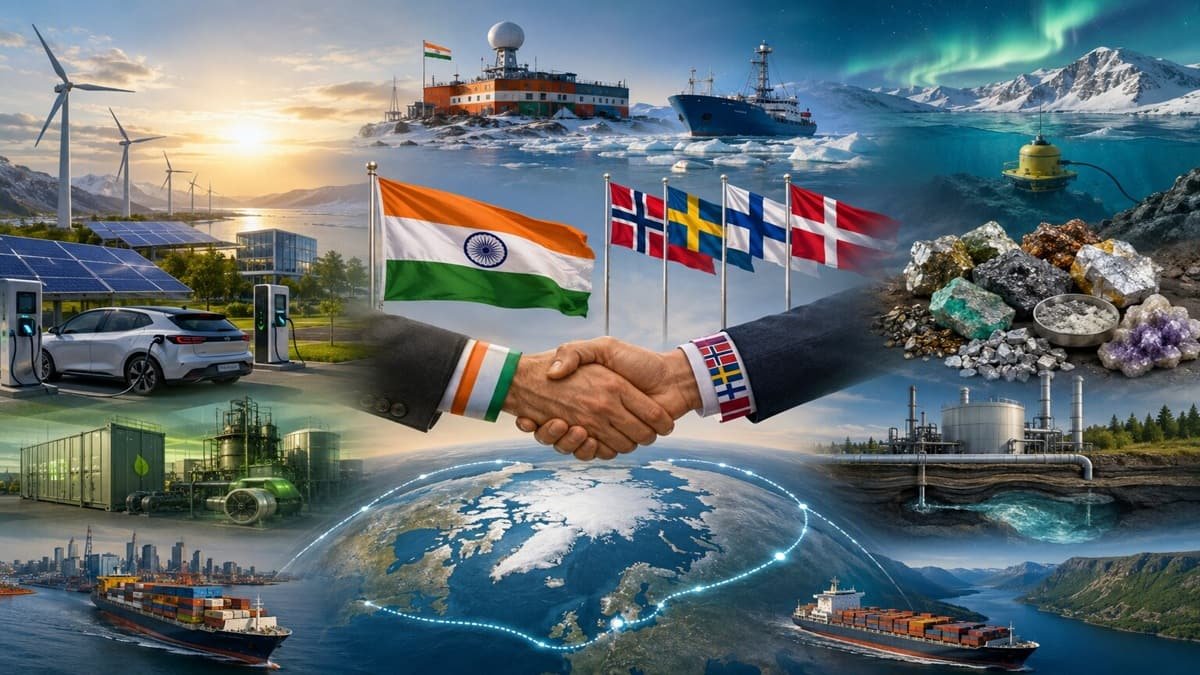
As PM Narendra Modi attends the India-Nordic Summit in Norway, the partnership is evolving from a technical collaboration into a strategic alliance shaped by Arctic geopolitics, critical minerals and shifting global power equations.
Prime Minister Narendra Modi is set to attend the third India-Nordic Summit in Norway today as part of his ongoing four-nation European visit.
The circumstances surrounding this summit are fundamentally different from those during the previous editions held in 2018 and 2022. A transformed global geopolitical landscape has pushed the India-Nordic relationship beyond a largely technical partnership
into a more strategic one.
Former Indian ambassador to Finland KP Fabian told Firstpost that the Nordic countries have long demonstrated one of the world’s most effective models of regional cooperation. Recalling his tenure in Finland between 1985 and 1988, Fabian said his Swedish counterpart had once told him that “every official at the level of Deputy Secretary and above knew each other and kept in touch.”
According to Fabian, the Nordic experience offers valuable lessons for South Asia, where stronger regional cooperation remains essential.
Changed security architecture
The Russia-Ukraine war has significantly altered the security architecture of Northern Europe, prompting Sweden and Finland to join the trans-Atlantic military alliance Nato. Denmark, meanwhile, has found itself navigating tensions with the current US administration over Greenland. Fabian, however, believes Finland and Sweden “have not increased their security by joining Nato.” He also noted that Nordic countries are increasingly seeking to diversify their strategic partnerships amid global uncertainty.
India, too, emerged from a military conflict with Pakistan last year, during which countries such as China and Türkiye played an active role in supporting Islamabad. Against this backdrop, New Delhi has emerged as an important stakeholder in the Nordic region’s efforts to diversify its geopolitical and geo-economic partnerships while reducing excessive dependence on Washington-led frameworks. Fabian believes India should not limit its engagement with Nordic countries to technical cooperation alone, but instead deepen the geopolitical dimension of the partnership.
Focus areas of partnership
Nordic countries are global leaders in green energy, electric mobility and green shipping technologies. At a time when disruptions in the Strait of Hormuz due to the ongoing Iran conflict have exposed vulnerabilities in global shipping networks, diversification of maritime partnerships and routes has become strategically important.
India and the Nordic countries are also looking to reduce their dependence on China for critical minerals. Resource-rich Nordic nations present significant opportunities in this regard. Norway possesses deep-sea mining potential, Sweden holds substantial rare earth reserves, while Denmark offers access to Greenland, which contains vast deposits of strategic minerals.
Norway is also a global leader in carbon capture and storage (CCS) technology. As India seeks to decarbonise its heavy industries, collaboration with Nordic companies could help New Delhi scale up localised green technologies.
Notably, Norway is part of the European Free Trade Association (EFTA), which has committed to investing more than $100 billion in India over the next 15 years.
Arctic: A new geopolitical frontier
Beyond trade and technology, the Arctic has emerged as one of the most important dimensions of the India-Nordic partnership. Once geopolitically insulated, the region is increasingly becoming a theatre of competition among major powers.
Partnerships with Nordic countries provide India geographical and strategic access to the Arctic. India has already expanded its regional presence through the Himadri research station and the IndARC underwater observatory.
The accelerating melting of Arctic ice is opening new possibilities for shipping, resource extraction and military activity. As a result, India, despite not being an Arctic nation, is increasingly becoming an Arctic stakeholder.
India has already connected itself to Russia’s Far East through the Chennai-Vladivostok maritime corridor. A future Arctic maritime link could provide New Delhi with an alternative trade route to Europe, reducing dependence on the Persian Gulf and the Suez Canal route. Experts estimate that Arctic shipping routes could reduce the distance between Asia and Europe by nearly 40 per cent, making trade faster and more cost-effective.
Geopolitical experts argue that India should seize an early-mover advantage in the Arctic by investing in Arctic-capable ice-class tankers. China has already declared itself a “near-Arctic state” and is coordinating closely with Russia to expand its presence in the region. In this context, strengthening India’s strategic engagement with Nordic countries has become increasingly important.
Fabian also underlined that while summits remain important, diplomacy cannot rely solely on high-level meetings. “A good ambassador can get many things done without any summit,” he said, emphasising the importance of sustained institutional and diplomatic engagement between India and the Nordic region.
First Published:
May 19, 2026, 12:10 IST
End of Article