

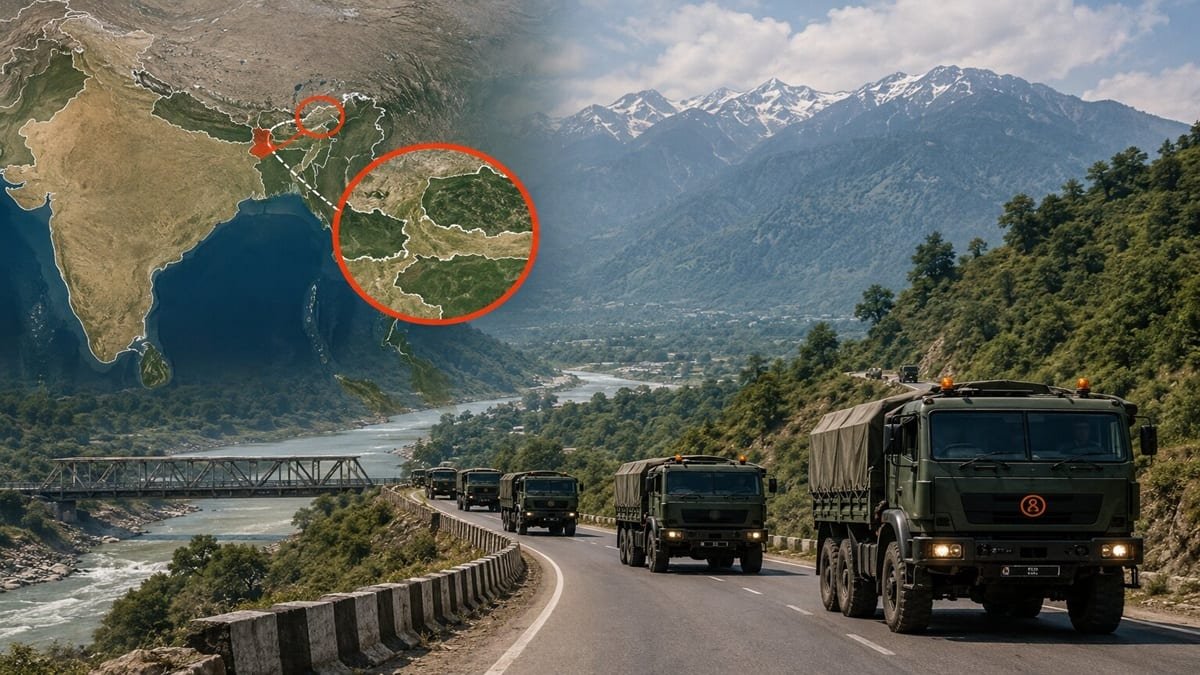
The Centre’s takeover of strategic highways in the Siliguri Corridor is expected to speed up road expansion and repairs. Experts say the move will improve defence preparedness and connectivity to the Northeast.
The West Bengal government has decided to hand over seven strategically important stretches of national highways to central agencies, a move expected to improve infrastructure, connectivity and defence logistics in the sensitive Siliguri Corridor, widely known as the “Chicken’s Neck”.
The decision, approved in principle by the state government, is expected to end delays surrounding several highway projects that had remained stalled for months. The stretches
will now come under the control of the National Highways Authority of India (NHAI) and the National Highways & Infrastructure Development Corporation Limited (NHIDCL), paving the way for faster expansion, repairs and maintenance.
The move carries strategic importance because several of these roads pass through or originate from the Siliguri Corridor, a narrow strip in north Bengal that serves as India’s only land link with the northeastern states.
At its narrowest point, the corridor is only about 20 to 22 kilometres wide and is surrounded by Nepal, Bhutan and Bangladesh, while China lies further north beyond Sikkim.
Why the Chicken’s Neck matters
The Siliguri Corridor is considered one of India’s most sensitive military and logistical corridors. Any disruption in this narrow passage can affect road, rail and military access to states including Assam, Arunachal Pradesh, Meghalaya, Mizoram, Manipur, Nagaland, Tripura and Sikkim.
SK Sood, former Director General of the Border Security Force, told Firstpost that the roads in question were already designated national highways but had been under the National Highway wing of the state Public Works Department. According to him, the latest order effectively transfers their management to NHAI and NHIDCL, which is likely to speed up widening, strengthening and repair work.
Sood said four of the stretches are directly connected to or emerge from the Chicken’s Neck corridor, making the transfer significant from both logistical and security perspectives. He added that stronger road infrastructure could improve security along routes linked to NH717, which connects to Nathu La near the India-China border.
Defence preparedness and connectivity
Security concerns surrounding the corridor have grown over the years, especially after the Doklam standoff in 2017 near the India-Bhutan-China trijunction. Frequent landslides and monsoon-related disruptions in north Bengal and Sikkim have also affected transport and military movement.
Sood said that the decision does not appear to be tied to any immediate security plan, but improved road conditions could make the movement of military hardware easier if greater attention is placed on routes such as NH717, especially given India’s strategic concerns involving China and Bangladesh.
Under the new arrangement, NHAI is expected to take charge of stretches including NH-31, NH-33 and NH-312, while NHIDCL will oversee routes such as the Sevok-Coronation Bridge section, Hasimara-Jaigaon road and the Changrabandha corridor.
‘National security is non-negotiable’
Vikram Singh, former Uttar Pradesh DGP, told Firstpost that the Chicken’s Neck has long remained a vulnerable point in India’s security structure and welcomed the move as an important step by both the state and central governments.
Singh said the corridor has historically been viewed as sensitive and vulnerable to attempts at disruption, adding that stronger infrastructure would help ensure that neither internal nor external threats are able to exploit the region.
Referring to past remarks linked to activist Sharjeel Imam, he argued that concerns around the corridor’s vulnerability had already entered public debate and that steps to secure it should have come earlier.
He stressed that India’s national security priorities must include strengthening the Siliguri Corridor and ensuring uninterrupted connectivity to the Northeast.
First Published:
May 19, 2026, 19:59 IST
End of Article