

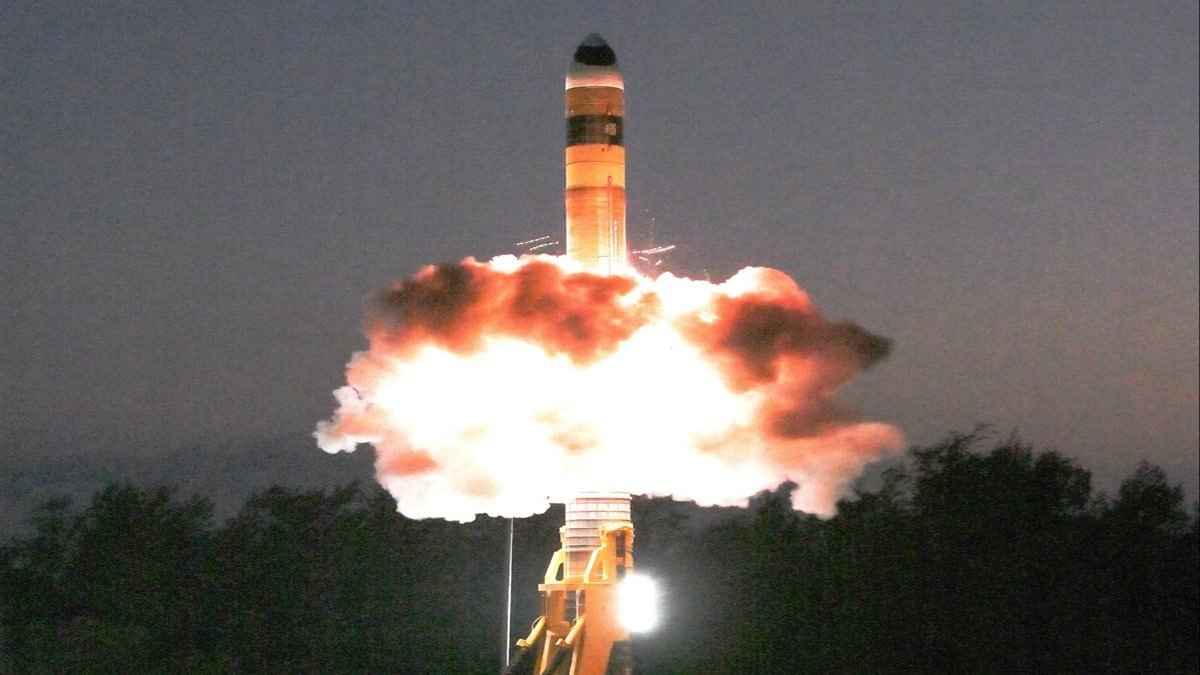
India on Friday successfully conducted the flight-test of an advanced version of its Agni missile equipped with MIRV technology, marking another major step in the country’s strategic weapons programme.
India on Friday successfully conducted the flight-test of an advanced version of its Agni missile equipped with Multiple Independently Targetable Re-entry Vehicle (MIRV) technology, marking another major step in the country’s strategic weapons programme.
The missile was launched from the Integrated Test Range (ITR) at APJ Abdul Kalam Island off the Odisha coast at around 6:30 PM.
Calling the test a major strategic milestone, Major General AK Siwach told Firstpost that the successful Agni-5 MIRV trial significantly enhances India’s strategic deterrence capability.
He said the technology allows a single missile to strike multiple targets simultaneously at ranges beyond 5,000 km, placing India among a select group of countries possessing advanced MIRV systems.
The successful trial further strengthens India’s long-range nuclear deterrence capability and demonstrates the country’s ability to strike multiple targets using a single missile system.
Advanced Agni variant successfully tested
According to the Ministry of Defence, the missile tested was an advanced variant of the Agni series with a strike range of more than 5,000 km. The missile was tracked throughout its flight by multiple ground-based and ship-based monitoring systems.
Defence Minister Rajnath Singh congratulated DRDO scientists, the Indian Army and industry partners involved in the project. He said that the successful test would significantly strengthen India’s defence preparedness amid evolving security challenges.
What MIRV capability means for India
MIRV technology allows a single ballistic missile to carry multiple nuclear warheads, each capable of hitting different targets independently.
After the missile reaches a certain altitude outside the atmosphere, a post-boost vehicle releases the warheads separately along different paths. These warheads then re-enter the atmosphere at hypersonic speeds and move towards their assigned targets.
Explaining the significance of the technology, Major General Siwach said that MIRV capability greatly improves India’s second-strike capability by ensuring a more credible and survivable nuclear deterrent. He noted that even after absorbing a first strike, India would retain the ability to retaliate effectively.
He further explained that MIRV systems can deploy several warheads along with decoys, making it much harder for enemy ballistic missile defence systems to intercept incoming missiles. According to him, this substantially improves the effectiveness of India’s strategic arsenal.
Strengthening India’s strategic balance
Major General Siwach also said the technology provides greater targeting flexibility, allowing a single missile to hit different targets spread across a large geographical area. He described the test as an important response to evolving regional security challenges and rapid missile developments in Asia.
He added that the successful development of the system by DRDO highlights India’s growing indigenous technological capabilities, especially in areas such as advanced guidance systems, avionics and warhead miniaturisation.
India had first demonstrated MIRV capability on the Agni platform under “Mission Divyastra” in March 2024, when Prime Minister Narendra Modi announced the successful Agni-V MIRV test.
With this capability, India joins a small group of countries that possess operational MIRV technology, including the United States, Russia, China, France and the United Kingdom.
Major General Siwach stressed that the capability remains aligned with India’s “No First Use” nuclear doctrine and is meant for credible deterrence and retaliation only. He also noted that the successful trial involving multiple payloads in the Indian Ocean Region confirmed the reliability and accuracy of the missile’s navigation and guidance systems.
First Published:
May 10, 2026, 12:16 IST
End of Article