

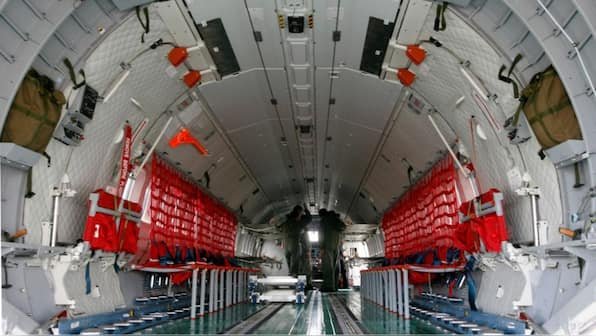
India’s push to manufacture military aircraft domestically could be approaching a milestone, as visuals emerging from Gujarat indicate that the first made-in-India Airbus C-295 transport aircraft may be nearing a formal rollout from the Tata Advanced Systems Limited (TASL) facility in Vadodara, Gujarat.
Videos posted on social media on Monday (May 11, 2026) appeared to show a nearly complete C-295 aircraft stationed inside the Tata-Airbus Final Assembly Line (FAL).
Although there has been no official announcement yet from the Indian government, Airbus, Tata Advanced Systems, or the Indian Air Force (IAF), the visuals do lend evidence to repeated comments that the aircraft could be unveiled earlier than the previously expected September 2026 timeline.
The programme is not merely another defence acquisition project. It represents the first instance of a military aircraft being manufactured in India by a private-sector company.
The development is also being viewed as a key test case for the government’s “Make in India” and “Atmanirbhar Bharat” initiatives in the defence sector, while it alsosignals a growing India-Spain defence partnership, with Airbus and Tata jointly spearheading the programme.
What is happening in Vadodara?
The aircraft seen in a video appeared largely complete externally, suggesting that the assembly process may be entering its final phases before rollout and subsequent testing.
Congratulations #TataAdvancedSystems C295#AtmanirbharBharat pic.twitter.com/FtsFscBsS1
— Dr. Ajayshree Singh Sambyal (@AjayshreeSamby3) May 11, 2026
In January earlier this year, External Affairs Minister S Jaishankar had said that the first “Made in India” C-295 would roll out before September, describing the programme as evidence of deepening defence-industrial cooperation between India and Spain.
Reports earlier this year also suggested that Prime Minister Narendra Modi could attend the rollout ceremony once the aircraft is formally unveiled.
The Vadodara plant itself is crucial to India’s future military aviation ambitions. The facility was
jointly inaugurated in October 2024 by Modi and Spanish Prime Minister Pedro Sánchez and is considered India’s first private-sector military aircraft final assembly line.
The plant was established under the partnership between Airbus and Tata Advanced Systems Limited and serves as the manufacturing hub for the 40 aircraft that are to be assembled in India under the larger procurement agreement.
What is the C-295 aircraft? Why does the IAF need it?
The Airbus C-295 is a medium tactical transport aircraft designed for military logistics, troop movement, medical evacuation, cargo operations, and special missions across diverse operational environments.
The ‘C’ refers to CASA (Construcciones Aeronáuticas SA), the Spanish aerospace company that designed it, now part of Airbus Defence and Space.
Powered by twin turboprop engines, the aircraft belongs to the medium-lift category and has been developed to function in both conventional and high-intensity operational theatres.
The aircraft is designed to operate from short, semi-prepared, and rugged airstrips, making it particularly suitable for Indian conditions, including mountainous regions, island territories, and forward bases.
One of the aircraft’s defining operational advantages is its Short Take-Off and Landing (STOL) capability.
The C-295 can use semi-prepared or unpaved runways measuring roughly 800 to 900 metres, enabling it to support missions in areas where larger transport aircraft may face operational constraints.
The aircraft can carry a maximum payload of approximately 9,250 kilogrammes, considerably more than the payload carried by the IAF’s ageing Antonov An-32 fleet, which can transport around 6,700 kilogrammes.
In troop-transport configuration, the aircraft can accommodate up to 71 personnel or roughly 50 paratroopers equipped for combat operations. For medical evacuation missions, the aircraft can carry 24 stretchers and seven medical attendants.
The aircraft cruises at around 480 kilometres per hour and can remain airborne for up to 11 hours depending on mission configuration and payload.
Another major operational improvement is the inclusion of a rear ramp door, a feature absent in the HS-748 Avro fleet currently being replaced.
The rear-loading system allows rapid deployment of personnel, faster loading and unloading of equipment, and transportation of specialised vehicles and military cargo.
The aircraft is also being equipped with indigenous electronic warfare systems jointly developed by Bharat Electronics Limited (BEL) and Bharat Dynamics Limited (BDL).
How did India’s Airbus-Tata deal take shape?
India signed the C-295 procurement agreement with Airbus in September 2021 in a deal valued at approximately $3.5 billion, or around ₹21,935 crore.
The agreement covers the acquisition of 56 aircraft intended primarily to replace the IAF’s ageing HS-748 Avro transport fleet.
The delivery structure was divided into two distinct phases. Under the arrangement, Airbus would manufacture and directly deliver the first 16 aircraft in flyaway condition from its facility in Seville, Spain. The
last of the 16 deliveries was completed in August 2025.
The remaining 40 aircraft would be produced and assembled in India through the Tata-Airbus partnership.
The programme was immediately viewed as a breakthrough because it moved beyond conventional licensed assembly arrangements and involved the creation of a full private-sector military aircraft assembly ecosystem within India.
The Vadodara facility became the centrepiece of this effort. Unlike earlier defence aviation programmes dominated by state-owned Hindustan Aeronautics Limited (HAL), the C-295 initiative opened the door for large-scale private-sector participation in aircraft manufacturing.
The programme also includes technology transfer related to complete airframe manufacturing and assembly processes, providing Indian industry with exposure to advanced aerospace production techniques.
The industrial ecosystem supporting the aircraft has expanded rapidly. Reports indicate that over 37 Indian companies, including multiple micro, small and medium enterprises (MSMEs), are now integrated into the supply chain.
How much of the aircraft is actually being built in India?
The C-295 programme has become one of the largest examples of defence manufacturing localisation in India’s aerospace sector.
According to programme details, between 13,000 and 13,400 aircraft parts are now being sourced or manufactured domestically. In addition, roughly 4,600 sub-assemblies are being produced within India.
Reports also indicate that nearly 96 per cent of the manufacturing work performed on the airframe in Spain is now being replicated within India’s industrial ecosystem.
The level of indigenous participation is expected to rise progressively during the production cycle. Initial indigenous content reportedly stood at approximately 48 per cent, but later production batches are expected to achieve nearly 75 per cent localisation.
Current estimates suggest that around 70 per cent of aircraft components are sourced domestically, while the remaining 30 per cent continue to come from international suppliers. Among the imported systems are the Pratt & Whitney engines used on the aircraft.
The project is also expected to generate significant industrial employment and technical capability. Estimates linked to the programme mention more than 6,000 direct and indirect jobs and approximately 42.5 lakh man-hours of industrial activity.
Beyond aircraft assembly, India is also developing a Maintenance, Repair and Overhaul (MRO) hub linked to the C-295 fleet. The facility is
expected to support not only Indian operators but potentially aircraft from neighbouring countries as well.
The regional opportunity is significant because 10 of the 36 global operators of the C-295 are located in India’s broader neighbourhood.
Which aircraft is the C-295 replacing in the Indian Air Force?
The immediate purpose of the programme is to replace the IAF’s HS-748 Avro fleet, aircraft that have remained operational since the 1960s.
The Avro fleet served India for decades in transport and logistics roles but increasingly faced limitations associated with ageing airframes, lower payload capacity, and outdated operational systems.
The lack of rear-ramp loading capability also restricted the Avro’s flexibility in tactical operations and rapid cargo deployment missions.
However, the C-295’s long-term significance extends beyond replacing the Avro fleet alone.
Defence analysts increasingly view the aircraft as a likely successor to at least part of the IAF’s Antonov An-32 transport fleet, which has served as the backbone of India’s tactical airlift capability since the 1980s.
The An-32 aircraft have operated across a vast range of terrains, from the Andaman and Nicobar Islands to high-altitude Himalayan bases. The fleet remains especially important for difficult landing operations in locations such as Daulat Beg Oldie (DBO).
Yet the ageing nature of the fleet has prompted discussions on future replacement options. Because the C-295 is now being manufactured within India, expectations are growing that the IAF may eventually place follow-on orders to replace a larger portion of the An-32 inventory.
India is currently exploring requirements for between 40 and 80 aircraft under the Medium Transport Aircraft (MTA) programme, which seeks aircraft capable of carrying payloads of at least 20 tonnes.
While the C-295 itself belongs to a lower payload category, additional procurement of the aircraft for tactical and medium-lift missions remains a strong possibility as the IAF modernises its transport structure.
Why is the Navy and Coast Guard also buying the aircraft?
The C-295 programme has already expanded beyond the Indian Air Force. India has approved an additional order worth approximately $3.1 billion for 15 more aircraft derived from the same platform.
Under this arrangement, nine aircraft are intended for the Indian Navy under the Medium-Range Maritime Reconnaissance Aircraft (MRMRA) programme, while six aircraft are designated for the Indian Coast Guard under the Multi-Mission Maritime Aircraft (MMMA) programme.
These variants are expected to undertake maritime surveillance, reconnaissance, coastal monitoring, and anti-submarine warfare missions.
The Navy’s aircraft are likely to complement existing long-range surveillance platforms such as the P-8I maritime patrol aircraft, while the Coast Guard’s fleet will strengthen maritime domain awareness and coastal security operations.
The adaptability of the C-295 platform is one of the reasons behind its expanding role across Indian services.
Apart from tactical transport and maritime surveillance, the aircraft can also be configured for disaster relief operations, humanitarian assistance, and medical evacuation missions in remote areas.
There have additionally been discussions around potentially adapting the platform for Airborne Early Warning and Control (AEW&C) functions and aerial refuelling support for smaller aircraft in the future.
Why is the C-295 programme being viewed as a turning point?
For decades, India largely remained dependent on imported defence platforms or state-led production systems. The C-295 initiative is different because it combines foreign collaboration, private-sector manufacturing and domestic supply-chain development.
The project is also reshaping India’s aerospace manufacturing architecture by reducing the dominance of state-owned production monopolies and opening military aviation production to private industry participation.
The programme’s industrial scale — spanning aircraft assembly, component production, indigenous electronic warfare integration, MRO infrastructure, and supplier development — is increasingly being viewed as a template for future defence manufacturing initiatives.
At the same time, the project is expected to give the IAF
a more modern and versatile tactical airlift platform capable of operating across demanding environments for decades.
Also Watch:
With inputs from agencies
First Published:
May 12, 2026, 18:40 IST
End of Article