

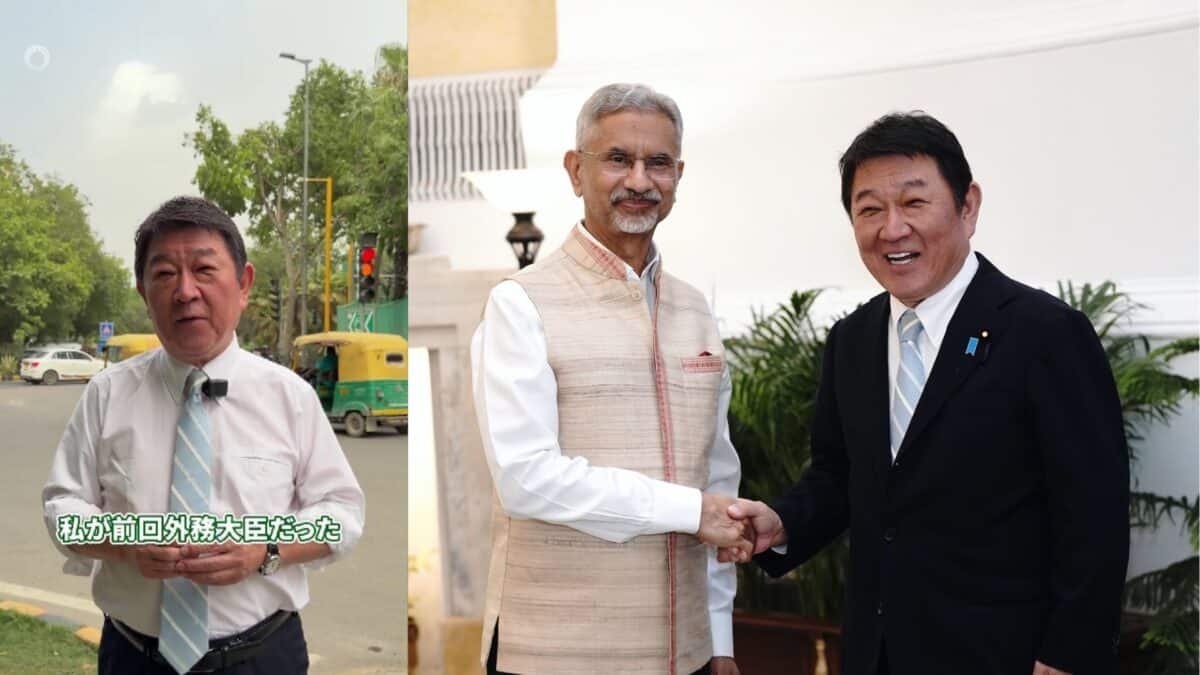
Standing beside New Delhi’s nonstop traffic and street-side bustle, Japan’s foreign minister used the city’s chaos as the backdrop for a clear message on why the Quad matters now more than ever
With Delhi’s traffic humming in the background—auto-rickshaws buzzing past, street vendors calling out, and the capital’s usual chaos in full swing—Japanese Foreign Minister Toshimitsu Motegi had a simple but sharp message as he arrived for the crucial Quad foreign ministers’ summit.
For Motegi, this visit is about much more than diplomacy and photo-ops. Standing in the middle of New Delhi’s buzzing streets, he made it clear that the Quad, bringing together Japan, India, the US and Australia, is now a key pillar for keeping global trade and regional stability intact as international tensions rise.
“The world is going through its biggest structural shift since World War II,” Motegi said, stressing that Japan and India have a special responsibility to keep the Indo-Pacific “free and open.”
茂木外務大臣は日米豪印(クアッド)外相会合に出席するために、インドを訪れています。今回の訪問の狙いについて、大臣からのメッセージをお送りします。#茂木外務大臣 #QUAD #日米豪印 pic.twitter.com/5Vdy7f1nCu
— 外務省 (@MofaJapan_jp) May 25, 2026
The timing is hard to ignore. With the Iran conflict rattling markets and the Strait of Hormuz crisis threatening energy flows, today’s summit is as much about economics as it is about security. For countries like India and Japan that depend heavily on imported energy and open sea routes, disruptions halfway across the world are now a direct national concern.
Jaishankar holds talks with Japanese counterpart Motegi
Separately, External Affairs Minister S Jaishankar held extensive bilateral talks with Motegi, at Hyderabad House in New Delhi. Meeting ahead of the Quad summit, the two leaders focused heavily on the economic security and maritime fallout triggered by the escalating West Asia crisis.
#WATCH | Delhi: During his meeting with Japanese FM Motegi Toshimitsu, EAM Dr S Jaishankar says, “… We have a special strategic and global partnership, and that signals that our ties have a larger implication, larger importance, larger impact. One example of that will be… pic.twitter.com/ssajjf94U3
— ANI (@ANI) May 25, 2026
Given that both India and Japan are major energy-importing nations with extensive global trading interests, the ministers agreed to coordinate closely to ensure free, safe commercial navigation through the vital Strait of Hormuz. They also resolved to deepen public-private collaboration to secure semiconductor supply chains and critical materials.
First Published:
May 26, 2026, 08:49 IST
End of Article