

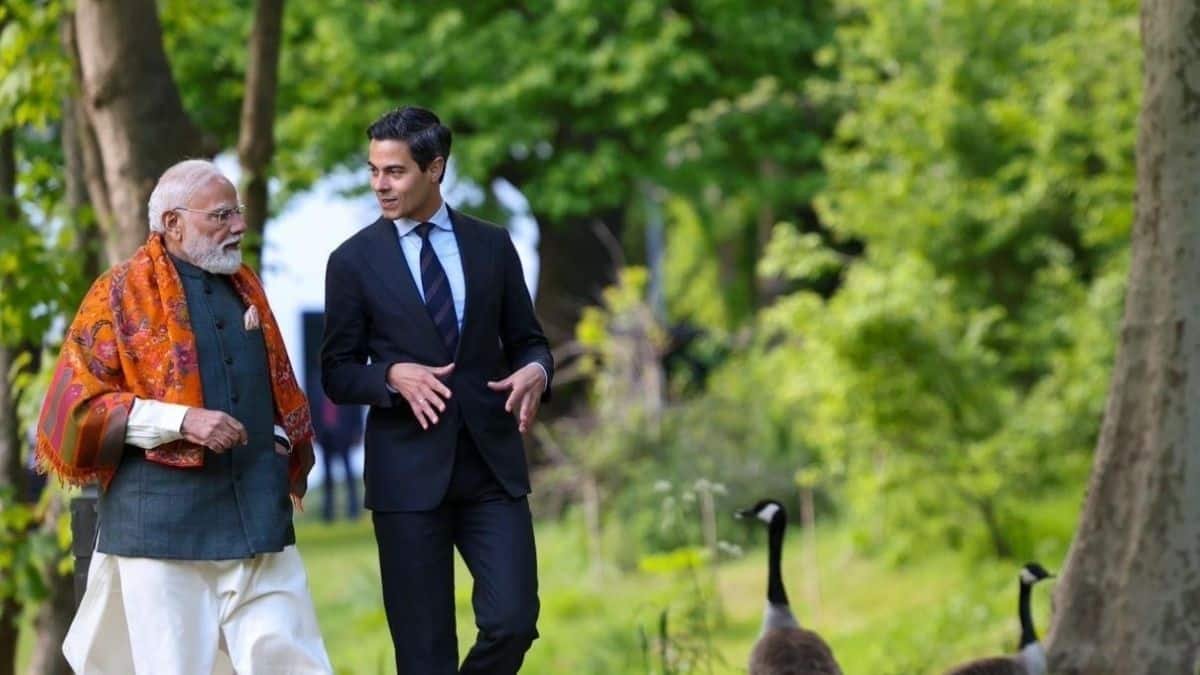
As Prime Minister Narendra Modi visited the Netherlands, Dutch Foreign Minister Tom Berendsen described the trip as a significant step forward in bilateral relations, saying India and the Netherlands had agreed to elevate ties to a “strategic partnership” amid shifting global geopolitics and expanding cooperation across technology, security and trade.
PM Modi arrived in the Netherlands as part of his wider European tour focused on deepening cooperation in trade, technology and security with major regional partners. Following bilateral talks, PM Modi and Dutch counterpart
Rob Jetten expressed confidence in the growing strength of India-Netherlands ties and the future direction of the partnership.
In an email interview with Firstpost, Berendsen said the relationship between the two countries had expanded significantly in recent years and was now entering a more ambitious phase.
“The longstanding relationship between India and the Netherlands has evolved very strongly over the past years, and both sides have now agreed to elevate it to a strategic partnership,” he said.
He noted, “This reflects the depth of trust and the expanding scope of cooperation between our
two countries.”
PM Modi’s visit: A strategic milestone
Berendsen said the Netherlands viewed India as “a logical and promising partner” because of its growing geopolitical and economic influence. “India is the world’s largest democracy and is emerging as a central player in the Indo-Pacific,” he said. “With a young population, a thriving technology sector, and growing military capacity, the country is of great importance for those seeking stability and economic opportunities in an increasingly multipolar world.”
The minister said Modi’s visit comes at a time when the international rules-based order is facing growing pressure. “This visit is an important milestone in our relationship and takes place at a time of geopolitical shifts and challenges to the international rules-based order,” he said.
According to Berendsen, both countries are now focused on building stronger cooperation in trade, security, maritime ties, innovation and people-to-people exchanges.
Semiconductor cooperation gains momentum
Responding to questions on the role of Dutch technology companies such as ASML in India’s semiconductor ambitions, Berendsen said both countries offer complementary strengths in the sector.
“Semiconductors today sit at the heart of economic security and technological competitiveness globally,” he said.
While the Netherlands has built what he called a “world-leading semiconductor ecosystem”, Berendsen noted that India brings engineering talent, innovation capacity and manufacturing ambitions to the partnership.
“Our focus is on building a sustained innovation bridge that connects academia, research institutions, startups, and industry across both countries,” he said.
He highlighted collaborations between Dutch organisations and Indian institutions such as the IITs and IISc through initiatives including BrainBridge.
According to Berendsen, recent global supply chain disruptions have increased the importance of trusted semiconductor ecosystems.
“In that context, India’s emergence as a key semiconductor hub, combined with Dutch technological strengths, offers a strong foundation for building a more resilient and future-ready global semiconductor landscape,” he said.
Shared focus on AI and digital governance
On artificial intelligence and whether middle powers should continue leading discussions around global AI governance, Berendsen said the Netherlands and India shared strong alignment on the issue.
“Both India and the Netherlands support an approach that balances innovation with democratic values, transparency, and inclusion,” he said.
He said both countries were exploring collaboration on ethical AI standards, cybersecurity, digital public infrastructure, research partnerships and capacity building.
“The Netherlands values India’s leadership on AI,” he added, pointing to the participation of the Dutch Prime Minister in the AI Impact Summit in New Delhi earlier this year.
Trade, hydrogen and economic connectivity
Berendsen also addressed the proposed India-EU Free Trade Agreement and the Netherlands’ role as a major European trade gateway.
On being asked how important India is to the Netherlands’ diversification strategy amid global tensions, he said, “India is increasingly important to Europe’s economic diversification strategy, and the Netherlands is well-positioned to become a major gateway for India-Europe trade.”
He said Dutch companies were increasing investments in logistics, renewable energy, agritech, life sciences and advanced manufacturing.
On being asked about major India-Netherlands projects for flood-prone regions, the minister spoke about discussions surrounding a proposed “Green Hydrogen Corridor” linking Indian ports with Rotterdam.
“The concept of a green hydrogen corridor linking Indian ports with Rotterdam is strategically very promising because it aligns India’s production potential with Europe’s future clean-energy demand,” he said.
Berendsen noted that discussions involving governments, ports and private stakeholders were continuing, though implementation would depend on infrastructure and regulatory readiness.
Water and agricultural technology cooperation
When asked about collaboration in water management and agricultural technology, Berendsen described water cooperation as one of the strongest pillars of the bilateral relationship.
“We have had a strategic water partnership since 2022,” he said.
He said Dutch expertise in flood resilience, coastal protection and climate adaptation was particularly relevant for India’s rapidly urbanising and climate-vulnerable regions.
“During the visit of Prime Minister Modi, a Letter of Intent on technical cooperation with regards to the Kalpasar project was signed,” he revealed.
On agricultural technology cooperation, Berendsen said the Netherlands viewed the sector as a natural area for deeper engagement with India.
“Potential cooperation areas include precision farming, greenhouse technologies, seed innovation, food processing, cold-chain logistics, sustainable irrigation, and climate-resilient agriculture,” he said.
“At scale, this cooperation could contribute significantly to food security, farmer productivity, and sustainable agriculture.”
Indo-Pacific and maritime security
Speaking about maritime security cooperation following the recent port call by Dutch frigate HNLMS De Ruyter in Kochi, Berendsen said the visit reflected the growing importance the Netherlands attached to the Indo-Pacific region.
“Maritime security cooperation can expand through naval exchanges, joint exercises, maritime domain awareness, cybersecurity cooperation, anti-piracy efforts, and protection of critical sea lanes,” he said.
“As a major trading nation, the Netherlands has a strong interest in ensuring a free, open, and rules-based Indo-Pacific.”
Ukraine war and strategic differences
Berendsen also addressed questions over differences between India and the Netherlands on the Ukraine war.
When asked about PM Modi’s call for peace in Ukraine and whether the Netherlands’ strong support for Kyiv creates friction with India’s neutral stance in building a deeper security partnership, Berendsen said the two countries may not always share identical positions on every geopolitical issue.
“For the Netherlands, the Russian war of aggression against Ukraine is the most serious security challenge facing Europe in decades,” he said.
At the same time, he stressed that strategic partnerships could continue despite differing approaches to geopolitical issues.
“India and the Netherlands may not always approach every geopolitical issue identically, but mature strategic partnerships are built on mutual respect and open dialogue,” he said.
“Differences on one issue do not prevent cooperation in many others.”
Indian diaspora and cultural links
On the role of the Indian-origin community in the Netherlands, Berendsen said the diaspora remained an important bridge between the two countries.
“It serves as a natural bridge between our societies,” he said.
He added that the community contributes across business, healthcare, academia, entrepreneurship and technology.
Berendsen also highlighted cultural cooperation, referring to the opening of a major Amrita Sher-Gil exhibition at the Drents Museum, featuring 48 paintings loaned from the National Gallery of Modern Art.
Cybersecurity and counter-terror cooperation
Discussing emerging security threats and cooperation under the Joint Working Group on Counter-Terrorism, Berendsen said cyber resilience and critical infrastructure protection were becoming increasingly important.
“The evolving threat landscape means the focus is on cyber resilience, protection of critical infrastructure and emerging hybrid threats,” he said.
He added, “Democratic societies must strengthen cooperation against transnational threats while also safeguarding open digital ecosystems.”
First Published:
May 17, 2026, 10:28 IST
End of Article