

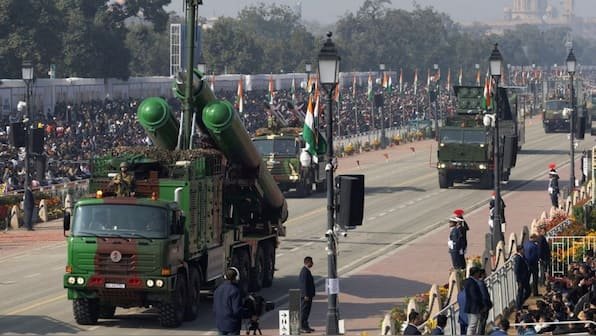
India commemorates the first anniversary of Operation Sindoor on Thursday (May 7, 2026).
While the tactical success of the 96-hour conflict in May last year remains etched in military history, the most enduring legacy of the operation is its seismic impact on the Indian economy.
By early this year, the “battle-proven” credentials earned by homegrown hardware during the conflict have translated into an unprecedented Rs 24,000 crore in fresh export orders, propelling India into the top tier of global defence exporters.
According to data released by the Ministry of Defence (MoD) in April 2026, India’s total defence exports for the 2025-26 financial year reached a historic peak of Rs 38,424 crore ($4.6 billion).
This figure represents a massive 62.6 per cent surge compared to the previous fiscal year, a growth trajectory fuelled almost entirely by the demonstrated lethality and reliability of indigenous systems under fire.
The transition of Indian defence technology from “budget-friendly alternative” to “strategic necessity” marks a turning point in the Atmanirbhar Bharat (Self-Reliant India) initiative.
How Operation Sindoor validated “Made in India” tech
Prior to May 2025, international perception of India’s domestic defence platforms was often characterised by scepticism. Global buyers frequently viewed indigenous systems as either perpetually under development or untested in the crucible of high-intensity electronic warfare.
Operation Sindoor
shattered these perceptions within a 96-hour window.
The precision strikes launched on May 7, 2025, specifically targeting the airbases at Nur Khan and Rahimyar Khan, served as a live demonstration of the Air-Launched BrahMos missile’s capabilities.
Its ability to navigate through sophisticated air defences and deliver surgical strikes provided the kind of marketing no defence expo could replicate.
The conflict also showcased India’s mastery of the “sensor-to-shooter” link. During the Suppression of Enemy Air Defences (SEAD) operations, Indian-developed loitering munitions — often referred to as “kamikaze drones” — successfully neutralised adversary radar installations in a highly contested electronic environment.
The success of these systems led to a flood of inquiries and contracts.
Between July 2025 and March 2026 alone, the Rs 24,000 crore in new export orders was driven by four primary “star” performers:
-
The BrahMos missile system: Long considered the crown jewel of Indian defence, its ability to bypass Chinese-origin HQ-9 air defence systems during the operation made it a high-priority acquisition for Southeast Asian and West Asian countries
facing similar regional threats. -
Akash air defence system (New Generation): The night of May 9-10, 2025, proved pivotal for
the Akash-NG. The system achieved a staggering interception rate of over 90 per cent against subsonic cruise missiles and retaliatory drone swarms. Consequently, by early this year, five nations across Africa and South America had signed procurement contracts, citing the system’s mobility and ability to engage multiple targets simultaneously. -
Indigenous loitering munitions: Operation Sindoor marked the first large-scale deployment of domestic “silent killers.” Their surgical precision and ability to identify high-value targets led to significant orders from ASEAN nations and Eastern European countries.
-
Netra AEW&C (Airborne Early Warning & Control): Acting as the “Eye in the Sky,” the Netra platform coordinated a massive 114-aircraft engagement. Its resilience against adversary jamming bolstered global confidence in India’s electronic warfare (EW) and radar suites.
How the surge has hit the Indian Economy
The financial ramifications of this export boom extend far beyond the Ministry of Defence’s balance sheet. The surge to Rs 38,424 crore has revitalised the domestic manufacturing ecosystem.
For the first time, the private sector has emerged as a dominant force, contributing 45.16 per cent (Rs 17,352 crore) of the total exports in FY2026. This represents a 54 per cent year-on-year growth for private firms, highlighting a successful synergy between the state and commercial enterprises.
This industrial momentum has had a tangible impact on the labour market. The MoD estimates that the export spike has supported approximately 1.5 lakh direct and indirect jobs within the defence manufacturing sector.
Moreover, the profits generated from these international sales are already being channeled into “Sindoor-II” generation technologies. Current Research and Development (R&D) efforts are focusing on AI-driven autonomous swarms and hypersonic glide vehicles to ensure India maintains its technological edge.
The broader industrial base has also seen a structural shift. As highlighted in the “Rubix Industry Insights: Defence” report shared with Firstpost, India’s defence production reached a record INR 1.54 trillion in FY2025, a 3.2-fold increase over the last decade.
The report points out that 65 per cent of India’s defence equipment is now manufactured domestically — a complete reversal of the situation a decade ago when the country relied on imports for nearly 70 per cent of its requirements.
The government’s fiscal commitment has kept pace with this growth. The defence budget has tripled since FY2014, reaching INR 7.85 trillion for FY2027.
This allocation represents 14.67 per cent of the total Union Budget, the largest of any ministry.
With a production target of INR 3 trillion and an export target of INR 500 billion by FY2029, the trajectory suggests that India is firmly on the path to becoming a global defence powerhouse.
How India is diversifying defence through policy
India’s rise as an exporter is mirrored by a strategic shift in its role as an importer. While India remains the world’s second-largest arms importer, it has successfully diversified its supplier base to reduce vulnerability.
The share of Russian imports has seen a dramatic decline, dropping from 70 per cent in the 2011-2015 period to approximately 40 per cent between 2021 and 2025. In its place, France has emerged as a key partner, accounting for 29 per cent of imports, followed by Israel at 15 per cent.
This diversification is supported by a robust internal policy framework. Several key initiatives have been credited for the 2026 milestone:
-
Export facilitation: A revamped, online Standard Operating Procedure (SOP)
has slashed the time required for export authorisations from several months to just a few weeks. -
PLI schemes: The Production Linked Incentive (PLI) scheme for drones and components, updated in late 2025, allowed domestic manufacturers to scale production rapidly to meet international demand.
-
Corporatisation: The transformation of the former Ordnance Factory Boards into seven Defence Public Sector Undertakings (DPSUs) has enabled more competitive global pricing.
-
Positive Indigenisation Lists (PIL): By restricting the import of specific components and platforms, the government has forced a deeper reliance on local MSMEs and startups.
Currently, over 16,000 MSMEs are active in the defence supply chain, and more than 1,000 defence startups have attracted nearly USD 2 billion in funding since 2017.
This burgeoning ecosystem is providing what Indian diplomats call “security-in-a-box” — a comprehensive package of missiles, radars, and training — which has become a vital tool in India’s “Act East” and “Look West” diplomatic policies.
How key players are securing major defence orders
The record-breaking export and production figures are the result of specific, high-value contracts and technological breakthroughs achieved by major players in the Indian defence industry.
Over the past year, several companies have secured landmark deals that define the current era of Indian military manufacturing.
Hindustan Aeronautics Limited (HAL)
HAL remains at the forefront of the aerospace sector. In 2025, the company secured one of the most significant contracts in the history of Indian defence: a INR 620+ billion order for 97 Tejas Mk1A fighter jets.
Additionally, HAL received an INR 135+ billion order for 12 Sukhoi Su-30MKI aircraft.
The company is also moving forward with the HTT-40 trainer aircraft and the fifth-generation Advanced Medium Combat Aircraft (AMCA) initiative.
Bharat Electronics Limited (BEL)
In April 2026, the MoD signed a INR 19.5 billion contract with BEL for two mountain radars designed by the DRDO. BEL has been prolific, securing contracts worth over INR 5.8 billion in June 2025 for missile sighting and communication systems.
Notably, BEL formed a joint venture with France’s Safran Electronics and Defence in November 2025 to manufacture HAMMER smart precision-guided air-to-ground weapons, further integrating Indian manufacturing with global standards.
Bharat Dynamics Limited (BDL)
BDL is expanding its footprint with two new manufacturing units. A facility at Ibrahimpatnam will focus on advanced assembly lines, while a new plant in Jhansi will handle propellant production and Grad rockets, with operations starting in FY2027.
In late 2025, BDL signed a INR 20.96 billion deal to provide INVAR anti-tank missiles for the Army’s T-90 tanks.
Larsen & Toubro (L&T)
L&T continues to be a leader in heavy engineering and land systems. In November 2025, they signed a contract for the indigenous production of BvS10 Sindhu vehicles in partnership with BAE Systems.
L&T also received a follow-on order in December 2024 for the second batch of K9 Vajra-T self-propelled howitzers. In April 2026, India and South Korea agreed to deepen this cooperation through a third phase focused on co-development and technology transfer.
Adani Defence and Aerospace
In February 2026, the group signed an MoU with Italy’s Leonardo to create a helicopter manufacturing ecosystem in India, targeting the production and maintenance of AW169M and AW109 TrekkerM helicopters.
Bharat Forge (and Kalyani Strategic Systems)
This group secured a INR 16.6 billion contract for domestic CQB carbines and over INR 2.5 billion for underwater systems. They are also supplying unmanned ISR platforms and loitering munitions under emergency procurement norms.
Mazagon Dock Shipbuilders Limited (MDL)
India is currently finalising a massive INR 900 billion deal with Germany for six advanced submarines under Project 75I, which will be built jointly by MDL and Thyssenkrupp Marine Systems.
Reliance Defence
In June 2025, the company secured a INR 6 billion export order for high-tech ammunition from Germany’s Rheinmetall Waffe Munition GmbH, one of the largest orders of its kind in this sector.
Tata Advanced Systems Limited
Early in 2026, Tata was awarded the contract to support the overhaul and upgrade of the Army’s first-generation Pinaka Multiple Launch Rocket Systems (MLRS).
How overcoming structural hurdles is crucial for the future
Despite the euphoria surrounding the first anniversary of Operation Sindoor, industry analysts flag several structural challenges that remain.
India still faces a significant reliance on imports for high-end technologies, most notably jet engines and advanced sensors. There is also a persistent gap in R&D intensity compared to global leaders like the US or China.
Addressing these pinch points will require deeper collaboration between the industry and academia, as well as accelerated investment in disruptive technologies.
However, the momentum is undeniable.
With the draft DAP [Defence Acquisition Procedure] 2026 and the continued success of the iDEX (Innovations for Defence Excellence) programme, the ecosystem is becoming increasingly resilient.
As we look toward the 2029 targets, the record-breaking figures of early 2026 serve as a testament to a nation that has successfully weaponised its industrial potential.
Also Watch:
With inputs from agencies
First Published:
May 06, 2026, 17:36 IST
End of Article