

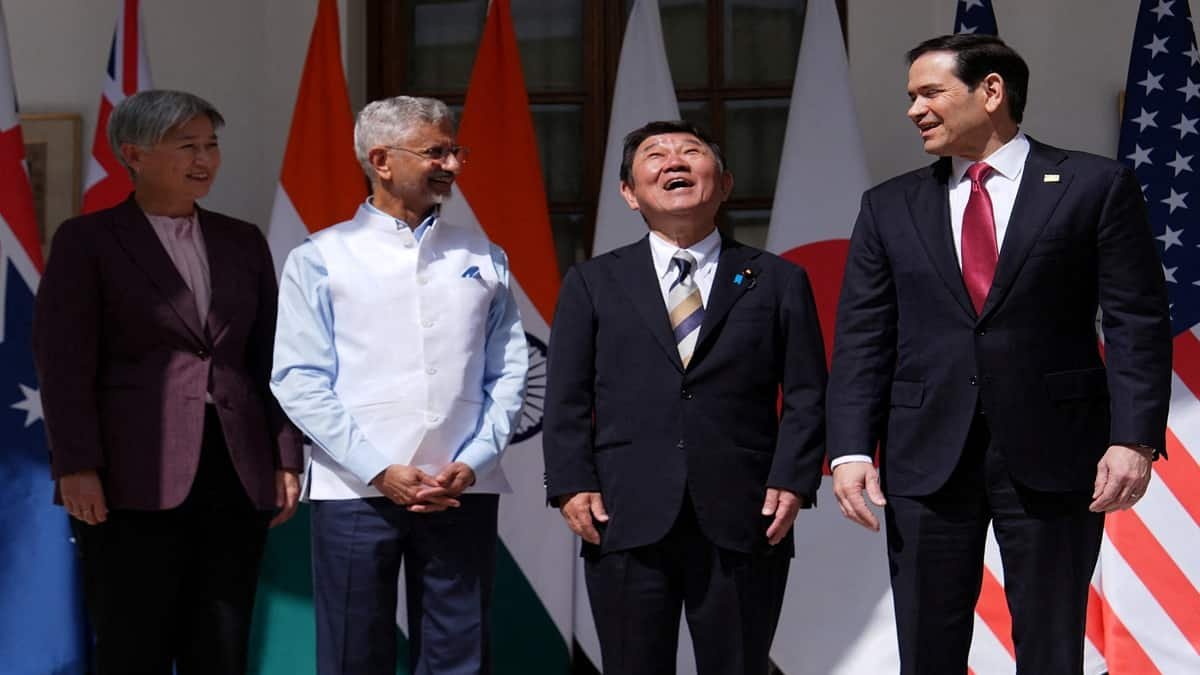
The Quad nations on Tuesday projected a united front on safeguarding maritime security, strengthening energy resilience, securing critical supply chains and preserving a free and open Indo-Pacific amid growing concerns over the Iran conflict.
The Quad nations on Tuesday projected a united front on safeguarding maritime security, strengthening energy resilience, securing critical supply chains and preserving a free and open Indo-Pacific amid growing concerns over the Iran conflict, and tensions in the Strait of Hormuz.
Foreign ministers of India, the United States, Australia and Japan announced a series of new initiatives ranging from maritime surveillance and port infrastructure to critical minerals and energy security, while also underlining the importance of international law, freedom of navigation and regional stability.
Addressing the media after the Quad Foreign Ministers’ meeting, India’s External Affairs Minister Dr S Jaishankar said that the Quad nations had agreed on the need for “zero tolerance” towards terrorism while reaffirming their commitment to a free and open Indo-Pacific.
#WATCH | Delhi | After Quad Foreign Ministers’ meeting, EAM Dr S Jaishankar says, “The Quad nations are open societies that foster innovation and creativity in our quest for growth and prosperity. These forces are strengthened when we undertake more exchanges as we intend to… pic.twitter.com/RFUKDObmlM
— ANI (@ANI) May 26, 2026
Jaishankar said that
nations facing terrorist attacks “have the right to defend themselves” and stressed that the four democracies were working together to strengthen regional stability through economic cooperation, maritime security and technological partnerships.
The foreign ministers also focused heavily on the growing strategic importance of the Indo-Pacific, particularly amid concerns that the Iran conflict and possible
disruption in the Strait of Hormuz could affect global energy supplies and maritime commerce.
Maritime security and Indo-Pacific focus
Jaishankar said that the Quad nations discussed safe and unimpeded maritime commerce and reaffirmed the importance of observing international law. He noted that cooperation among the four countries had expanded steadily in areas including maritime surveillance, logistics, undersea cables, training, humanitarian assistance and disaster relief.
US Secretary of State Marco Rubio announced several new Quad initiatives, including the launch of the Indo-Pacific Maritime Surveillance Cooperation Initiative to improve information-sharing among member countries. He also confirmed the expansion of the Indo-Pacific Maritime Domain Awareness Initiative, which will provide near-real-time maritime tracking data to countries across the region.
#WATCH | Following the Quad Foreign Ministers’ meeting, US Secretary of State Marco Rubio says,” I’m very happy today that as a result of the work that our teams have been doing leading up to this conversation, we have real concrete achievables that we can announce to our… pic.twitter.com/ROpfnpY5II
— ANI (@ANI) May 26, 2026
Rubio said that maritime security had become even more critical as nearly 60 per cent of global maritime trade passes through the Indo-Pacific. He also announced plans for the Quad to jointly work with Fiji on a port infrastructure project, calling it the grouping’s first collective port initiative in the Pacific region.
Iran conflict, energy security and supply chains
Australian foreign minister Penny Wong said that the deteriorating strategic environment and the Iranian threat to close the Strait of Hormuz had reinforced the need for stronger regional cooperation on energy security and freedom of navigation.
She said that the Quad had launched a new Indo-Pacific Energy Security Initiative and emphasised opposition to any “tolling proposition” affecting maritime routes. Wong also highlighted growing cooperation on maritime surveillance in the Indian Ocean, cyber security, law enforcement and efforts to combat illegal fishing and trafficking.
Rubio additionally announced the Quad Critical Minerals Framework, aimed at strengthening supply chains through coordinated investments in mining, processing and recycling of critical minerals.
Japan targets coercion, North Korea concerns
Japanese foreign minister Toshimitsu Motegi said that the Quad remained central to achieving a “Free and Open Indo-Pacific” and stressed that regional countries must retain the ability to determine their own future.
Without naming China directly, Motegi said the ministers had agreed to “strongly oppose attempts to unilaterally change the status quo by force or coercion.” He also voiced concern over restrictions on critical mineral exports and reaffirmed commitment towards the complete denuclearisation of North Korea.
Motegi said the situation surrounding Iran and the Strait of Hormuz carried “enormous impact” for the Indo-Pacific region, particularly from an energy supply perspective, and underlined the importance of diplomatic efforts to ensure free and safe navigation in the strategic waterway.
First Published:
May 26, 2026, 11:48 IST
End of Article