

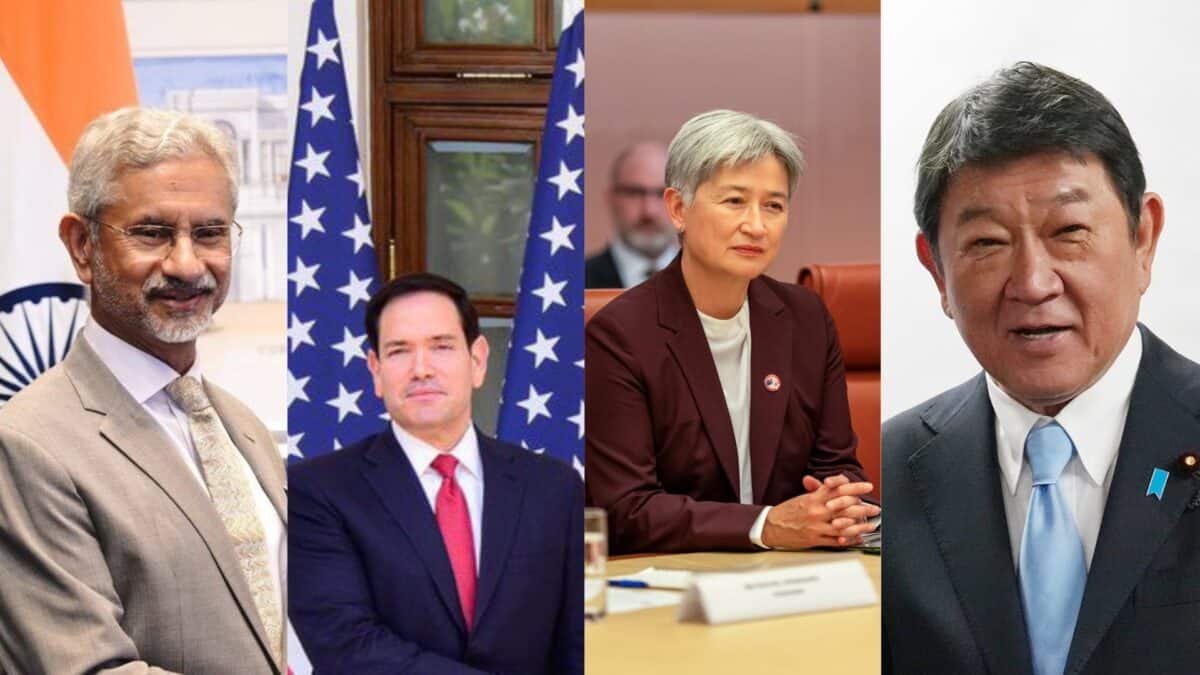
From maritime security to energy resilience, Quad foreign ministers meet in New Delhi as the four-nation alliance sharpens its response to West Asia’s growing impact on Indo-Pacific trade and stability
The foreign ministers of the Quadrilateral Security Dialogue (Quad) are meeting in New Delhi today to align priorities and boost momentum in the four-nation alliance.
Hosted by External Affairs Minister S Jaishankar, the meeting brings together
US Secretary of State Marco Rubio, Australian Foreign Minister Penny Wong, and Japanese Foreign Minister Toshimitsu Motegi.
While the Quad remains anchored in its vision of a “Free and Open Indo-Pacific,” this year’s discussions are expected to focus heavily on geopolitical disruptions beyond the region, particularly the escalating crisis in West Asia and its impact on global maritime trade and energy flows.
India-Japan talks focus on economic security
Ahead of the multilateral summit, Jaishankar held extensive bilateral talks with Motegi on Monday evening, underlining the growing strategic significance of the India-Japan Special Strategic and Global Partnership.
The discussions reflected shared concerns over intensifying global uncertainty, which Motegi described as the most significant structural shift in the post-war era.
FM MOTEGI held a meeting with H.E. Dr. Subrahmanyam JAISHANKAR, Minister of External Affairs of India, during his visit to India. FM MOTEGI explained Japan’s Updated Free and Open Indo-Pacific (FOIP), and both ministers confirmed that Japan and India would cooperate toward its… pic.twitter.com/HlDOh5K7SD
— MOFA of Japan (@MofaJapan_en) May 25, 2026
Jaishankar highlighted the direct impact of instability in West Asia on both nations, noting that India and Japan are heavily dependent on imported energy and uninterrupted maritime trade routes. He stressed that economic security, resilient supply chains, and secure shipping corridors have become central concerns for all major economies.
The two sides also reviewed cooperation in critical technologies, semiconductors, and rare earth supply chains, while advancing private-sector dialogue aimed at strengthening industrial resilience.
#WATCH | Delhi: During his meeting with EAM Dr S Jaishankar, Japanese FM Motegi Toshimitsu says, “The world is faced with the most significant structural change in the post-war era, driven by a shift in the balance of power and the intensification of conflict and confrontations.… pic.twitter.com/jBI3KGYUG2
— ANI (@ANI) May 25, 2026
West Asia crisis tops Quad agenda
A key issue dominating today’s summit is the economic fallout from shipping disruptions linked to tensions in West Asia, especially concerns over the Strait of Hormuz and its role as a critical artery for global energy supplies.
With threats to freedom of navigation growing, Quad ministers are expected to coordinate a unified response focused on preserving open sea lanes and protecting the economic lifelines connecting West Asia to the Indo-Pacific.
The grouping is positioning itself as a stabilising force at a time of mounting uncertainty across international trade routes.
Expanding practical cooperation
Beyond immediate security challenges, the ministers will review progress on key Quad-led initiatives. This includes the Indo-Pacific Maritime Domain Awareness (Ipmda) Partnership, which enhances satellite-based tracking of illicit maritime activity and dark shipping across regional waters.
Discussions will also focus on finalising frameworks for critical mineral supply cooperation, aimed at reducing strategic dependence on vulnerable supply chains and ensuring secure access to rare earth materials essential for clean energy transitions.
The New Delhi summit is expected to help overcome recent friction and build momentum toward a leaders’ summit later this year.
Following the formal sessions, the visiting foreign ministers are scheduled to jointly call on Prime Minister Narendra Modi, marking the final key engagement of their official visit to New Delhi.
First Published:
May 26, 2026, 07:12 IST
End of Article