

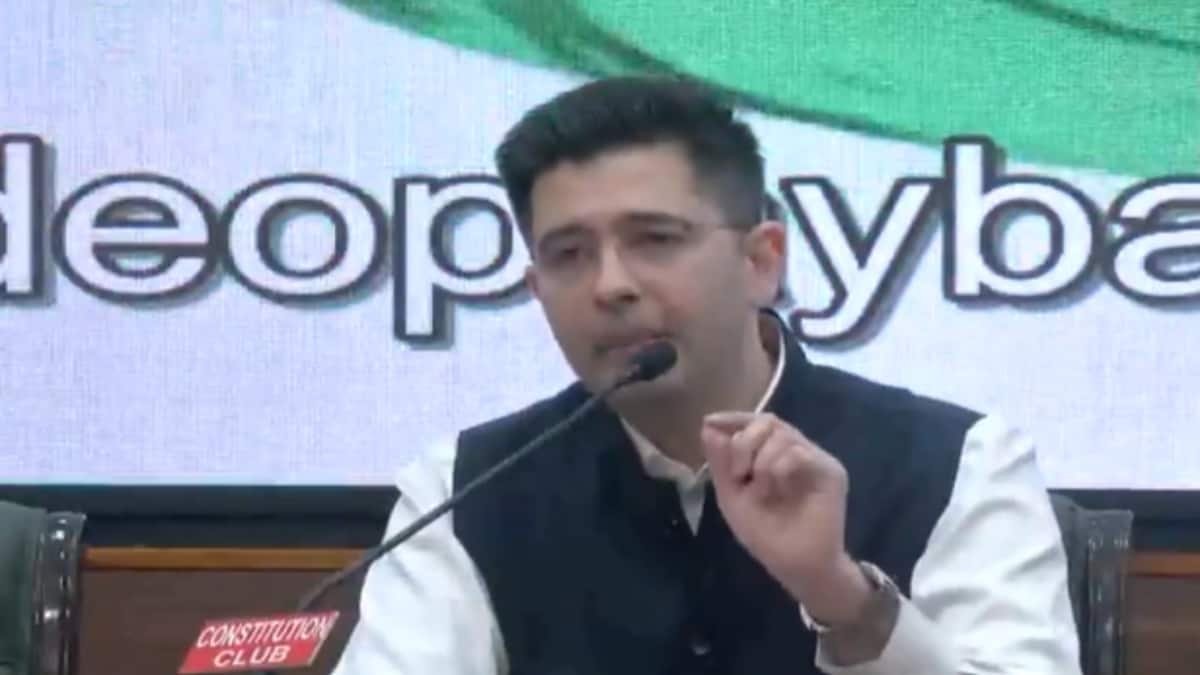
In a major setback for the Aam Aadmi Party (AAP), seven of its Rajya Sabha MPs resigned on Friday, marking a significant political realignment in the Upper House.
At a press conference, AAP leader Raghav Chadha, accompanied by Sandeep Pathak and Ashok Mittal, announced that two-thirds of the party’s Rajya Sabha strength had stepped down and would join the Bharatiya Janata Party (BJP) as a faction.
Chadha further stated that fellow MPs Harbhajan Singh and Swati Maliwal were also among those quitting the AAP.
#WATCH | 2/3rd MPs of AAP in Rajya Sabha announce merging with the BJP.
AAP MP Raghav Chadha says, “There are 10 AAP MPs in the Rajya Sabha, more than 2/3rd of them are with us in this. They have signed and this morning we submitted the signed letter and documents to the Rajya… pic.twitter.com/mn4kuYs2ht
— ANI (@ANI) April 24, 2026
“There are 10 AAP MPs in the Rajya Sabha, more than 2/3rd of them are with us in this. They have signed and this morning we submitted the signed letter and documents to the Rajya Sabha Chairman…3 of them are here before you. Besides us, there are Harbhajan Singh, Rajinder Gupta, Vikram Sahney and Swati Maliwal,” ANI quoted him as saying.
“We have decided that we, the 2/3rd members belonging to the AAP in Rajya Sabha, exercise the provisions of the Constitution of India and merge ourselves with the BJP,” Chadha added.
He accused the AAP of completely straying from its principles, values and core morals.
“AAP, that I nurtured with my blood and sweat and to which I gave 15 years of my youth, has completely strayed from its principles, values and core morals,” said Chadha.
Chadha was recently removed as the deputy leader of AAP in the Rajya Sabha and was replaced by Mittal in the Upper House.
“In the Rajya Sabha, the Aam Aadmi Party has 10 MPs. More than two-thirds of them are with us in this initiative.
“They have already signed, and this morning we submitted all the required documentation, including signed letters and other formal paperwork, to the chairman of the Rajya Sabha,” Chadha told reporters.
Hitting out at Arvind Kejriwal-led AAP, Chadha said that the party is no longer working for the country, but for its own benefit.
“Over the past few years, I have increasingly felt that I am the right person in the wrong party. Today, I announce my decision to move away from AAP and work more closely with the ‘janata’ (public),” he said.
Another Rajya Sabha MP, Sandeep Pathak, said that he had never thought that this situation would arise, but it has.
“For 10 years, I remained associated with this party. And today, I am parting ways with the Aam Aadmi Party,” Pathak said.
On April 15, the Enforcement Directorate (ED) conducted raids at business entities linked to AAP Rajya Sabha MP Ashok Mittal in Punjab as part of a FEMA probe.
Will Raghav Chadha face disqualification?
The merger of AAP Rajya Sabha MPs with the BJP has triggered legal and constitutional questions over whether Raghav Chadha and others could face disqualification under India’s anti-defection law.
The development invokes constitutional provisions governing party mergers in Parliament, where a minimum two-thirds support within a legislative group is required to avoid disqualification. With more than seven of AAP’s 10 Rajya Sabha MPs reportedly backing the move, the threshold appears to have been met.
However, legal experts have raised questions over whether the anti-defection law applies in its current form.
Former Lok Sabha Secretary General PDT Achary told News18 on Friday that numerical strength alone is not sufficient to protect MPs from disqualification.
“The original party (in this case, AAP) has to merge with the BJP for members to escape the anti-defection law,” he was quoted as saying.
He added that unless the party led by Arvind Kejriwal formally merges with the BJP, MPs including Chadha and others could still be at risk. “The original party has to merge,” he stressed.
Meanwhile, sources indicate that AAP is preparing to file a petition seeking the disqualification of the seven Rajya Sabha MPs under the anti-defection law.
What is anti-defection law?
The anti-defection law, introduced through the 52nd Constitutional Amendment in 1985 and placed in the Tenth Schedule of the Constitution, bars elected representatives from switching parties or defying party whips without risking disqualification.
The final decision rests with the Speaker or Chairman of the House, a process often criticised for delays and political interpretation.
Originally, the law allowed a “split” if one-third of legislators broke away, but this provision was removed by the 91st Amendment in 2003. Currently, only mergers supported by at least two-thirds of a party’s members are protected from disqualification.
In 1988, Lalduhoma, a Lok Sabha member from Mizoram, became the first person to be disqualified under the new anti-defection law for allegedly shifting allegiance, setting a crucial precedent for the law’s application.
With inputs from agencies
First Published:
April 24, 2026, 20:52 IST
End of Article