

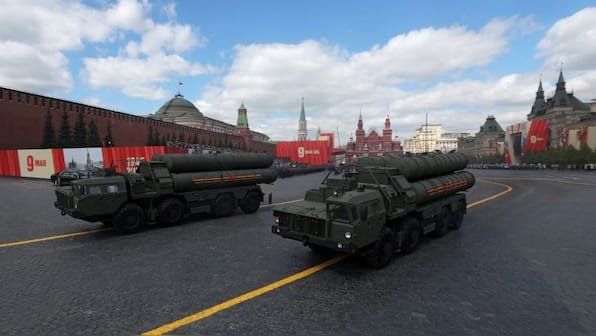
India is reportedly preparing to receive the long-awaited fourth squadron of the Russian-origin S-400 Triumf air defence system this week.
The S-400, referred to by the Indian Air Force (IAF) as the “Sudarshan Chakra,” recently evolved from a strategic deterrent into a combat-tested operational platform following its reported role during Operation Sindoor in May 2025.
India originally signed the S-400 agreement with Russia in October 2018 under a government-to-government arrangement valued at nearly $5.43 billion, or approximately Rs 40,000 crore at the time.
The agreement covered the supply of five squadrons of the advanced long-range surface-to-air missile system. Three squadrons have already been integrated into India’s defence network and are operational across strategically important sectors.
The
fourth squadron is now arriving in India this month, after reportedly departing Russian territory.
The fifth and final squadron under the original contract is expected to be delivered by late this year, although some assessments suggest early 2027 remains a possibility depending on logistical timelines.
India’s has
also reportedly decided to pursue an additional five S-400 squadrons after the system’s operational performance during the India-Pakistan military confrontation of May 2025, as well as roughly 280 interceptor missiles intended to replenish stocks.
If completed, the future inventory would rise to 10 squadrons, considerably expanding India’s long-range air defence umbrella.
Why has the S-400 become important for India?
The S-400, manufactured by Russian state-owned defence conglomerate Almaz-Antey, is widely considered among the most capable long-range air defence systems currently in service globally because of its ability to detect, track, and engage multiple categories of aerial threats simultaneously over extended distances.
For India, the system fills a critical requirement in building what military planners describe as a layered and network-centric air defence environment.
The S-400 provides the Indian Air Force with the capability to engage enemy assets long before they approach Indian airspace, thereby creating a large anti-access and area denial zone across sensitive sectors.
One of the key reasons the system is viewed as strategically vital is its reach. The longest-range interceptor missile associated with the S-400, the 40N6E, is capable of targeting aircraft and other airborne objects at distances of up to 400 kilometres.
This means high-value enemy assets such as airborne early warning aircraft, surveillance platforms, strategic bombers, and electronic warfare systems can potentially be tracked and engaged from deep inside Indian-controlled operational space.
The system also possesses the ability to counter a wide spectrum of threats rather than focusing on a single mission profile.
Apart from fighter aircraft, the S-400 can reportedly engage cruise missiles, ballistic missiles, stealth platforms, unmanned aerial vehicles, and precision-guided munitions.
Unlike certain Western air defence systems that prioritise ballistic missile interception, the S-400 is designed to operate across several categories of threats at the same time.
This versatility has made it particularly attractive for India, which faces diverse aerial challenges across both the western and northern fronts.
Another major advantage lies in its networking capability. The S-400 does not operate independently within India’s military framework. Instead, it forms part of a much larger integrated air defence structure that combines indigenous and imported systems into a common operational grid.
How does the S-400 function within India’s wider air defence network?
Within the Indian defence ecosystem, the S-400 acts as a central node inside
the Indian Air Force’s Integrated Air Command and Control System, commonly known as IACCS. This highly automated network processes real-time information gathered from a wide range of military and civilian sensors.
The network receives inputs from airborne early warning and control platforms such as Netra and Phalcon systems, civilian radar infrastructure, military surveillance assets, and ground-based monitoring stations.
Once data is collected and processed, engagement priorities are allocated across different air defence layers.
In this architecture, the S-400 serves as the long-range shield, while indigenous and medium-range systems handle closer targets and lower-cost threats.
Systems such as
Akash and the MRSAM, also known as
Barak-8, are integrated into this structure to ensure expensive S-400 interceptors are preserved for high-priority engagements.
This layered arrangement becomes particularly important in scenarios involving saturation attacks, where an adversary may launch multiple drones or low-cost munitions alongside more sophisticated missiles. Smaller targets can be filtered and intercepted by shorter-range systems, leaving the S-400 free to focus on strategic threats.
India is also preparing for the future integration of Project Kusha, the country’s indigenous long-range surface-to-air missile initiative. Defence planners are reportedly designing the future air defence environment in a way that allows the S-400 and Project Kusha to operate simultaneously under a unified command framework.
The S-400’s flexibility also stems from its use of multiple interceptor missiles, each designed for specific engagement profiles:
-
The 40N6E missile, which has a maximum range of 400 kilometres, is intended primarily for strategic airborne assets including AWACS and electronic warfare aircraft.
-
The 48N6 interceptor, capable of engaging targets up to 250 kilometres away, is suited for high-speed fighter aircraft and ballistic missile interception.
-
The 9M96E2 missile covers medium-range engagements up to 120 kilometres and is optimised for cruise missiles and stealth aircraft.
-
Meanwhile, the shorter-range 9M96E interceptor is used against low-flying cruise missiles, unmanned aerial vehicles, and precision-guided munitions at distances of around 40 kilometres.
This layered interceptor structure allows Indian operators to use missiles selectively based on the nature of the threat rather than relying on a single engagement profile for every target.
How are S-400 systems transported from Russia to India?
The movement of S-400 squadrons from Russia to India represents a major logistical exercise because the system is not a single piece of equipment.
Each squadron includes launcher vehicles, engagement radars, command-and-control units, missile carriers, communications systems, and technical support infrastructure. These components are first transported from Russian facilities through specialised cargo vessels.
The shipments travel to Indian ports, where unloading operations are coordinated under heavy security arrangements. From there, the equipment is transferred through railway networks and heavy-duty road convoys to designated Indian Air Force deployment locations.
Because of the size and sensitivity of the hardware involved, the deployment process requires careful sequencing. Radar systems, missile launchers, and communication vehicles need to be integrated into operational formations before the squadron becomes fully functional.
The delivery schedule for the fourth and fifth squadrons experienced major disruptions during the past two years due to the ongoing Russia-Ukrainian War.
Global semiconductor shortages, manufacturing bottlenecks inside Russia’s defence sector, and restrictions on banking channels after sanctions on Moscow also slowed implementation timelines.
Financial transactions became particularly challenging after several Russian banking entities were disconnected from the SWIFT system.
To continue payments linked to the S-400 agreement, India and Russia reportedly shifted toward alternative arrangements including Rupee-Ruble trade mechanisms and the use of other currencies outside traditional Western banking frameworks.
By late last year, Russia was able to scale up defence production capacity and gradually address supply backlogs, allowing the fourth squadron to move toward shipment earlier this month.
Where has India deployed the S-400 systems so far?
India’s existing S-400 deployments have been strategically positioned to provide maximum coverage across sensitive military sectors.
One squadron has been deployed near the Siliguri Corridor, commonly known as the “Chicken’s Neck,” a narrow stretch of land linking India’s northeastern states with the rest of the country.
This area is considered one of India’s most strategically sensitive geographic points because disruption there could isolate the Northeast from the rest of the country.
Another squadron has been stationed at Pathankot, allowing coverage across Jammu and Kashmir and parts of Punjab. Existing deployments also protect sectors covering Rajasthan and Gujarat along the western frontier.
The fourth squadron arriving this week is expected to also strengthen India’s western sector.
Military analysts have also pointed out that the S-400’s radar range and engagement envelope create operational complications for adversary air forces because high-value aircraft are forced to operate farther from Indian airspace.
What role did the S-400 play during Operation Sindoor?
The S-400 received quite a lot of international attention following reports surrounding its operational use during Operation Sindoor, the four-day military confrontation between India and Pakistan that took place between May 6 and May 10, 2025, after
the Pahalgam terror attack.
During the conflict, the S-400 reportedly transitioned from a strategic deterrent platform into an actively employed combat asset.
According to operational accounts, the system was used extensively across northern and western sectors to monitor and engage Pakistani aerial activity. Reports indicated that the S-400 tracked incoming missile salvos, drones, cruise missiles, and fighter aircraft during the confrontation.
One of the most widely discussed aspects of the operation involved the reported interception of a high-value aerial target at an extreme distance of 314 kilometres. Additional reports also stated that
an aggressive JF-17 fighter aircraft was neutralised at nearly 200 kilometres.
The S-400 reportedly established a highly restrictive operational environment by forcing hostile airborne early warning aircraft and support platforms to remain deep inside their own territory.
This reduced the adversary’s ability to coordinate aerial operations effectively near Indian airspace.
The system was also subjected to heavy electronic warfare measures and suppression attempts during the confrontation.
Reports suggested that around 60 CM-400AKG supersonic anti-radiation missiles were launched in an attempt
to target Indian S-400 batteries located near airbases such as Adampur.
Despite the attempted saturation attacks and electronic warfare pressure, the system reportedly remained operational throughout the conflict.
Which other countries operate the S-400?
Russia remains the largest operator of the system, maintaining numerous regiments deployed across its territory.
Russian S-400 batteries have also seen extensive use during the ongoing conflict in Ukraine, where the system reportedly recorded confirmed interceptions of Western-supplied ATACMS tactical ballistic missiles during late 2025.
China became the first foreign customer of the S-400 after signing a contract in 2014.
Deliveries to Beijing began in 2018, and the systems have reportedly been positioned along eastern and southern coastal sectors, extending Chinese anti-access coverage over regions including the Taiwan Strait and disputed islands in the East China Sea.
Turkey acquired the S-400 (Nato reporting name: SA-21 Growler) under a controversial agreement signed in 2017.
The delivery triggered major tensions with the United States and Nato allies, ultimately resulting in Turkey’s removal from the American F-35 stealth fighter programme and the imposition of CAATSA [Countering America’s Adversaries Through Sanctions Act] sanctions.
Belarus also operates S-400 systems supplied by Russia since late 2021, with its air defence network functioning in coordination with Moscow.
Military analysts have additionally pointed toward indications that advanced Russian air defence components, including operational S-400 elements, may have been supplied to Iran as the latter deals with a conflict against US-Israel in West Asia.
Countries including Saudi Arabia, Iraq, Egypt, and Serbia had previously shown varying degrees of interest in the S-400 programme. However, diplomatic pressure from Western countries and the threat of sanctions slowed or froze many of these discussions.
Saudi Arabia eventually shifted focus toward American systems, including a major request involving Patriot PAC-3 MSE missiles intended to address regional missile threats.
Meanwhile, India
has also discussed the advanced S-500 Prometheus (also known as the 55R6M “Triumfator-M”) system, Russia’s most advanced mobile surface-to-air missile (SAM) and anti-ballistic missile (ABM) system.
What does the S-400 deal say about India-Russia defence ties?
For decades, the Soviet Union and later Russia have supplied India with key military platforms including Su-30MKI fighter aircraft, MiG-29 jets, T-90 tanks, and Talwar-class frigates. In recent years, however, the relationship has increasingly moved toward co-development and local production.
One of the most prominent examples is BrahMos Aerospace, which jointly produces the BrahMos supersonic cruise missile.
The programme has evolved beyond domestic military use and entered the export market, with countries such as the Philippines emerging as buyers, and Indonesia and Vietnam also being discussed in connection with the system.
India and Russia are also jointly producing AK-203 assault rifles at a facility in Amethi, Uttar Pradesh. The project is expected to manufacture more than 600,000 rifles for the Indian Army.
Cooperation is also extending into the modernisation of India’s Su-30MKI fighter fleet, where joint work is underway to enhance radar systems, avionics, and electronic warfare capabilities.
Another important element of the evolving partnership involves plans for a localised maintenance, repair, and overhaul facility for the S-400 inside India. Such a facility would reduce the need to transport large radar assemblies and missile components back to Russia for servicing.
For the Indian Air Force, a domestic maintenance hub would also improve operational readiness by shortening repair timelines and increasing long-term self-reliance in maintaining one of the country’s most important air defence assets.
With inputs from agencies
First Published:
May 19, 2026, 15:52 IST
End of Article