

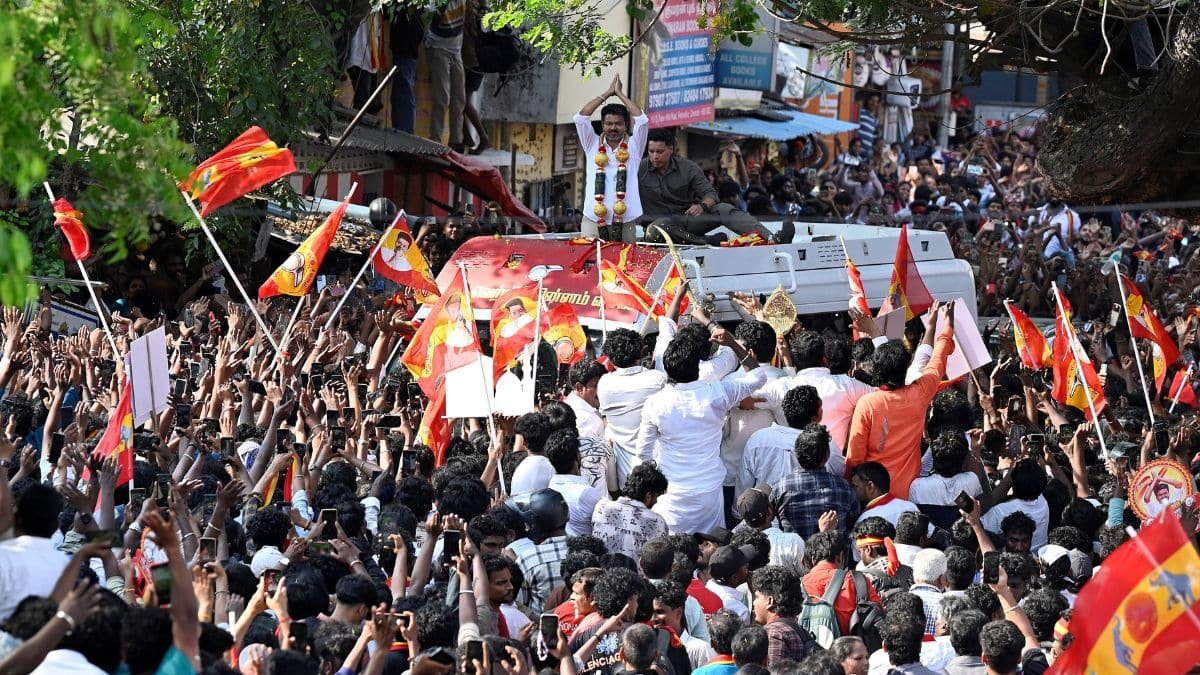
Tamil Nadu’s post-election political deadlock appears to be nearing a conclusion, with Tamilaga Vettri Kazhagam (TVK) chief C Joseph Vijay now seemingly securing the support needed to cross the majority mark in the 234-member Assembly after days of shifting alliances, legal petitions, resort politics and last-minute negotiations
After a fractured verdict in the 2026 Tamil Nadu Assembly election disrupted the decades-old dominance of the DMK and AIADMK, the race to form the government turned into one of the most dramatic political episodes in the state’s recent history.
The latest developments indicate that Vijay’s camp has now moved ahead with the backing of Congress, the Left parties, the Viduthalai Chiruthaigal Katchi (VCK), and the Indian Union Muslim League (IUML).
The political arithmetic now places the TVK-led bloc above the halfway mark of 118 seats required to form the government.
Though Vijay personally won two constituencies and will eventually vacate one, the alliance still maintains what his supporters describe as a workable majority.
When Vijay ultimately takes oath as chief minister, he
would become the first leader outside the DMK-AIADMK ecosystem to govern the state since 1967, a milestone that many political observers are describing as a historic shift in Tamil Nadu politics.
What are the final numbers to form the next Tamil Nadu govt?
The biggest question dominating Tamil Nadu politics since the results were declared has been whether Vijay
could gather enough legislators to cross the halfway mark of 118 seats required to form the government.
TVK emerged as the single largest party in the Assembly with 108 seats. However, because Vijay himself won from two constituencies, the party’s effective operational strength stands at 107 seats.
That meant the actor-turned-politician required support from smaller parties and independent allies to establish majority support before
Governor Rajendra Vishwanath Arlekar.
The final arithmetic shifted decisively after Congress, the Communist Party of India (CPI), the Communist Party of India (Marxist), VCK and IUML all moved toward supporting the TVK-led formation.
The alliance now stands at:
This gives the bloc a total strength of 121 seats on paper, or an effective working tally of 120 once Vijay vacates one constituency. The figure is politically significant because it gives the alliance a small cushion over the required mark of 118.
The margin also reduces the importance of the lone Amma Makkal Munnettra Kazhagam (AMMK) MLA, whose position had become a major point of controversy earlier in the week.
How did Vijay’s TVK finally achieve a majority?
Congress breaks ranks with the DMK-led bloc
One of the earliest and most consequential developments in the government formation process was the decision of Congress to support Vijay despite having contested the election as part of the DMK-led alliance.
Congress became the first major political party to formally shift away from the opposition grouping and back TVK’s bid for power. However, the party attached clear political conditions to its support.
Congress leaders stated that their backing depended on TVK ensuring that “communal forces” remained outside the alliance structure, a remark widely viewed as an indirect reference to the BJP-led NDA.
Tamil Nadu Congress chief K Selvaperunthagai later disclosed that TVK had offered Congress two cabinet positions along with one Rajya Sabha seat as part of the emerging arrangement.
Congress leaders also suggested that the understanding with TVK could extend beyond the immediate government formation process and continue into future local body elections and parliamentary contests.
Despite Congress extending support, Vijay still remained short of the majority mark at that stage, making the role of smaller parties increasingly critical.
Left parties step in, but stay out of government
The Communist Party of India and CPI(M) subsequently announced support for Vijay, though both parties clarified that they would not join the cabinet and would instead provide outside support.
CPI state secretary M Veerapandian said the decision was intended to ensure “stable, secular and democratic governance” while also preventing political instability and the possibility of President’s Rule being imposed in Tamil Nadu.
The CPI maintained that its support was conditional and linked to preserving secular governance in the state.
The CPI(M), meanwhile, framed its decision as an intervention aimed at preventing prolonged uncertainty in the Assembly.
CPI(M) state secretary P Shanmugam said the Left parties were attempting to stop what he described as a possible “backdoor entry” of the BJP into Tamil Nadu politics through instability.
At the same time, the Marxist party clarified that it would continue to maintain ideological alignment with the DMK on issues related to federalism and state rights even while supporting a TVK-led government from outside.
The support of the Left parties pushed Vijay closer to the majority mark, but uncertainty continued because the VCK had not yet submitted a formal letter of support.
VCK’s delay fuels suspense before eventual support
Among all the parties involved in the negotiations, the VCK emerged as perhaps the most closely watched player during the final phase of the coalition-building exercise.
Early reports on Friday suggested that TVK had already secured the support needed to cross the majority threshold after receiving backing from the Left parties and indications of support from the VCK. However, confusion soon followed because the VCK stopped short of immediately issuing a formal letter.
This hesitation triggered speculation across the state about whether the coalition talks had stalled. Political discussions reportedly continued through Saturday morning, with reports indicating that the VCK was seeking clarity on political assurances and representation before finalising its position.
The uncertainty finally ended when VCK chief Thol Thirumavalavan confirmed the party’s support for Vijay.
“At present, we are focused on only one thing. We should not allow a situation to arise where we are unable to form a Vijay government. We should not allow President’s rule to come into effect in Tamil Nadu. On this basis, standing outside and extending our support is an aid to forming a government,” he said.
The VCK’s backing became a turning point in the numbers game because it effectively pushed Vijay’s coalition across the majority line.
IUML support strengthens Vijay’s position further
Soon after the VCK announcement, the Indian Union Muslim League also formally extended unconditional support to the TVK-led formation.
The IUML’s decision added two more legislators to Vijay’s side and strengthened the coalition’s stability.
Party leader Kader Mohideen reportedly submitted a support letter similar in structure to those provided by the CPI and CPI(M).
The IUML’s support helped transform what had earlier been viewed as a precarious majority chase into a more secure coalition arrangement.
With VCK and IUML joining Congress and the Left parties, much of the non-DMK segment of the so-called secular opposition effectively moved behind Vijay’s leadership.
What twists & controversies did we witness on the way?
Governor deadlock & constitutional debate
Even as Vijay’s alliance numbers improved, the constitutional process surrounding government formation became increasingly contentious. Governor Rajendra Vishwanath Arlekar reportedly insisted that TVK demonstrate support through physical signatures from MLAs before any invitation to form the government could be issued.
TVK leaders objected to the Governor’s stance and argued that the single largest party should ordinarily receive the first opportunity to form the government and prove its majority on the Assembly floor.
The dispute escalated into a legal confrontation after TVK filed a writ petition in the Supreme Court challenging the Governor’s refusal to immediately invite Vijay.
A second petition was later filed arguing that insisting on “subjective satisfaction” regarding majority support, instead of allowing a floor test, amounted to a move against democratic norms.
The forged letter controversy & AMMK’s opposition
Another major flashpoint emerged around claims involving the Amma Makkal Munnettra Kazhagam led by TTV Dhinakaran.
At one stage during the coalition negotiations, reports circulated claiming that the AMMK’s lone MLA might support Vijay’s bid for chief minister. The situation escalated after documents allegedly showing AMMK support for TVK began circulating publicly.
Dhinakaran strongly rejected the claims and accused TVK supporters of using fabricated documents to misrepresent his party’s position.
He filed a police complaint alleging that a “photocopied, forged document” had been submitted to the Governor’s office.
The AMMK leader also publicly reiterated that his party’s legislator remained aligned with the AIADMK-led NDA bloc and supported AIADMK general secretary Edappadi K. Palaniswami for the chief minister’s post.
Describing the developments as “horse-trading” and a “mockery of democracy,” Dhinakaran accused TVK of attempting to artificially inflate its support base.
The controversy briefly complicated Vijay’s efforts because the coalition numbers remained uncertain before VCK and IUML formally joined the alliance.
There were also claims from AMMK circles that a video allegedly showing support for Vijay had been generated using artificial intelligence technology.
However, once VCK and IUML extended backing, the AMMK dispute lost much of its political significance because Vijay’s coalition had already crossed the required threshold.
DMK and AIADMK on the sidelines
While smaller parties actively negotiated during the post-election phase, the two major Dravidian rivals largely remained outside the coalition-building process.
The DMK, led by Chief Minister MK Stalin, secured 59 seats in the election, while the AIADMK finished with 47 seats.
Speculation briefly emerged over
the possibility of an understanding between the DMK and AIADMK after the fractured verdict. However, leaders from both camps reportedly dismissed such suggestions as politically unworkable.
Instead, both parties concentrated on holding their respective alliances together while monitoring the evolving negotiations around TVK.
Stalin later signalled that the DMK would sit in the Opposition and function as a “constructive Opposition,” effectively acknowledging that the immediate race to form the government had shifted toward Vijay.
The BJP, which secured five seats, also remained outside the coalition framework taking shape around TVK. Several of Vijay’s allies framed their support as an effort to prevent BJP influence in the state’s governance structure.
Meanwhile, NDA ally Pattali Makkal Katchi (PMK), led by Dr Anbumani Ramadoss secured four seats, and the DMK ally Desiya Murpokku Dravida Kazhagam (DMDK) secured one seat.
Resort politics, swearing-in plans
As negotiations escalated, concerns over possible poaching attempts led Congress to move its five MLAs to a resort in Hyderabad. The legislators were expected to return to Chennai later as TVK prepared to formally stake claim to form the government.
Inside TVK circles, preparations reportedly began for a possible swearing-in ceremony even before the Governor formally issued an invitation.
Party insiders suggested that Vijay preferred Sunday, May 10, for the oath-taking ceremony because it was considered auspicious.
Two possible venues were discussed — a low-key ceremony at Raj Bhavan if the invitation arrived late, or a larger public event at Chennai’s Jawaharlal Nehru Indoor Stadium.
Congress leader Rahul Gandhi is also expected to attend the proposed ceremony.
Meanwhile, outside the TVK headquarters in Chennai, supporters continued to gather in large numbers despite the uncertainty surrounding the Governor’s decision.
The immediate focus, however, remains on how quickly a floor test is conducted in the Assembly.
With inputs from agencies
First Published:
May 09, 2026, 18:47 IST
End of Article