

Prime Minister Narendra Modi announced the ‘Act Far East’ policy in 2019 to co-develop projects in Russia’s Far East region. However, progress has been slow due to the Covid-19 pandemic and the Russia–Ukraine war.
Lately, India and Russia have held discussions on several projects in the Far East under the ‘co-production’ model, Firstpost has learnt.
With Russian President Vladimir Putin’s visit, India’s Act Far East policy is expected to gather pace. If ongoing talks succeed, work on projects under discussion could begin soon. These projects span sectors such as minerals, agriculture, and food processing.
Russia’s Far East boasts some of the world’s largest reserves of natural resources, ranging from fossil fuels like oil and gas to metals such as gold, nickel, copper, tin, and zinc, as well as precious stones like diamonds, and rare earths like neodymium, dysprosium, yttrium, lanthanum, and cerium.
To casual observers, it might appear that India is eager to tap into the Far East’s vast resources. In reality, it is Putin who has been equally keen to attract Indian investments and workers to the region. Beyond economic benefits, Indian presence in Russia’s Far East would serve core strategic objectives of both countries and address one of Putin’s main sources of strategic insecurity.
Russia’s Far East: Population crisis and China’s shadow
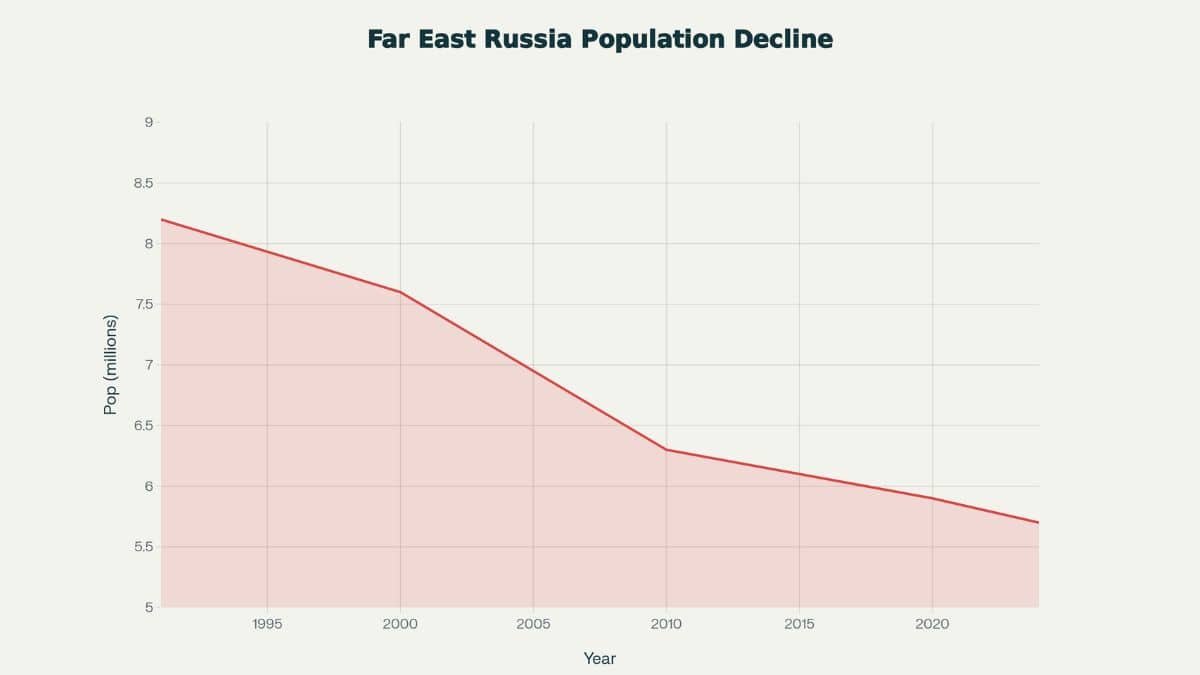
The Far East comprises 40 per cent of Russia’s territory but has fewer than 7 million people. For comparison, the region is twice as large as India but its population is smaller than that of Pune or Ahmedabad. Since the 1990s, the population has declined by up to 20 per cent — the sharpest fall among ethnic Russians. Surveys indicate that up to a third of remaining ethnic Russians also wish to leave.
As the region lacks workers for its export-oriented industries and everyday tasks, Chinese and Korean nationals have flooded in.
As Russia owes the sustenance of its sanction-hit economy to China and relies on Chinese supplies for the war in Ukraine, President Putin cannot refuse entry to Chinese workers or companies setting up operations in the region, but he is acutely aware of the risks posed by China’s growing presence and economic influence, people familiar with the matter told Firstpost.
Currently, as much as 90 per cent of all foreign investment in the Far East comes from China and about 5 per cent of the region’s population is Chinese.
Given the acute need for workers and investment, as well as the reliance on China and even North Korea, President Putin has had to tolerate even the illegal influx of Chinese and North Korean workers, but he has been working with India to balance their influence in the region, a person familiar with the matter said.
Russia’s insecurities extend beyond demographics. China, despite its alliance with Russia, has never concealed its territorial ambitions. In fact, as recently as 2023, China published maps depicting Russian territory as its own.
A second person aware of the matter said Russia fears a ‘silent takeover’ of the Far East by China given its large footprint and historical claims on vast swathes of the territory.
To address both economic needs and the Chinese challenge, President Putin wants Indian workers and companies to establish factories and townships in the Far East under the ‘co-production’ model, the person said.
As Firstpost previously reported, the co-production model envisions joint manufacturing of export-oriented goods, fresh investments, technology transfer, joint research and development, and revenue generation for both countries. In the Far East, this would mean Indian investments —Modi has already announced a $1 billion line of credit— funding projects that employ Indian workers in the region.
India and Russia have discussed as many as 18 projects under this model in the Far East, Firstpost has learnt.
Russia needs India to tackle China
China is the lifeline of Russia’s war machine and its sanction-hit economy. However, Putin is also concerned about over-reliance on China, especially in the Far East region.
Russia has imported around 90 per cent of high-priority goods and nearly all critical machinery from China, according to research by Amit Kumar of the Takshashila Institution.
Moreover, China accounts for nearly a third of Russia’s imports and exports, in addition to being its largest oil buyer.
Kumar warned that Russia’s dependence on China has shrunk its space for strategic autonomy — particularly in relation to India.
India’s inability to rival China’s economic appeal for Russia “threatens cooperation between the Kremlin and New Delhi”, Kumar cautioned.
“As the power asymmetry between China and Russia rapidly expands, the room for Russia’s strategic autonomy vis-à-vis India shrinks at an equally rapid pace. Hence, the question is no longer about Russia’s willingness, but its capability to resist China’s pressure,” Kumar noted in his report.
Such concerns have been discussed internally within the Russian government.
In a memo written in late 2023 or early 2024, Russia’s internal security service, the FSB, warned that China was an “enemy” whose academics were laying the groundwork to stake claims on Russian territory and whose intelligence agents were conducting espionage in the Far East under the guise of mining firms and university research centres, according to The New York Times.
As China’s relationship with India remains fundamentally tense due to its rejection of Indian sovereignty, territorial claims, occupation of Indian territory, and periodic incursions, India and Russia share a common interest in checking Chinese influence in the Far East.
If Indian investments succeed and Indian townships begin mineral extraction or food processing operations in the region, the co-production model could significantly bolster Russia’s strategic autonomy and strengthen India–Russia ties to counter China’s influence in Asia and globally, a source aware of government thinking told Firstpost.
The source added that while China and Russia share an interest in confronting the United States, China’s tendency to never relinquish territorial claims, even on allies, and its refusal to treat any country as an equal means Russia cannot fully trust China.
End of Article