

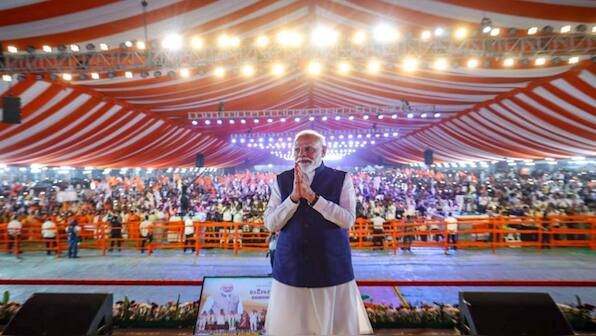
It’s been over 70 days since the US and Iran have been at war, disrupting supply chains across the world and upending the world market. Amid this situation, Prime Minister Narendra Modi had a message for all Indians on Sunday (May 10) — he urged all to revive work-from-home practices, cut fuel consumption, and even avoid buying gold for weddings for one year.
The PM’s extraordinary message on Sunday from Hyderabad gave a sense of déjà vu; the appeal to Indians was reminiscent of Covid-era measures to prevent the spread of the disease.
But why has PM Modi made such an appeal? Is the country about to return to Covid-like measures? We analyse and get you the answers.
What is PM Modi’s appeal to all Indians?
During the inauguration and laying of the foundation stone for projects worth around Rs 9,400 crore in Telangana,
PM Modi urged Indian citizens to adopt more restrained consumption patterns. He noted that patriotism isn’t only about sacrificing one’s life for the nation, but also about living responsibly and fulfilling duties towards the country during difficult times.
At the heart of his address was the goal of reducing fuel consumption. He urged Indians to reduce petrol and diesel consumption by using metros and public transport wherever available, opting for car-pooling, and preferring the railways to transport goods. He also encouraged the use of electric vehicles.
“We do not have major oil reserves. We import petrol, diesel, and gas in large quantities. Due to this war, the prices of petrol, diesel, gas, and fertiliser have gone up significantly. The Indian government has been trying to insulate the people of the country from the impact of the war in the last two months. Government is taking the entire burden on its own, so that there is no pressure on the citizens,” said Modi.
“But when supply chains are under pressure, the challenges keep increasing, no matter how many steps we take,” he said. “Therefore, in the interest of the nation, we will have to brave the situation unitedly. We need to take certain pledges and fulfill them. First and foremost, being restrained in the use of petrol and diesel. We need to cut the use of petrol and diesel. People should adopt travel by metro and car-pooling in cities,” said the PM.
He also called for the revival of Covid-era efficiency measures in the national interest, including working from home, online conferences, and virtual meetings.
“During the Corona period, we adopted work from home, online meetings, video conferences, and developed many such systems. We had also become accustomed to them,” he said, adding, “Today, the need of the hour is that we restart those practices, as it would be in the national interest, and we must once again give them priority.”
Additionally, PM Modi urged the people of the country to save foreign reserves by avoiding overseas vacations and foreign weddings. “The growing culture of weddings abroad, travelling abroad, and vacationing abroad is becoming prevalent among the middle class. We must decide that during this time of crisis, we should postpone travelling abroad for at least a year,” he said.
He further requested the people to avoid non-essential gold purchases for one year. He asked families to reduce edible oil consumption, stressing that it would benefit both the national economic health and personal health.
“If every household reduces the use of edible oil, it is a huge contribution to patriotism. This will improve the health of the national treasury and the health of every family member,” said PM Modi amid his speech.
He further encouraged the people to prioritise Made-in-India and locally manufactured products, including daily-use items such as shoes, bags, and accessories.
But what’s behind PM Modi’s appeal?
But why did the Indian leader make such a request to the Indians? It’s the Iran war and its impact on the global supply chain and oil markets.
As a result of the war, the
Strait of Hormuz, a maritime chokepoint essential for supplying nearly 20 per cent of the world’s oil supply, has remained blocked for over two months. This blockade has resulted in an escalation of oil prices.
Until now,
India has been able to shield its citizens from the oil shock — global prices of oil have touched $126 a barrel. State-run oil marketing companies like Indian Oil Corp Ltd, BPCL, and HPCL are estimated to be facing under-recoveries of around Rs 30,000 crore every month while keeping petrol and diesel prices unchanged.
In fact, a Moneycontrol report stated that India is currently spending around Rs 1,600–1,700 crore daily to shield consumers from global fuel price spikes.
In such a situation, working from home and other fuel-saving measures could go a long way in easing pressure on government finances. And that’s why more than 70 countries, including Thailand, Indonesia, Pakistan,
Bangladesh, and the Philippines, have introduced energy-saving measures like remote work to save fuel amid the Iran war crisis.
Moreover, by requesting people to avoid international travel, he’s trying to curb the spending of foreign reserves. As per a News18 report, foreign exchange reserves are facing a strain — nearly Rs 1 lakh crore has been spent over the past 10 weeks owing to higher import bills and global uncertainty.
There’s also the matter of gold. India remains one of the world’s largest gold importers, bringing in nearly 700–800 tonnes annually, contributing heavily to foreign exchange outflow. If Indians curbed their purchase of the precious yellow metal, India would be able to reduce the money spent on importing it.
Is the government mulling more measures amid the war?
PM Modi’s address has also raised concerns about whether economic measures will be introduced sooner rather than later.
Soon after PM Modi addressed the crowds at Secunderabad in Telangana, speculation arose of fuel prices being increased. An India Today report, citing sources, said that petrol and diesel prices are likely to be increased before May 15 as oil marketing companies battle massive under-recoveries caused by soaring crude prices. The report stated that petrol and diesel prices could rise by around 4-5 per litre, while domestic
LPG cylinders may become costlier by 40-50.
Another economic measure that could be adopted is increasing the duty on gold. By doing so, it would discourage people from buying the yellow metal. Currently, the government imposes customs duties and other levies on gold imports, with an effective import tax of around six per cent in most cases.
There’s also a possibility that rules under the Liberalised Remittance Scheme (LRS) are tightened. Under the Reserve Bank of India’s LRS framework, Indian residents are currently allowed to send up to $250,000 abroad in one financial year for purposes such as foreign education, travel, investments, property purchase and maintenance of relatives overseas.
Only time will tell what the government decides. But we should brace ourselves for tougher times and heed the PM’s message.
With inputs from agencies
First Published:
May 11, 2026, 09:03 IST
End of Article