

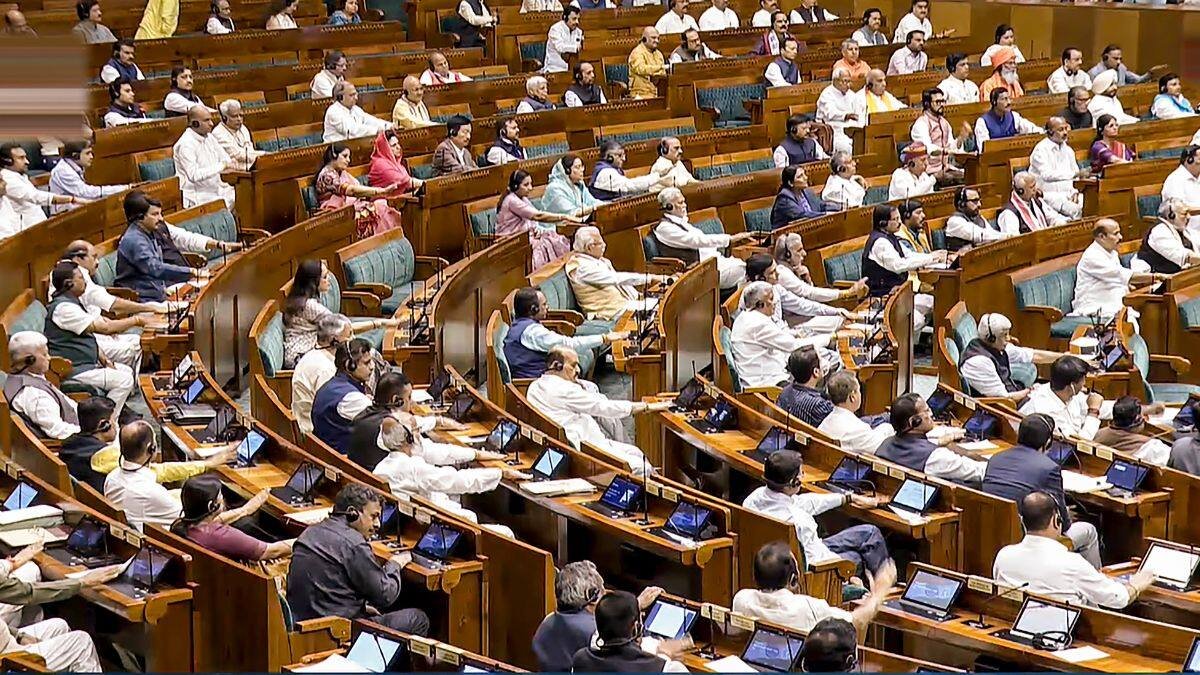
Union Law Minister Arjun Ram Meghwal on Thursday said that the strength of the Lok Sabha will be increased to 815, with 272 seats reserved for women, adding that neither men nor any state will lose representation due to the implementation of the quota.
In his introductory remarks in the Lok Sabha during the debate on three key bills —including amendments to the women’s reservation law and the setting up of a delimitation commission — Meghwal said the allocation of 272 seats is the “simple formula” for implementing 33 per cent reservation for women.
“According to the women’s reservation bill, the strength of the Lok Sabha will be increased to 815, of which women’s quota will be of 272 seats,” PTI quoted the minister as saying.
He clarified that under the proposed legislation, the current strength of the Lok Sabha will see an increase of 50 per cent.
“Neither men nor any state will suffer any loss after the implementation of the women’s quota,” he said.
Meghwal also stated that within the women’s quota, seats will be further reserved for women belonging to Scheduled Castes and Scheduled Tribes in both Parliament and state assemblies.
He said the implementation of the Nari Shakti Vandan Adhiniyam, 2023, in its current form would not allow reservation of constituencies for women in time for the 2029 elections, as it depends on census data to be made available after 2026. Hence, a constitutional amendment was necessary.
“The main objective of the bill is to give women their due rights,” he said.
Highlighting India’s democratic history, Meghwal said women in India received voting rights alongside men from the first general election, unlike several Western countries.
“In the United States were given voting rights 144 years after men and the women in the United Kingdom were given voting rights with certain conditions in 1918 and fully only 10 years later in 1928, he said.
“In India, women got the right to vote along with men since the first election,” he said.
Meghwal urged all parties to support the legislation and ensure its passage in Parliament.
The Lok Sabha on Thursday took up the Constitution (131st Amendment) Bill, 2026, the Union Territories Laws (Amendment) Bill, 2026, and the Delimitation Bill, 2026 for discussion and passage.
The Constitution amendment bill was introduced after a 40-minute debate, following which the opposition sought a division of votes on its introduction. The Bill was eventually introduced with 251 members voting in favour and 185 against.
Key provisions of the Bill
Under the Constitution (131st Amendment) Bill, Lok Sabha seats will be increased to operationalise the women’s reservation law before the 2029 general elections, following a delimitation exercise based on the 2011 Census.
Seats in state and Union Territory assemblies will also be increased to implement 33 per cent reservation for women.
The draft legislation proposes that seats reserved for women in the Lok Sabha and state assemblies will be rotated among different constituencies within states and Union Territories.
Meanwhile, several opposition parties have decided to jointly vote against the delimitation provisions in the Bill, while clarifying that they support women’s reservation in principle.
Southern states to gain: Amit Shah
Meanwhile, Home Minister Amit Shah on Thursday rejected what he called a “false narrative” being spread around the proposed delimitation exercise and women’s reservation legislation.
Intervening in the Lok Sabha debate on three key bills — including amendments to the women’s quota law and the establishment of a delimitation commission — Shah said representation from southern states will not be reduced, but will instead increase significantly.
He said the number of Lok Sabha seats in five southern states will rise from 129 to 195, marking an increase of nearly 50 per cent, while their share of representation will remain broadly stable.
“Lok Sabha seats in Karnataka will increase to 42 from the present 28; in Andhra Pradesh, the number of Lok Sabha sets will increase to 38 from 25; in Telangana, it will be 26 from present 17; in Tamil Nadu, the number of Lok Sabha seats will go up to 59 from the present 39; and in Kerala, it will be 30 seats from the present 20,” he said.
Shah said that although some documents mention a figure of up to 850 seats, the actual strength of the Lok Sabha will be 816, describing the higher number as only a rounded projection. He added that the increase represents a 50 per cent expansion over the current strength.
“Lok Sabha seats in Karnataka will increase to 42 from the present 28; in Andhra Pradesh, the number of Lok Sabha sets will increase to 38 from 25; in Telangana, it will be 26 from present 17; in Tamil Nadu, the number of Lok Sabha seats will go up to 59 from the present 39; and in Kerala, it will be 30 seats from the present 20,” he said.
Explaining the rationale behind the figure, Shah said the new structure ensures proportional growth across states and maintains balance in representation.
“The delimitation bill is exactly like the previous law brought by your government. There is no change, not even a comma or a full stop,” he said, rejecting opposition allegations of procedural changes or “mischief” in the exercise.
He also clarified that the implementation of women’s reservation will take effect only in 2029, and all elections until then— including the 2027 Uttar Pradesh Assembly polls — will be held under the existing system.
“Akhilesh ji, (SP chief Akhilesh Yadav) you don’t need to worry even though you are not going to win the elections in Uttar Pradesh,” he said.
Shah further dismissed claims that the women’s reservation bill was introduced with electoral timing in mind, including the upcoming West Bengal elections.
The Lok Sabha on Thursday debated three bills: the Constitution (131st Amendment) Bill, 2026, the Union Territories Laws (Amendment) Bill, 2026, and the Delimitation Bill, 2026. The constitutional amendment was introduced after a division vote, with 251 members supporting it and 185 opposing it.
According to the proposed legislation, Lok Sabha seats will be increased to operationalise 33 per cent women’s reservation following a delimitation exercise based on the 2011 Census. Seats reserved for women will also be rotated across constituencies in states and Union Territories.
Opposition parties have said they support women’s reservation in principle but have expressed disagreement over the delimitation provisions.
With inputs from agencies
First Published:
April 16, 2026, 21:33 IST
End of Article