

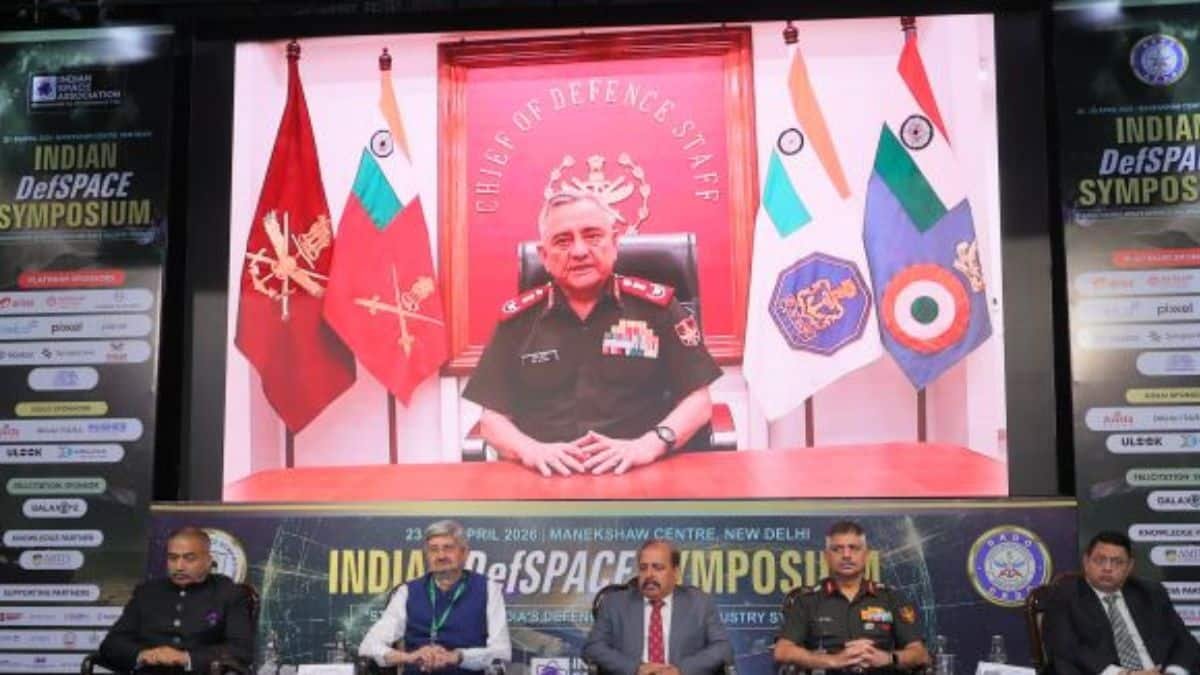
With space becoming increasingly militarised and acting as a force multiplier, India cannot afford to be reactive in developing space‑domain capabilities that will define the future of modern warfare, Chief of Defence Staff General Anil Chauhan has warned.
In an address at the India DefSpace Symposium 2026, Chauhan said space was no longer the exclusive domain of a few spacefaring nations, as the emergence of private players and expanding alliances meant that an increasing number of countries and non-state actors now had access to space‑domain capabilities — as seen in the West Asia conflict.
Chauhan said that although space had been envisioned as a global commons, it had become increasingly contested and weaponised.
“It expands the battlespace, creating new opportunities in the conflict escalation matrix. It enables nations to see deeper, strike further, decide faster, and deter more effectively — all without kinetic mobilisation. In a sense, space has emerged as a non-nuclear strategic domain, bridging the conventional and nuclear deterrence frameworks. However, this also means that vulnerability in space translates directly into vulnerability on land, sea, and air,” Chauhan said.
For India, Operation Sindoor last year marked its first brush with the application of space capabilities in warfare. While Indian officials said China provided Pakistan with real‑time tracking and targeting information, India also used both public and private space‑based capabilities in planning and executing the operation.
From situational to anticipatory awareness
Chauhan said that space capabilities represent a leap from situational awareness to anticipatory awareness.
Chauhan noted that failure in space would force India to fight blind, while success would allow it to fight with foresight.
By infusing artificial intelligence with space‑based capabilities, Chauhan said, a country could move beyond improved situational awareness to anticipatory awareness.
Traditional situational awareness typically offered a two‑dimensional view of the battlefield whereas AI‑enabled space systems now generate a four‑dimensional operational picture, integrating latitude, longitude, altitude, and time, and fuse multi‑orbit satellite data, cyber inputs, electromagnetic signatures, and terrestrial sensors into predictive models of the battlespace, according to Chauhan.
And that would allow forces to stay a step ahead of the adversary.
“This shift from situational awareness to anticipatory awareness compresses the OODA loop, enables pre‑emptive responses, and transforms space into the cognitive high ground of multi‑domain operations. Artificial intelligence must therefore sit at the core, not at the periphery, of our space architecture,” said Chauhan.
The concept of OODA loop —short for ‘Observe, Orient, Decide, Act’— was developed by Colonel John Boyd of the US Air Force. It describes the cycle through which decisions are made in conflict, emphasising speed and accuracy, and states that the side that moves through the loop faster and more effectively can disrupt an adversary’s decision‑making, outmanoeuvre it, and gain the upper hand.
Greater private‑sector involvement in defence-space domain
Chauhan called on the private sector to play a leading role in developing India’s space‑domain capabilities and said the country needed dual‑use systems that could be employed as required in a military context.
While Chauhan did not mention it, frustration over the failure of the NavIC navigation system was a constant theme at the conference, driving calls for greater engagement with the private sector as attendees felt India’s military requirements could not be met by government efforts alone.
Chauhan said India must move beyond reliance on a limited number of high‑value space assets and stressed that it was equally important to recognise that “future space capability will not be built by government agencies alone”.
“It will be co‑developed with industry, startups, and technology innovators leveraging advances in data analytics and artificial intelligence. We must move from viewing space as a programme to treating it as a continuous operational asset providing persistent surveillance, assured communication, navigation integrity, and real‑time decision support. Our objective is not merely to access space but to secure operational advantage through space,” said Chauhan.
As several speakers highlighted the lack of self‑reliance in the space sector, particularly as major satellite imagery and space‑analysis companies remain under the influence of Western governments, Chauhan stressed on the need for the development of dual‑use capabilities in India.
For instance, during the ongoing West Asia conflict, Planet Labs has stopped publishing imagery of the region on the orders of the US government.
“We therefore need to design dual‑use architecture that seamlessly transits to military roles during crises, enables persistent maritime surveillance across the Indian Ocean region, supports artificial intelligence‑driven fusion centres for predictive decision‑making, and reduces ground vulnerabilities through distributed processing,” said Chauhan.
First Published:
April 27, 2026, 08:55 IST
End of Article