

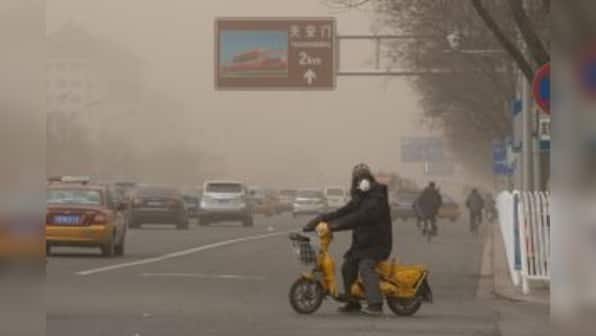
“I remember one morning in 2013 in Beijing when I opened the curtains and everything outside was the same colour—a dull, dirty yellow,” recalls Xinxiu Tian, a Beijing native and now a PhD researcher at Johns Hopkins University in the US.
“The air had this sharp smell, like burnt wood mixed with coal. You could almost taste it,” she added, reflecting on the grim reality of the city back then.
Hop skip to 2018, and Tian’s view had transformed. “I remember looking up and seeing a clear blue sky, like the city was slowly healing,” she told Firstpost.
For some, it’s just air changing its hue. But for a country that once developed at breakneck speed—and for others still racing down that path—pollution has been, and continues to be, a defining crisis. Case in point: Delhi’s relentless AQI spikes, lately hovering around 305, a level that Scandinavian countries would classify as nearly poisonous.
And for Tian—and millions of Beijing residents—the transformation didn’t unfold through gentle nudges or advisory frameworks. It moved through fierce political will, sweeping industrial crackdowns, and a governance structure that left little room for negotiation.
Which brings us to the real question: how exactly did China pull this off, and how does India compare?
The turning point came with the China’s 2013 Action Plan on Prevention and Control of Air Pollution, powered by a legally binding “Target Responsibility System.” This was the master lever that, as Shivang Agarwal, Fellow at the Institute for Governance & Sustainable Development (IGSD) in Washington, DC, puts it, “tied the career progression of local cadres to specific air-quality improvements”—a level of accountability India has never attempted.
India’s 2019 National Clean Air Programme, on the other hand, works with “non-binding targets” and leans more on gentle persuasion than hard rules.
And then came the big twist. On July 11, India changed its own guidelines and said most coal power plants no longer needed flue gas desulfurisation units (FGDs), basically the machines that clean out sulphur dioxide from power-plant smoke. It was a major rollback of a rule that had been in place since 2015. Just like that, around 78% of India’s 537 thermal power units were off the hook from installing this crucial pollution-control equipment.
This is where China and India really diverge.
China sprinted ahead because its centralised system could snap entire regions into compliance. Beijing set up “regional coordination mechanisms” to manage air pollution across whole areas where the air mixes together, called airsheds. This included industrial provinces like Hebei, which surrounds the capital. Because of these rules, Hebei had no choice but to follow Beijing’s orders.
India, meanwhile, is wrestling with the opposite reality. Its federal structure scatters responsibility, and the Indo-Gangetic plains get pulled apart by political turf wars over stubble burning. It creates what Agarwal from IGSD calls “a blame-game dynamic viewed through an electoral lens.”
And the outcome is stark. While China’s regional bureaus crack down with real muscle, India’s Commission for Air Quality Management (CAQM)—the body meant to coordinate and enforce air-quality rules across Delhi and its neighbouring states—often ends up acting more like a watchdog without teeth.
Note: This is an interactive data chart. Please hover over the graph to view the AQI figures for Beijing and Delhi across the years.
Zooming in on regulatory tools, the gap widens again.
China has pulled out all the stops, using everything from emissions caps and mass shutdowns to clean-production audits. One of its most effective tools is the Continuous Emission Monitoring System, or CEMS, which sends real-time data directly to central authorities. This setup allows Beijing to bypass local interference and ensures that enforcement is taken seriously.
India has also introduced CEMS and expanded continuous monitoring through Continuous Ambient Air Quality Monitoring Stations, or CAAQMS, across roughly 200 cities. But the system still faces major challenges. “CAAQMS suffers from uneven coverage, almost no monitoring in rural areas, frequent downtime, and quality assurance problems,” says Nimish Singh, Fellow at The Energy and Resources Institute (TERI) in New Delhi.
Next comes the big industrial question, which is really the engine behind China’s gains.
During its 13th Five-Year Plan, Beijing rolled out what it called “supply-side structural reform” and shut down old coal and steel plants at lightning speed. India, by comparison, is not ready for anything like that. Around 70 percent of its electricity still comes from coal, and there are about 80 gigawatts of new thermal plants in the works.
Coal belt states like Jharkhand and Odisha rely on mining for millions of jobs, so a sudden wave of plant closures would require a huge and currently unfunded “Just Transition” plan, which is a strategy to help workers and communities shift away from fossil-fuel industries while protecting their livelihoods. Right now, that plan does not exist in India.
Energy restructuring tells the same story in a different register.
China went all-in on renewables, using aggressive feed-in tariffs, which guarantee renewable energy producers a fixed price for the electricity they generate, to push capacity past 930 gigawatts by 2020. At the same time, it kept the grid stable with natural-gas pipelines from Russia and Central Asia. India could try to match that renewable boom, but it does not have the same stability behind it. The Indian grid faces a serious “grid inertia challenge” and lacks access to cheap piped gas, noted Agarwal.
The gap doesn’t stop at energy. When it comes to monitoring and enforcement, the difference is just as dramatic.
China’s “vertical management” stripped local officials of control over air-monitoring stations, creating a real-time, tamper-proof nationwide network across 363 cities. India’s State Pollution Control Boards, meanwhile, remain chronically understaffed and financially tangled with the industries they regulate. “Independent audits consistently find that India’s monitoring infrastructure suffers from calibration drifts and data gaps that render enforcement legally porous,” added Agarwal.
Look at urban mobility and the contrast jumps right out.
By 2017, China’s Shenzhen city made history by switching its entire bus fleet of over 16,000 buses to electric, while also expanding public transport, retiring old diesel buses, and adding more cycling lanes and pedestrian zones to make getting around easier and cleaner.
India has programmes like FAME II (Faster Adoption and Manufacturing of Hybrid and Electric Vehicles) and PM-eBus Sewa, worth about $7 billion, but as Agarwal points out, they can’t create the same kind of impact.
Finally, there is the data revolution that helped China clean its air.
Once Beijing took air-quality monitoring out of local officials’ hands, the “Blue Sky Map” took off, with millions of people checking pollution levels every day and demanding action. This put real pressure on mayors who failed to improve air quality. India also has the National Air Quality Index (NAQI), but as Agarwal notes, “the data is often aggregated rather than raw, and source-specific emission data remains behind government firewalls.”
In fact, the limits of that accountability were visible recently in Delhi, where protests at India Gate drew a massive government crackdown. The India Meteorological Department (IMD) declined to comment on Firstpost’s queries.
Delhi vs geography
It’s not that Delhi’s authorities don’t want cleaner air, but the city’s geography somehow works against them.
The city sits in the low-lying Indo-Gangetic Plain, a flat, landlocked basin with weak winter winds that allow smog to stagnate. “During colder months, temperature inversion acts like a lid, trapping pollutants close to the ground, while the region’s lack of coastal or mountain-driven ventilation means dirty air has nowhere to escape,” said an official from the Central Pollution Control Board (CPCB) who did not want to be named due to fear of political repercussions.
Surrounding states add to the burden, funnelling smoke from stubble burning, industrial zones and freight corridors straight into Delhi, they added.
Beijing, by contrast, has nature on its side. Siberian winter winds, mountain-valley air currents, and its proximity to the Bohai Sea all help sweep smog away. Simply put, Beijing has a natural ventilation system that Delhi doesn’t.
That said, India could borrow a few lessons from Beijing, which made real headway against smog in the 2010s. As Singh from TERI puts it, the key takeaway is the need for “well-defined frameworks and financial backing” to turn airshed-level policies from paper into action.
End of Article