

India just undertook one of its most extensive public safety technology exercises, launching a nationwide test of its indigenous Cell Broadcast Alert System (CBAS).
The initiative, driven by the National Disaster Management Authority (NDMA) and the Department of Telecommunications (DoT), represents a major evolution in how emergency warnings are communicated to citizens in real time.
The system is part of a broader alerting framework known as SACHET (Integrated Alert System), developed domestically by the Centre for Development of Telematics (C-DOT).
The test, conducted across all 28 states and 8 Union Territories, marks the transition from limited pilot trials to a nationwide evaluation of a technology designed to deliver near-instant warnings during crises.
“In the future, through this same system, instant alerts can be sent in the local language and according to the location in the event of a disaster or emergency. This initiative is an important step towards further strengthening citizen safety and ensuring rapid information during disasters.” Union Minister for Communications Jyotiraditya Scindia wrote in a post on X.
What happened during the nationwide alert test?
Shortly before noon on Saturday (May 2, 2026),
mobile phones across the country began emitting a sharp, attention-grabbing tone accompanied by vibrations.
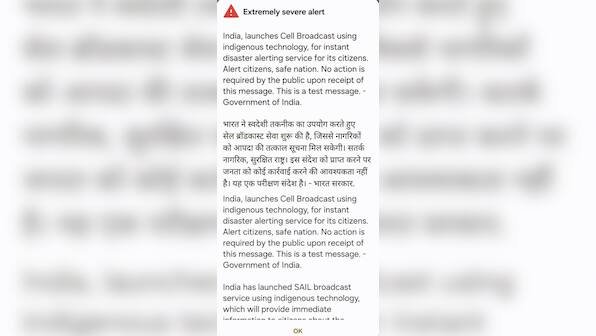
At the same time, a full-screen notification appeared on devices, prominently displaying the label “extremely severe alert.” The message was shown in English, followed by a Hindi version and, in many cases, additional regional language formats.
The alert message stated: “India launches Cell Broadcast using indigenous technology for instant disaster alerting service for its citizens. Alert citizens, safe nation. No action is required by the public upon receipt of this message. This is a test message. Government of India.”
The design of the alert ensured it could not be ignored. Even devices set to silent mode or configured under “Do Not Disturb” displayed the message with an accompanying alarm-like sound.
This feature is deliberate, ensuring that critical warnings are noticed regardless of user settings.
Officials also clarified that some users might receive the alert multiple times. This repetition is part of the testing methodology, as different telecom networks and cell towers are assessed for performance and reliability.
The government reiterated that no action is needed upon receiving such messages during the testing phase.
What is the SACHET platform and how does it fit in?
The CBAS operates within the broader SACHET (Integrated Alert System) platform, which is designed to serve as India’s centralised disaster communication backbone. Developed indigenously by C-DOT, the platform reflects a push toward self-reliance in critical technological infrastructure.
SACHET integrates multiple alerting mechanisms, with cell broadcast emerging as its most advanced component.
The platform allows authorities to issue warnings across different communication channels, but the introduction of cell broadcast significantly enhances the speed and reach of these alerts.
The indigenous nature of the system is a key feature. By developing the technology domestically, India reduces dependence on foreign vendors for critical infrastructure related to public safety.
This approach also enables customisation for local needs, including multilingual messaging and region-specific targeting.
How does cell broadcast technology actually work?
Cell broadcast is fundamentally different from conventional messaging systems. Rather than sending messages individually to phone numbers, it uses mobile network infrastructure to distribute a single message to all devices connected to specific cell towers within a defined area.
This method operates on a one-to-many model. A single transmission from a tower can reach thousands or even millions of devices simultaneously, depending on the coverage area.
Because the system does not rely on individual connections, it avoids the bottlenecks that often affect SMS delivery during periods of heavy network usage.
The technology leverages the routine communication between cell towers and mobile devices. Normally, this interaction provides background information necessary for network connectivity.
However, the same mechanism can be utilised to transmit emergency alerts directly to handsets without requiring phone numbers or prior user registration.
Another important aspect is geo-targeting. Authorities can send alerts to specific locations — such as a neighbourhood, city, or district — rather than broadcasting messages nationwide. This precision helps minimise unnecessary alarm among populations outside the affected area.
Cell broadcast also supports multilingual messaging, allowing alerts to be issued in English, Hindi, and various regional languages. This ensures that warnings are accessible to a diverse population, a crucial factor in a country with significant linguistic variation.
Why is cell broadcast considered more effective than SMS alerts?
India has long relied on SMS-based alert systems for disaster warnings. These systems have been widely used and have played a role in disseminating information during cyclones, weather events, and other emergencies.
Government data indicates that over 134 billion SMS alerts have been sent in more than 19 languages.
However, SMS technology has inherent limitations. Messages are sent individually to each recipient, which can lead to delays when networks are congested.
During large-scale emergencies, when millions of people may attempt to make calls or access the internet simultaneously, these delays can extend significantly.
In contrast, cell broadcast bypasses these constraints. Because it sends a single message to all devices in a coverage area, it does not depend on network capacity in the same way as SMS. This enables near-instant delivery, even during peak traffic conditions.
The difference is particularly critical in sudden-onset disasters such as earthquakes or flash floods, where even a few minutes can make a significant difference in outcomes.
By moving away from SMS-based alerts — which often arrived 15-30 minutes late during past disasters like the Odisha cyclones — India now has a “near-zero latency” system.
What types of emergencies will the system cover?
The CBAS is designed to handle a wide spectrum of emergency scenarios, both natural and human-induced. Its primary focus is on high-severity events that pose immediate risks to life and property.
Natural disasters form a major category, including earthquakes, cyclones, tsunamis, and flash floods. Weather-related threats such as lightning strikes and extreme heat are also included, reflecting the increasing frequency of such events in India.
The system is also equipped to address man-made hazards. These include industrial incidents like gas leaks, chemical spills, and potential nuclear emergencies. By enabling rapid communication in such scenarios, authorities aim to minimise exposure and guide public response.
At present, the system is oriented toward disaster management. Unlike some international counterparts, it does not yet include specialised categories such as child abduction alerts.
However, the underlying infrastructure could support such applications in the future.
How does India’s system compare with global alert frameworks?
India’s adoption of cell broadcast technology aligns it with a growing group of countries that use similar systems for public safety.
In the United States, the Wireless Emergency Alerts (WEA) system delivers messages related to natural disasters, national security threats, and missing children cases.
Japan operates the J-Alert system, known for its rapid response capabilities in earthquakes, tsunamis, and missile threats.
European nations have implemented comparable frameworks under the EU-Alert system, following regulatory directives to establish public warning mechanisms.
Other countries, including Canada, Israel, Australia, South Korea, and Taiwan, have also deployed cell broadcast-based alert systems tailored to their specific risk environments.
These systems are often integrated with broader emergency communication strategies, including sirens, radio broadcasts, and television alerts. While the core technology is similar across these systems, the scope of alerts varies.
Why is this system important for India’s disaster preparedness?
India faces a wide range of natural hazards, including cyclones along its coastline, floods in river basins, earthquakes in seismic zones, and extreme weather events linked to climate variability.
In recent years, the frequency and intensity of such events have shown an upward trend.
Early warning systems play a critical role in reducing the impact of disasters. By providing timely information, they enable individuals and authorities to take preventive measures, such as evacuation or sheltering.
According to global bodies such as the International Telecommunication Union (ITU), technologies like cell broadcast are essential components of modern early warning systems. They are particularly valuable in reaching large populations quickly and reliably.
The United Nations’ “Early Warnings for All” initiative also highlights the importance of such systems in adapting to climate-related risks. By ensuring that warnings reach people in time, these technologies contribute to saving lives and reducing economic losses.
What should users expect during the testing phase?
As the system undergoes further evaluation, users may continue to receive test alerts on their mobile devices. These messages will typically appear as full-screen notifications accompanied by a distinct sound and vibration pattern.
Only devices with cell broadcast test alerts enabled will receive these messages. Users can manage these settings through their phone’s safety and emergency alert options.
Authorities have stressed that repeated alerts during this phase are normal and part of the testing process. Each transmission helps assess different aspects of the system, including coverage, timing, and compatibility across networks and devices.
The government has consistently advised users to ignore these alerts once they have acknowledged them.
Regardless, Saturday’sexercise represents a critical milestone in the development of India’s cell broadcast capabilities. It signals a shift from experimental trials to large-scale implementation.
Further testing will continue to refine the system’s performance and ensure reliability under various conditions. Once these evaluations are complete, the system is expected to become fully operational, automatically delivering alerts during real emergencies.
The timeline for a full implementation has not been announced so far.
With inputs from agencies
First Published:
May 02, 2026, 17:57 IST
End of Article