

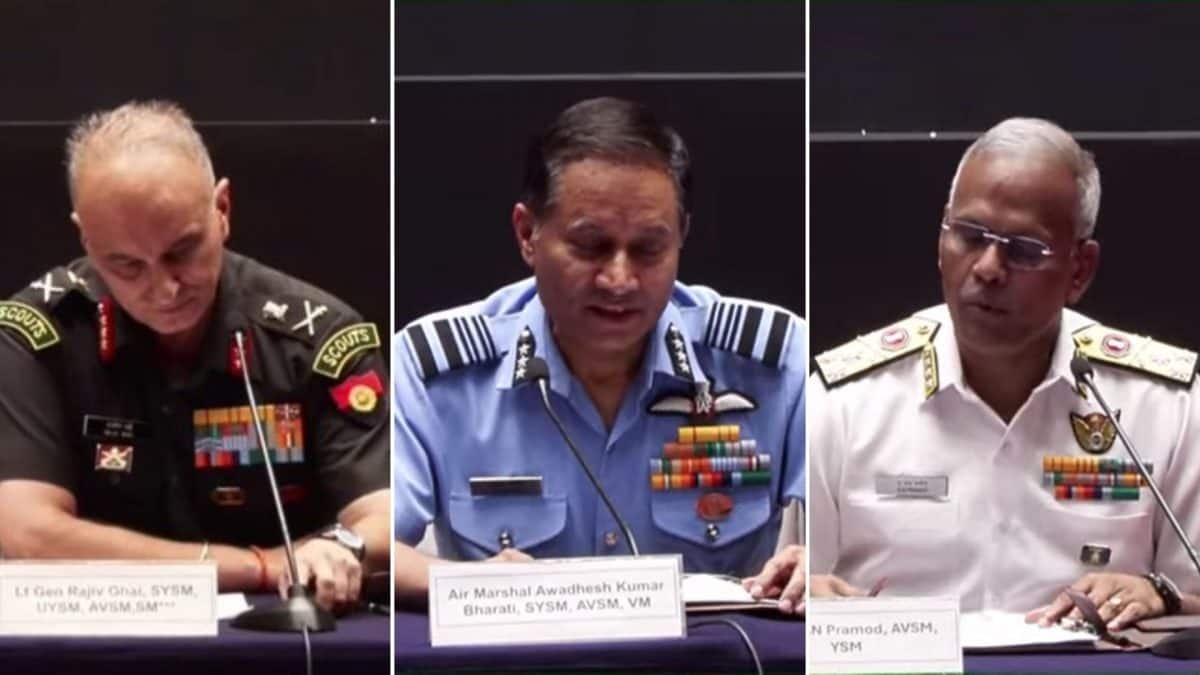
One year after Operation Sindoor, India’s top military leadership used a high-profile press conference in Jaipur to send a clear message on Thursday that the operation may have paused, but India’s fight against terrorism has not ended.
The joint briefing by former Director General of Military Operations Lieutenant General Rajiv Ghai, former Director General Air Operations Air Marshal Awadhesh Kumar Bharti and Director General Naval Operations Vice Admiral AN Pramod highlighted how the Army, Air Force and Navy coordinated during the May 2025 operation launched in response to the
Pahalgam terror attack that killed 26 civilians.
‘A statement of resolve’
“I begin by paying homage to the innocent civilians who lost their lives in Pahalgam,” Lt Gen Ghai said at the outset, describing Operation Sindoor as “a statement of resolve.”
According to Ghai, the government had given the armed forces “two clear directions” before the operation began — “clear political-military objectives” and “operational flexibility.”
He said Operation Sindoor marked a major shift in India’s security doctrine, with the country moving “beyond its earlier approaches and methods” to target terror infrastructure across the Line of Control “with precision and clarity.”
Calling the operation a “whole-of-government approach,” Ghai said intelligence agencies, cyber and information warfare units, border guarding forces, ministries and the armed forces worked “in concert” during the operation.
“The operation is now being widely acknowledged as the gold standard, both militarily and strategically across the world,” he said.
Ghai revealed that seven targets were struck by the Indian Army and two by the Indian Air Force during the operation, all timed “to perfection” to achieve “total surprise” and inflict “maximum damage” on terror infrastructure in Pakistan and Pakistan-occupied Kashmir.
“Signalling that no sanctuary is safe,” he added.
#WATCH | Jaipur, Rajasthan: At the press conference on the anniversary of Operation Sindoor, Lt Gen Rajiv Ghai says, “Operation Sindoor proved that Atmanirbhar is not just a slogan, it is indeed a force multiplier. Today, over 65% of our defence equipment is being manufactured… pic.twitter.com/CT6EFz5mkO
— ANI (@ANI) May 7, 2026
He also stressed that Pakistan’s attempts to target Indian military infrastructure were neutralised due to a “carefully and deliberately laid out air defence architecture.”
A major focus of the briefing was India’s growing defence self-reliance. Ghai said systems such as the BrahMos and Akash, along with indigenous surveillance systems, ammunition and electronic warfare suites, played a “decisive role” during the conflict.
“Operation Sindoor proved that Aatmanirbharta is not just a slogan, it is indeed a force multiplier,” he said, adding that over 65 per cent of India’s defence equipment is now manufactured domestically.
Air Force: ‘No half measures’
Air Marshal Bharti said the operation demonstrated that India’s “desire for peace is mistaken for weakness.”
“When we act, there are no half measures. It is decisive and calibrated,” he said. “When the first target was hit, that decisive strike was almost partial justice for the families of the victims of Pahalgam.”
Bharti clarified that India’s military objectives remained limited and focused strictly on terror infrastructure.
“Our fight was with the terrorists and their support structure and not to have any collateral damage. It was more of self-defence,” he said while explaining why India agreed to pause hostilities. “We paused when the request came. We delivered the message and the message was very clear — acts of terror will carry consequences.”
He added that the operation offered invaluable combat experience to the armed forces. “There is no better training than an actual operation,” he said, while asserting that the Indian Air Force “will be the first responder whenever the need arises.”
#WATCH | Jaipur, Rajasthan: At the press conference on the anniversary of Operation Sindoor, Air Marshal Awadhesh Kumar Bharti says, “Going into this operation, our high directions were very clear. The objective was clear, and the forces were given full operational freedom.… pic.twitter.com/3LidEaCuz4
— ANI (@ANI) May 7, 2026
Navy: Forward deployment and deterrence
Vice Admiral Pramod outlined the Indian Navy’s role during the conflict, saying the force transitioned to “combat readiness” immediately after the Pahalgam attack.
“As the campaign unfolded, forward deployment of the Indian Navy created deterrence for the Pakistanis,” he said.
According to Pramod, Operation Sindoor demonstrated India’s ability to respond effectively to “asymmetric provocation” and highlighted the growing role of drones, layered defence systems and long-range precision weapons in modern warfare.
Vice Admiral AN Pramod, he’s a one-man operation. If it comes to it, Karachi’s gone before sunrise. 🥵 #OperationSindoor pic.twitter.com/51rd4HdNPs
— BALA (@erbmjha) May 7, 2026
He also described the information domain as a “parallel battlespace” during the conflict and said the operation reinforced the principles of jointness among the three services.
“I would like to assure the citizens of Bharat that the Indian Navy remains ready and forward deployed,” he said. “The Indian Navy, along with the Army and Air Force, has demonstrated the capability to strike deep, strike far and strike sure anytime anywhere anyhow.”
First Published:
May 07, 2026, 13:22 IST
End of Article