

A year after private satellite imagery was linked to the Pahalgam attack, Chief of Defence Staff General Anil Chauhan has warned that the democratisation of space‑based capabilities presents both an opportunity and a strategic vulnerability.
In an
address at the India DefSpace Symposium 2026, Chauhan said states and non‑state actors no longer need to develop their own space capabilities as they can access them either through friendly countries or by buying them from private players — something India witnessed last year when
China shared real‑time tracking and targeting information with Pakistan during Operation Sindoor.
At the two‑day conference, Chauhan was joined by a host of serving and retired military officers, independent experts, and top industry executives to discuss the military applications of space. While there was broad consensus on the promise of space for India’s national security, many warned that India must rapidly bridge the gap between ambition and capability — particularly amid the ongoing churn in international relations.
The mismatch between expectations and industry realities
In public and private discussions, stakeholders said officials were often unrealistic in their expectations. Air Chief Marshal (Retired) RKS Bhadauria in a session suggested the government should assure Indian companies that it would prioritise procurement from them, allowing them to invest confidently in developing products and services.
“We need to have confidence in our industry to develop and deliver. We need to say that once you reach this stage, we will take only from you or we will take only from Indian as compared to the foreign satellites, and put down clearly a kind of letter of intent. Unless we do that kind of action, there will be no way that the private sector —small players or startups— can generate enough money. And you cannot bank only on the government money to do this kind of activity,” said Bhadauria, who served as Indian Air Force (IAF) chief during 2019‑21.
Separately, an industry executive said that the lack of assured procurement had indeed hampered the development of military‑focused space capabilities.
Speaking on condition of confidentiality, the executive showed Firstpost an aerial image of a Pakistani military establishment, saying their company, along with other private firms, had been approached by officials in the run‑up to Operation Sindoor for satellite imagery of such locations in Pakistan. The executive said the images were provided as requested.
“Those images were provided for free, but we have not had regular orders,” the executive said.
Industry executives broadly agreed that it was difficult for start‑ups to develop purely military‑centric products or services without consistent orders. At best, they said, companies could work on dual‑use products and services that could be repurposed for military applications.
Another executive from a company specialising in satellite imagery argued that the criticism by serving and retired officials of Western government’s dominance was misguided — officials throughout the conference said that foreign firms like Planet Labs and Maxar should be barred from covering ‘sensitive locations’ in India and that the government should work out ways to bypass
embargoes that the US government has currently in place on Planet Lab’s West Asia’s coverage.
But an executive told Firstpost, requesting anonymity, that unless you are willing to shoot down a satellite photographing your country or jam those satellites that require substantial resources, or develop some proprietary technology to block the satellites’ working, you simply cannot prevent someone like Planet Labs or Maxar.
In any case, the executive added, the Indian government relies on Planet Labs and Maxar to get images all the time so the talk to ban them does not make sense.
“India relies on Maxar or Planet Lab because there is no indigenous capability either with the government or the private sector. Instead of discussing infeasible premises like banning these companies or jamming their satellites, the focus should be on developing an indigenous alternative,” the executive further said.
Is India moving fast enough on space capabilities?
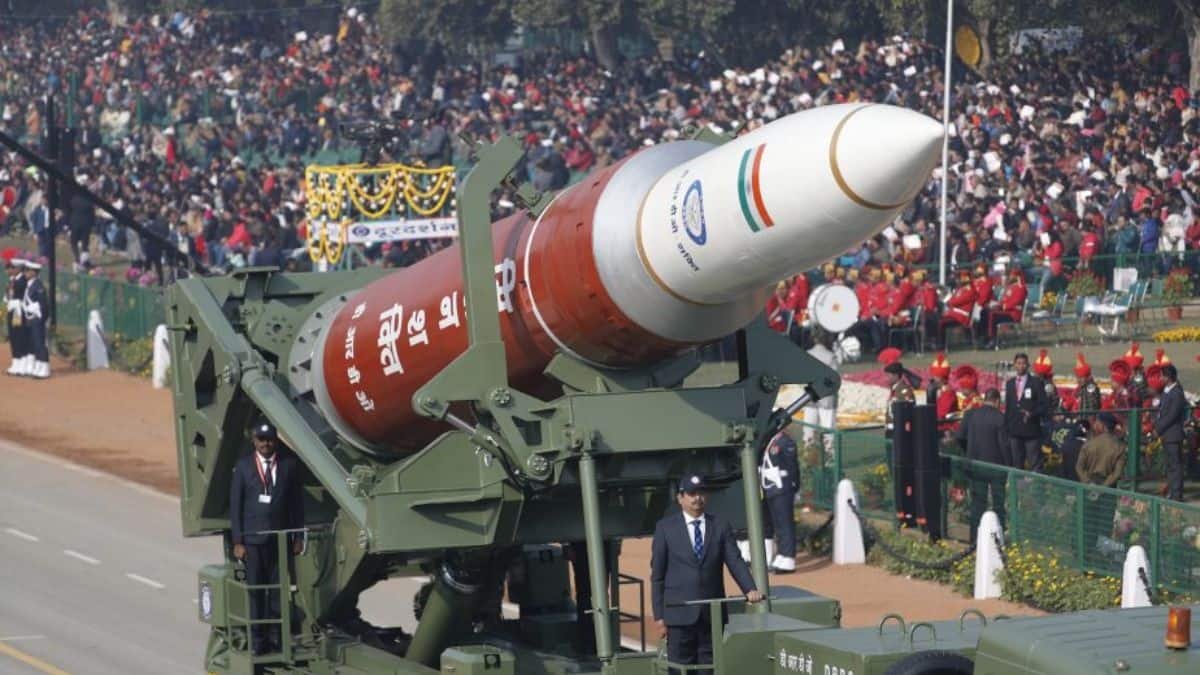
India is among a small group of countries with anti‑satellite missile capabilities and has a dedicated Defence Space Agency (DSA), which is on course to evolve into a full‑fledged command in the coming years. At the tactical level, the reliance on space‑enabled capabilities is increasing steadily.
“The tactical‑level operations today are increasingly dependent on space‑enabled capabilities. Whether it’s an artillery unit who’s fired a precision‑delivered ammunition, or soldier who’s launched a kamikaze drone, an Air Force who’s launched a satellite‑guided weapon, or the submarine who’s launched a sub‑surface‑to‑land missile,” said Lieutenant General Zubin A Minwalla, Deputy Chief of Integrated Defence Staff, during a session.
However, experts cautioned that this was not enough. They argued it was time for India to be more overt about offensive capabilities in space. They noted that it was only a matter of time before Earth’s conflicts expanded into space. In recent years, there have been reports that Russia has either already deployed a nuclear weapon in space or has developed the capability to do so.
Minwalla warned that adversaries were investing heavily in capabilities designed to deny, degrade, or disrupt space‑based assets.
Bhadauria said the US‑China arms race in space would have direct implications for India.
“The day the US has weapons in space — we are not worried about the US having weapons — China will develop that capability, and it’s a direct threat to us. And we will have no choice but to achieve that,” he said.
With space‑based capabilities —whether satellite navigation or communications— now embedded in everyday military operations, Lieutenant General (Retired) Dushyant Singh warned, space would likely be the domain of first strikes in future conflicts.
“Space is not the final frontier. It is the first line of defence. If something is going to go off the moment the battle starts, it will be the space‑based assets which will be targeted,” said Singh, Director General of the Centre for Land Warfare Studies (Claws).
Such strikes could involve targeting satellites used to guide troops on the ground, track adversaries’ missile‑launch sites, monitor maritime movements, ensure secure military and government communications, and keep critical national infrastructure —military, civilian, and industrial— functional.
Chauhan summed up the stakes: “If we fail in space, we will be forced to fight blind. However, if we can dominate in space, we’ll fight with foresight.”
Experts at the conference argued India must not only deepen its adoption of space‑based capabilities but also build resilience and redundancy — requiring a far faster and closer embrace of the private sector and quicker decision-making and policy-making lest India is left to play catch-up.
First Published:
April 27, 2026, 11:50 IST
End of Article