

As India marks the first anniversary of the Pahalgam terror attacks, new details have emerged. Amid the military conflict between India and Pakistan last year, the IAF unit at Haryana’s Sirsa, led by Air Commodore Rohit Kapil, intercepted a ballistic missile aimed at Delhi
One year ago on this day (April 22), India saw one of its worst terror attacks — the Pahalgam attack that saw terrorists gunning down 26 civilians being killed as they had gathered at one of Jammu and Kashmir’s scenic tourist spots.
India countered with the deadly Operation Sindoor that sought to break the back of terror emanating from Pakistan. This prompted Islamabad to hit back, raining down drones at several locations in India.
Now, a year later, it has emerged that Pakistan targeted New Delhi, and had it not been for the Indian Air Force’s Haryana unit at Sirsa, the attack would have been successful.
How did India thwart Pakistan’s attack? Here’s what has emerged.
Pakistan takes aim at Delhi amid Op Sindoor
After the
Pahalgam terror attack on April 22, 2025, India launched Operation Sindoor, taking aim at the terror infrastructure in Pakistan and Pakistan-occupied Kashmir. In turn, Islamabad hit back harder, using drones and shelling to target several places in India.
At the height of the conflict last May, a Pakistani missile — either a
Fatah-II or a Shaheen — was launched, with its target believed to be Delhi.
On May 10, 2025, the Indian military announced that it had foiled Pakistan’s attempt to target Delhi, after it deployed the Fatah-II ballistic missile.
India’s Barak-8 thwarts Pakistan’s attack
However, the Pakistan missile was neutralised by an IAF unit stationed at Sirsa in Haryana, a vital forward air base near the western border.
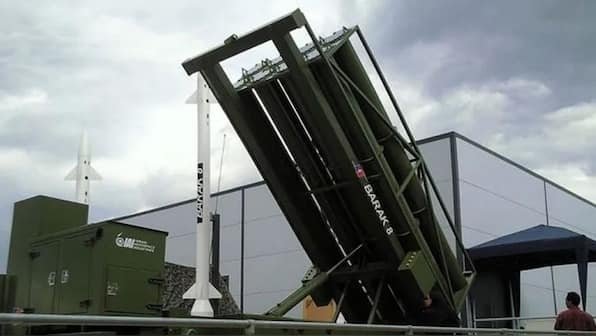
The unit did so by enabling the
Barak-8 surface-to-air missile system and destroying a missile attack from Pakistan. The Barak-8 is a medium-range surface-to-air missile (MRSAM) that has an operational range of 70 km, which can be expanded to 100 km.
In fact, days after the attack, videos showed debris from the Pakistani missile in Sirsa, and videos of the same went viral online.
Jointly developed by India and Israel, the Barak-8 missile system is highly advanced, having digital radar, interceptors with modern RF sensors, a two-way data link, and system-wide connectivity. It boasts of a speed of up to Mach 2 and can carry a 60-kg warhead, which explodes near the target.
The Barak-8 is designed to intercept a wide array of airborne targets, including cruise missiles, fighter jets, helicopters, UAVs, and even ballistic missiles. It boasts of providing all-weather, 360-degree protection. The Barak-8 can target and destroy multiple objectives at once, thanks to its multi-function surveillance tracking and guidance radar, ensuring precise targeting.
In 2017, Israel sold the missile system to India and was later inducted into the arsenal of the Indian Navy as well as the Air Force.
Air Commodore Rohit Kapil leads the operation
Leading the operation to take out Pakistan’s missile was India’s Air Commodore Rohit Kapil, Air Officer Commanding (AOC) of 45 Wing in Sirsa. As per a Times of India report, it was Kapil’s quick thinking that helped the IAF to thwart the attack and saved thousands of lives in the process.
Air Commodore Rohit Kapil was commissioned into the IAF’s Flying Branch on June 20, 1998, as part of the 161 Course. A fighter pilot by training, he specialised in the Su-30MKI multirole fighter and has accumulated more than 3,500 hours of operational flying experience across various IAF aircraft types.
Kapil is a Cat ‘A’ qualified flying instructor and has also completed the Advanced Command and Staff Course in the United Kingdom, equipping him with advanced strategic and operational expertise.
Air Commodore Kapil has also represented the IAF on the global stage. He led the Indian contingent in joint military training exercises with the Republic of Singapore Air Force (RSAF) and the arrival ceremony of IAF aircraft at Japan’s Hyakuri Air Base.
For his role in Operation Sindoor, he was also awarded the Yudh Seva Medal by President Droupadi Murmu in August last year.
Thanks to the IAF’s 45 Wing and Air Commodore Kapil, the national capital escaped unaffected.
With inputs from agencies
First Published:
April 22, 2026, 11:31 IST
End of Article