

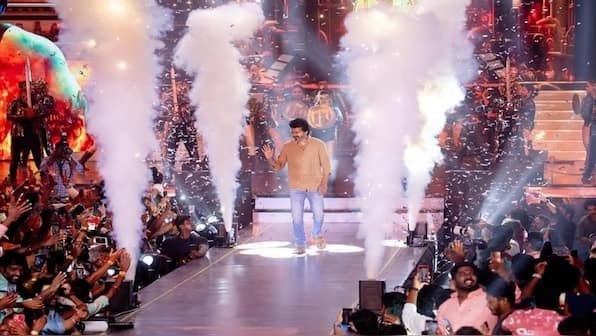
The votes are still being counted, but if early trends are any indication, then a political earthquake has just struck the state of Tamil Nadu. Actor-turned-politician Vijay’s Tamilaga Vettri Kazhagam (TVK) is currently holding pole position in the Tamil Nadu race, disrupting the dominance of the AIADMK and the DMK.
It seems that the sentence — “Vijay dhan varuvaaru (Vijay will come)” — which became famous during the election campaign, is coming true.
But who is TVK’s Vijay, and how has he managed to script this stupendous victory in the state of Tamil Nadu?
C Joseph Vijay: From cinematic hero to political contender
Vijay began his cinematic career as a child in the 1980s. In 1992, he was launched by his parents — filmmaker SA Chandrasekhar and singer-writer Shoba Chandrasekhar — as a lead actor in the movie titled Naalaiya Theerpu. The film flopped, but his career did not.
In the subsequent years, Vijay, also referred to as Thalapathy, rose to the top. His filmography has over 70 titles to his name, during which he has played a vast array of characters — from the romantic hero in the late 1990s to the angry young man in the 2000s to a carefully-honed image as saviour and vigilante in films after 2012.
As Chennai-based film critic Aditya Shrikrishna told the BBC, “Though Vijay’s early roles often leaned into hyper-masculine tropes, he later consciously course-corrected his image. He later started projecting a saviour figure rooted in social justice in his movies. He spoke of farmers’ distress in Kaththi, healthcare corruption in Mersal, supporting women’s sports in Bigil, and electoral manipulation in Sarkar.”
In fact, his 2013 film Thalaivaled to speculation that he was about to make an entry into politics. If Pritham K Chakravarthy is to be believed, then the “seed was planted” by his father, who was keen on joining politics.
An entry into politics
In February 2024, Vijay announced his entry into politics with the TVK. In the southern state of Tamil Nadu, the move wasn’t very surprising as many of the bigwig actors have turned to politics — think MG Ramachandran (MGR), Jayalalithaa, Rajinikanth, Kamal Haasan, Vijaykanth and Khushbu, to name a few.
But many note that while he began his political career in 2024, the signs were already there. In 2011, Vijay sat with the Nagapattinam fishermen in support of Sri Lankan Tamils. In 2017, he spoke out after the suicide of Anitha, a young medical aspirant, during the anti-Neet protest.
As Prabhakar T, a political journalist, told The Caravan, “Vijay’s descent into politics was neither sudden nor accidental, and his public interventions signalled political intent over a long arc.”
However, his entry into politics could hardly be called smooth sailing. Last September, during a rally in Karur, a
stampede took place, killing 41 people, including 11 children. Vijay, who left the venue immediately, was criticised and questions arose about his leadership skills.
Moreover, in February, his wife began divorce proceedings against him, citing abusive behaviour and cheating.
Vijay shows his political prowess
But Vijay continued his political activities, strengthening the party’s organisational structure and using his star power to sway the voters.
He declared the BJP as his party’s “ideological enemy” and the DMK its “political enemy”. During his campaigning, he’s also taunted DMK’s MK Stalin by referring to him as ‘uncle’.
During the Tamil Nadu election campaign, Vijay and his party, the TVK, has also used the Gen-Z’s disillusionment against the traditional DMK and AIADMK to their benefit. The party has also sought to use Vijay’s persona to sway the voters. “You can’t compare our leader with anyone except superstar Rajinikanth,” said KG Arunraj, TVK general secretary (propaganda and policy), to The Hindu.
He further added that, unlike Rajinikanth, Vijay has quit films at the peak of his career. “So, people have faith in him,” said Arunraj.
In the TVK’s manifesto, Vijay has focused on the youth, women, and fisherfolk. The party believes that these three sections could reshape the elections and hence, announced that a first-of-its-kind minimum support price (MSP) for eight selected fish varieties, Rs 27,000 as relief during the annual fishing ban period, along with subsidised diesel, insurance coverage and housing support.
Additionally, the party proposed collateral-free education loans of up to Rs 25 lakh – from Class 12 through higher education, including PhD programmes. The party has rolled out an array of women-centric measures, including six free LPG cylinders annually, a steep hike in monthly financial assistance from Rs 1,000 to Rs 2,500, and the provision of eight grams of gold under marriage assistance schemes.
And it seems that Vijay has been able to understand the pulse of the state. As per the latest trends, the TVK is surging ahead, inching its way to the target of 118 seats to secure a win. With this, he has done the impossible — break down the dominance of the two Dravidian parties, DMK and AIADMK. Only rarely has it been governed by others. Before Dravidian dominance, Congress ruled the state (then called Madras State) between 1947 and 1967. Thereafter, only once has the state come under Congress’s rule. In 1988-1989, there was a brief period of Congress rule under Janaki Ramachandran (technically the AIADMK faction), followed by President’s Rule.
Challenges for Vijay and TVK
But even with a win on the cards for Vijay and his party, the TVK, it won’t be easy for the actor-politician. Some analysts note that the party lacks a credible second-tier leadership and unresolved alliance questions.
As political analyst Sumanth C Raman told BBC, “Vijay could upset some electoral carts if he chooses to align with the state’s main opposition AIADMK party to take on the ruling DMK. Whether he will play his cards well is to be seen.”
For now, Vijay and his party, the TVK, can bask in their impending victory.
With inputs from agencies
First Published:
May 04, 2026, 12:03 IST
End of Article